
Laryngeal Cartilages, Intrinsic Muscles & Recurrent Laryngeal Nerve Palsy
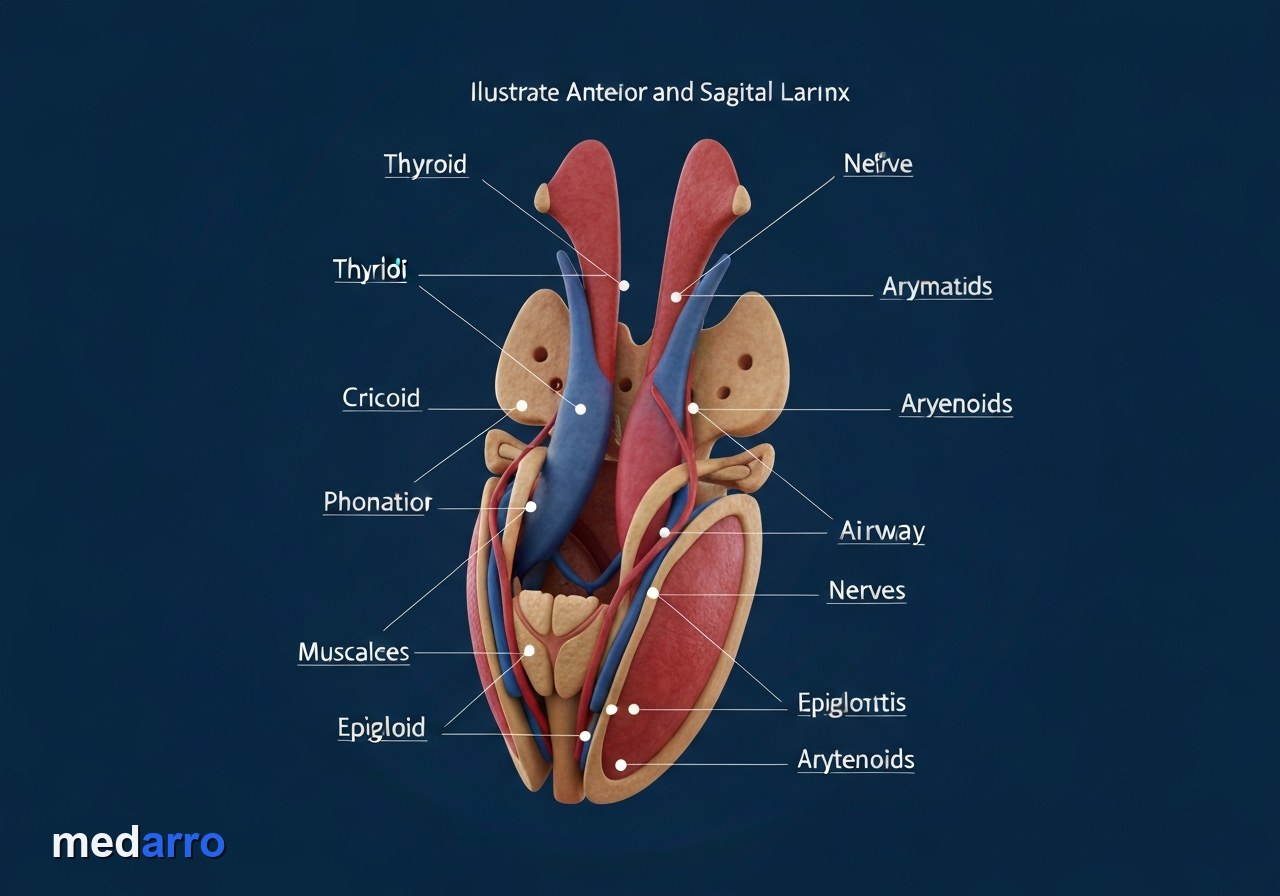
High-Yield Clinical Pearls & Exam Keys
All intrinsic muscles of the larynx are supplied by the Recurrent Laryngeal Nerve (RLN) EXCEPT the Cricothyroid muscle, which is supplied by the External Branch of the Superior Laryngeal Nerve (SLN).
The Posterior Cricoarytenoid (PCA) muscle is the ONLY ABDUCTOR of the vocal cords ('Safety Muscle of the Larynx' - Pulls Cords Apart).
The Cricothyroid muscle is the primary TENSOR of the vocal cords (raises vocal pitch).
Left RLN has a longer intrathoracic course: loops under the Aortic Arch (ligamentum arteriosum) before ascending in the tracheoesophageal groove; Right RLN loops under the Right Subclavian Artery.
Unilateral RLN injury: vocal cord assumes paramedian position; hoarse breathy voice, airway adequate. Bilateral complete RLN injury: both cords in paramedian position, causing severe stridor, dyspnea, and life-threatening airway obstruction requiring emergency tracheostomy.
Ask Dr. Medarro about Anatomy
Instant NMC-grounded answers with standard textbook citations
Laryngeal Nerve Injuries and Vocal Consequences
| Nerve Injured | Muscles Paralyzed | Vocal Cord Posture & Voice |
|---|---|---|
| External Branch of SLN | Cricothyroid (tensor) | Loss of high-pitched voice, vocal fatigue (singers) |
| Internal Branch of SLN | None (purely sensory above vocal cords) | Loss of protective cough reflex above glottis, aspiration risk |
| Unilateral RLN | All ipsilateral intrinsic muscles except cricothyroid | Cord fixed in paramedian position, hoarseness of voice |
| Bilateral RLN (Complete) | All intrinsic muscles bilaterally except cricothyroids | Both cords in paramedian position, severe inspiratory stridor, airway emergency |
Interactive Clinical Vignette Practice
Live Rule-Out EngineA 38-year-old female undergoes total thyroidectomy for papillary thyroid carcinoma. Postoperatively, she develops acute inspiratory stridor, severe dyspnea, and intercostal retractions immediately upon extubation. Laryngoscopy reveals both vocal cords fixed in the paramedian position. Which nerve was injured bilaterally?
Unlock Complete Viva Traps & Additional Case Vignettes
Access model examiner answers, comprehensive rule-out breakdowns, and 4K spotter explanations.
Want 50+ Clinical Vignettes & 4K 3D Spotters on Anatomy?
Practice Spaced Repetition Decathlon, generate instant 7-day adaptive study plans, and upload your college PDFs into the personal vault.