
Deviated Nasal Septum (DNS): Anatomical Types, Cottle Test & SMR vs Septoplasty
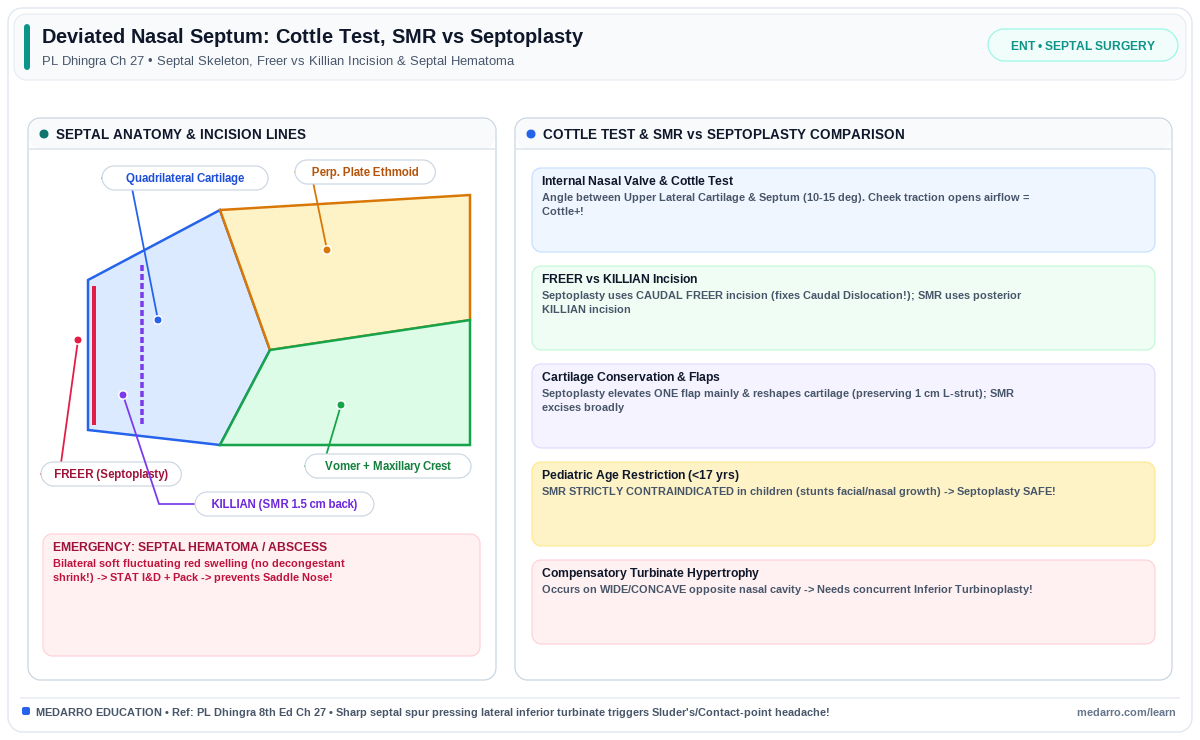
High-Yield Clinical Pearls & Exam Keys
Septal Skeleton (3 Main Parts): (1) Anterior QUADRILATERAL (Septal) Cartilage, (2) Posterosuperior PERPENDICULAR PLATE OF ETHMOID, (3) Posteroinferior VOMER (+ nasal crest of maxilla/palatine bone).
DNS Types: ANTERIOR CAUDAL DISLOCATION (protrudes into opposite nostril -> causes severe internal/external valve obstruction!), C-shaped, S-shaped (bilateral blockage), SEPTAL SPUR (sharp osteocartilaginous ridge impacting inferior turbinate -> Sluder's/Contact point neuralgia!).
COTTLE TEST: Pull cheek laterally to open nasal valve angle (normally 10-15 degrees between upper lateral cartilage & septum) -> Immediate airflow relief = INTERNAL NASAL VALVE obstruction (positive Cottle!).
SMR vs Septoplasty: Submucous Resection (SMR) EXCISES large septal cartilage leaving only 1 cm dorsal/caudal L-strut (KILLIAN incision 1-1.5 cm behind caudal edge; CONTRAINDICATED in children <17 yrs -> Saddle Nose & Retracted Columella!). SEPTOPLASTY CONSERVES & reshapes cartilage via FREER Hemitansfixion incision at caudal border (Safe in children/rhinoplasty!).
Ask Dr. Medarro about ENT (Otorhinolaryngology)
Instant NMC-grounded answers with standard textbook citations
Septal Incisions, Hematoma Emergency & Saddle Nose Prevention
FREER HEMITRANSFIXION INCISION (at Caudal Cartilage Border -> Septoplasty) vs KILLIAN INCISION (1-1.5 cm Posterior -> Submucous Resection / SMR!)
SEPTAL HEMATOMA (Post-trauma / Post-op soft fluctuating bilateral red swelling): MUST DRAIN IMMEDIATELY + anterior packing! Untreated -> cartilage necrosis in 48-72 hrs -> SEPTAL ABSCESS -> SADDLE NOSE & Cavernous Sinus Thrombosis!
COMPENSATORY TURBINATE HYPERTROPHY: Develops on the WIDE / CONCAVE side opposite the DNS to regulate airflow (must be addressed concurrently with Turbinoplasty!).
Submucous Resection (SMR) vs Conservative Septoplasty
| Surgical Feature | Submucous Resection (SMR) | Septoplasty (Gold Standard Today) |
|---|---|---|
| Primary Incision Site | KILLIAN incision (1-1.5 cm behind caudal septal border) | FREER hemitransfixion incision (right along caudal septal border) |
| Mucoperichondrial Flap Elevation | Raised on BOTH sides of cartilage/bone | Raised mainly on CONCAVE/ONE side (preserves unilateral blood supply!) |
| Extent of Cartilage Removal | Radical excision of deviated segment leaving only L-strut (1 cm) | CONSERVATIVE reshaping, scoring, shaving spurs & repositioning! |
| Suitability in Children (<17 yrs) | CONTRAINDICATED (stunts nasal/midface growth) | SAFE when severe symptomatic airway obstruction warrants correction |
| Post-Op Risk Profile | Higher risk of Septal Perforation, Saddle Nose, & Flapping Septum | Minimal perforation risk; preserves structural support for future Rhinoplasty |
Interactive Clinical Vignette Practice
Live Rule-Out EngineA 9-year-old boy falls off his bicycle onto his nose. Two days later he returns with progressive bilateral complete nasal blockade, low-grade fever, and severe throbbing nasal tip pain. Anterior rhinoscopy reveals smooth, boggy, bright-red bilateral midline swellings that fail to shrink after topical 0.05% Oxymetazoline spray. What is the IMMEDIATE definitive management?
Unlock Complete Viva Traps & Additional Case Vignettes
Access model examiner answers, comprehensive rule-out breakdowns, and 4K spotter explanations.
Want 50+ Clinical Vignettes & 4K 3D Spotters on ENT (Otorhinolaryngology)?
Practice Spaced Repetition Decathlon, generate instant 7-day adaptive study plans, and upload your college PDFs into the personal vault.