
Vocal Cord Paralysis: Unilateral vs Bilateral RLN/SLN Injury & Semon's Law
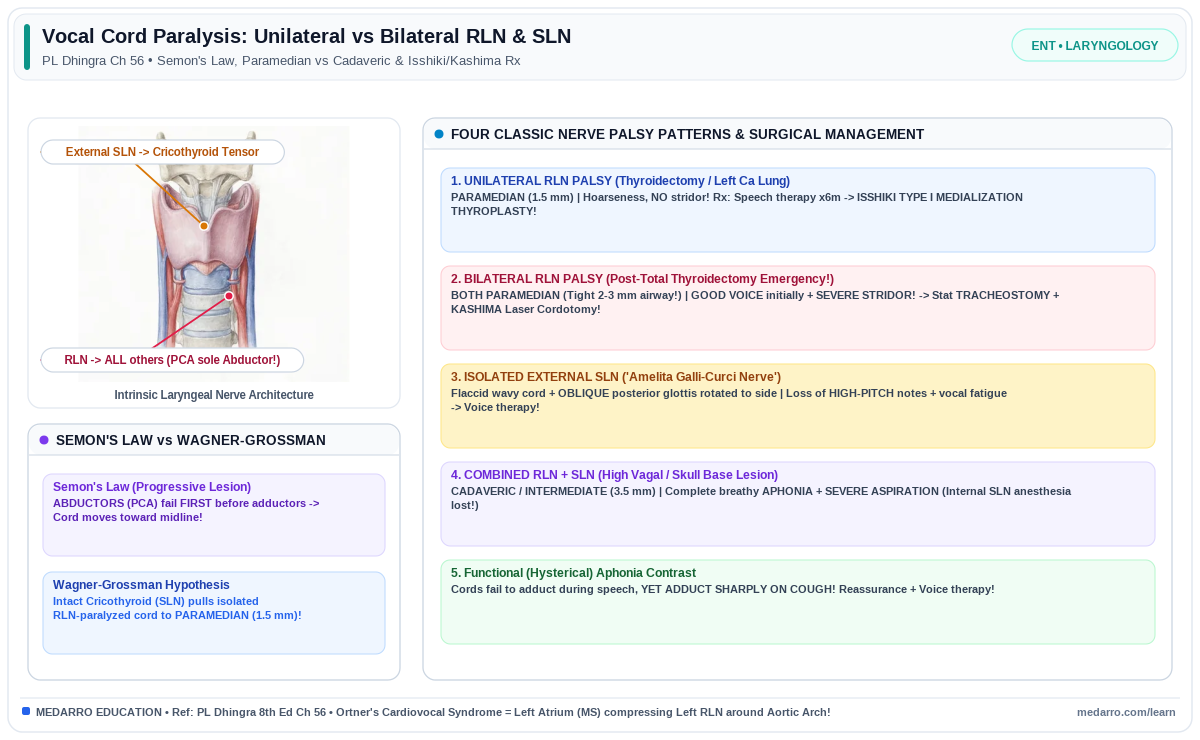
High-Yield Clinical Pearls & Exam Keys
INTRINSIC LARYNGEAL MUSCLES RULE: ALL intrinsic muscles supplied by RECURRENT LARYNGEAL NERVE (RLN) EXCEPT CRICOTHYROID (tensor — supplied by EXTERNAL branch of Superior Laryngeal Nerve / SLN!). ONLY ABDUCTOR of vocal cords = POSTERIOR CRICOARYTENOID ('Safety Muscle of Larynx'!).
UNILATERAL RLN PALSY (Most common cause: Thyroidectomy > Bronchogenic Ca / Left RLN!). Cord sits in PARAMEDIAN position (1.5 mm from midline — intact Cricothyroid adducts it!) -> HOARSENESS that often improves via contralateral compensation; NO stridor! Treat: Speech therapy -> Type I Isshiki Medialization Thyroplasty if persistent >6 months!
BILATERAL RLN PALSY (Post-Total Thyroidectomy emergency!): BOTH cords paralyzed in PARAMEDIAN position leaving narrow 2-3 mm chink -> GOOD VOICE initially, SEVERE STRIDOR & DYSPNEA! -> Emergency TRACHEOSTOMY -> Later KASHIMA LASER POSTERIOR CORDOTOMY / Arytenoidectomy to widen airway!
COMBINED RLN + SLN PALSY (High Vagal lesion): Cord sits in CADAVERIC / INTERMEDIATE position (3.5 mm from midline) -> Aphonia + Severe Aspiration (Sensory Internal SLN also lost!). SEMON'S LAW: In progressive organic lesions, ABDUCTORS (PCA) fail BEFORE adductors! WAGNER-GROSSMAN explains Paramedian vs Cadaveric via unopposed Cricothyroid!
Ask Dr. Medarro about ENT (Otorhinolaryngology)
Instant NMC-grounded answers with standard textbook citations
Vocal Cord Positions, Thyroidectomy Nerves & Surgical Interventions
PARAMEDIAN (1.5 mm) = Isolated RLN Palsy (unopposed Cricothyroid + Interarytenoid tone! Unilateral = Hoarse; Bilateral = STRIDOR with decent voice!)
CADAVERIC / INTERMEDIATE (3.5 mm) = Combined RLN + SLN Palsy (Total loss of tone -> Aphonia + Aspiration!)
ISOLATED EXTERNAL SLN PALSY ('Amelita Galli-Curci Nerve'): Flaccid wavy cord with OBLIQUE posterior commissure rotated to paralyzed side -> Voice fatigue / loss of HIGH PITCH!
Vocal Cord Nerve Injuries: Unilateral RLN vs Bilateral RLN vs External SLN vs Combined
| Nerve Lesion Pattern | Cord Position & Key Sign | Primary Clinical Presentation & Management |
|---|---|---|
| Unilateral RLN Palsy (Thyroid / Left Lung Ca) | PARAMEDIAN (1.5 mm); opposite cord crosses midline to compensate | Hoarseness, breathy voice, NO stridor -> Voice therapy; Isshiki Type I Medialization Thyroplasty after 6 months! |
| Bilateral RLN Palsy (Total Thyroidectomy) | BOTH PARAMEDIAN (tight 2-3 mm airway chink!) | STRIDOR & acute asphyxia risk WITH preserved voice! -> Immediate TRACHEOSTOMY + Kashima Laser Cordotomy! |
| External SLN Palsy (Superior Pole ligation) | Wavy/flaccid cord; Anterior commissure tilts to healthy side (oblique glottis) | Inability to sing high-pitch notes & rapid vocal fatigue ('Galli-Curci' nerve) -> Speech therapy |
| Combined RLN + SLN (High Vagal / Skull Base) | CADAVERIC / INTERMEDIATE (3.5 mm); bowed motionless cord | Severe breathy APHONIA + ASPIRATION (anesthetic supraglottis via Internal SLN loss!) -> Injection laryngoplasty / Type I Thyroplasty |
| Functional Aphonia (Hysterical) | Cords abduct on inspiration, fail to adduct on phonation EXCEPT during COUGH! | Normal SHARP COUGH sound despite whisper -> Reassurance & psychotherapy |
Interactive Clinical Vignette Practice
Live Rule-Out EngineImmediately following total thyroidectomy for a multinodular goiter, a 46-year-old woman is extubated and promptly develops loud high-pitched inspiratory stridor and marked suprasternal retractions, yet speaks clear words when distressed. Fiberoptic laryngoscopy shows both vocal cords motionless very close to the midline. Which surgical injury explains this paradox?
Unlock Complete Viva Traps & Additional Case Vignettes
Access model examiner answers, comprehensive rule-out breakdowns, and 4K spotter explanations.
Want 50+ Clinical Vignettes & 4K 3D Spotters on ENT (Otorhinolaryngology)?
Practice Spaced Repetition Decathlon, generate instant 7-day adaptive study plans, and upload your college PDFs into the personal vault.