
Firearm Wounds Entry vs Exit Characteristics & Contact vs Distance Shots
High-Yield Clinical Pearls & Exam Keys
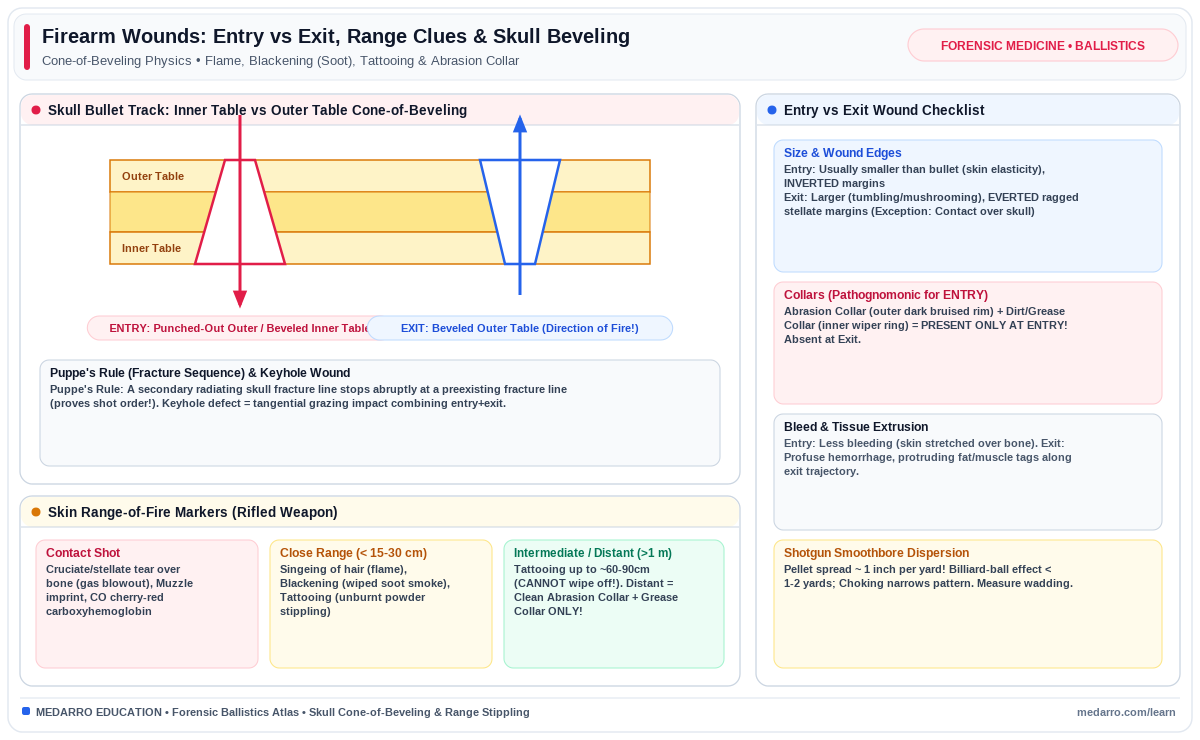
Abrasion Collar + Grease/Dirt Collar appear ONLY at ENTRY wounds (NEVER at Exit wounds, unless 'shored exit' pressed against a hard belt/wall mimicking an abrasion rim!). Abrasion collar occurs because spinning projectile indents and scrapes elastic epidermis inwards; Grease collar is wiped lubricant/bullet debris.
Contact Shots (muzzle pressed directly against skin): Gas blows UNDER skin over flat bone (skull) stripping scalp backwards -> large ragged Cruciform/Stellate tears with a stamped 'Muzzle Imprint' & CO carboxymyoglobin pink muscle inside track; minimal outer skin soot!
Firing Range Indicators (Rifled Gun): Flame Singeing of hair (<15 cm); Blackening/Smudging from deposited soot (<30-45 cm, wipes off easily with wet swab); Powder Tattooing / Stippling from unburnt gunpowder grains embedded into dermis (<60-90 cm, CANNOT be wiped off!). Beyond ~1 meter = ONLY Abrasion + Grease collar.
Skull Beveling Direction Rule: Bullet entry punches a sharp clean circle in Outer Table and bevels WIDE cone inward into Inner Table ('Inward Beveling'). Bullet EXIT bevels outward ('Outward Beveling').
Ask Dr. Medarro about Forensic Medicine & Toxicology
Instant NMC-grounded answers with standard textbook citations
Ballistic Forensic Diagnostic Gold Rules
Puppe's Rule: Determines order of multiple cranial fractures — a LATER gunshot/blow's radiating fracture line TERMINATES cleanly when it hits a pre-existing fracture line!
Billiard-Ball Effect (Shotgun Close Range <1-2 meters): Shot mass travels together acting as a single 'rat-hole' bullet before pellets begin spreading ('Dispersion diameter in inches ≈ Range in yards minus 1'!).
Dum-Dum / Expanding Bullets vs Tandem Bullets: Tandem occurs when a misfired stuck bullet in corroded barrel is pushed out by a SECOND bullet fired right behind it -> two bullets enter via single entry wound!
Firearm Entry Wound vs Exit Wound Comparison
| Morphological Feature | Entry Wound | Exit Wound |
|---|---|---|
| Wound Size vs Bullet | Usually SMALLER than bullet diameter (elastic skin recoil) EXCEPT Contact tear! | Usually LARGER & more ragged/slit-like (yawing/tumbled deformed bullet + bone fragments) |
| Edges | INVERTED inwards | EVERTED outwards (tags of fat protruding) |
| Abrasion & Grease Collars | PRESENT (pathognomonic Entry markers!) | ABSENT (except rare Shored Exit against rigid surface/wall!) |
| Blackening / Flame / Tattooing | Present strictly by range (<15 cm flame, <30 cm soot, <90 cm stippling) | COMPLETELY ABSENT |
| Skull Bone Beveling | Internal / INWARD Beveling (wider crater inside inner table) | External / OUTWARD Beveling (wider crater outside outer table) |
Interactive Clinical Vignette Practice
Live Rule-Out EngineAt autopsy of a 35-year-old shooting victim, a 1.2-cm circular scalp defect over the right parietal bone shows inverted edges, a 2-mm circumferential abrasion collar, and abundant embedded unburnt powder grains across a 6-cm zone that CANNOT be washed off with normal saline. Flame singeing and soot smudging are completely absent. What was the approximate firing distance (rifled handgun)?
Unlock Complete Viva Traps & Additional Case Vignettes
Access model examiner answers, comprehensive rule-out breakdowns, and 4K spotter explanations.
Want 50+ Clinical Vignettes & 4K 3D Spotters on Forensic Medicine & Toxicology?
Practice Spaced Repetition Decathlon, generate instant 7-day adaptive study plans, and upload your college PDFs into the personal vault.