
UMN vs LMN Lesions: Corticospinal Localization, ALS Mixed Signs & Spinal Cord Tracts
High-Yield Clinical Pearls & Exam Keys
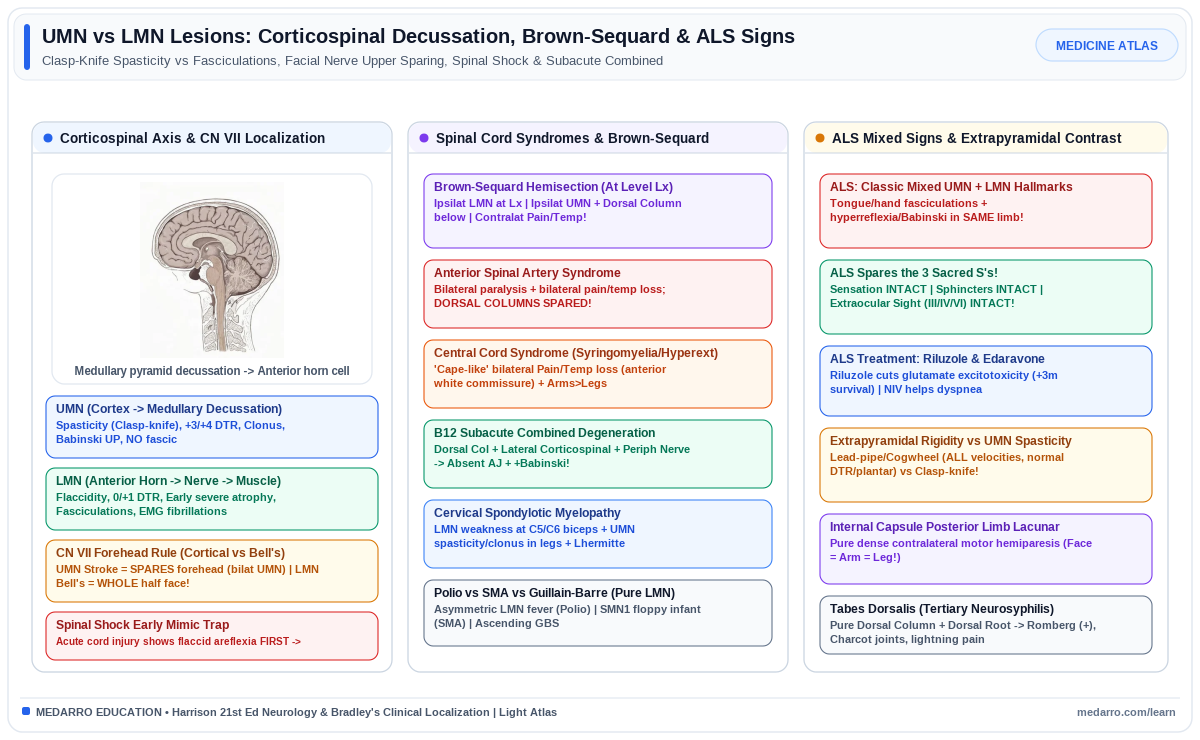
Acute Spinal Cord Transection initially presents with 'Spinal Shock' (flaccid areflexia mimicking LMN for days to weeks!) BEFORE evolving into true chronic UMN spasticity, hyperreflexia, and Babinski sign.
Clasp-knife spasticity (UMN, velocity-dependent, increases with stretch then gives way via Golgi tendon organ) vs Lead-pipe/Cogwheel rigidity (Extrapyramidal basal ganglia, uniform across all velocities) vs Gegenhalten (frontal lobe paratonia).
Lateral Medullary / Pyramid vs Subcortical localization: Cranial nerves VII (upper face spared in UMN cortical stroke, BOTH upper+lower paralyzed in LMN Bell palsy!) and XII (tongue deviates TOWARD LMN hypoglossal side; AWAY from cortical UMN lesion in majority, wait — toward side of weakness!).
Brown-Sequard Hemisection (at level Lx): Ipsilateral LMN at level of lesion, Ipsilateral UMN spastic weakness + Dorsal Column (vibration/proprioception) loss BELOW lesion, and Contralateral Spinothalamic (pain/temp) loss 1-2 segments below lesion.
ALS (Lou Gehrig disease) is the quintessential MIXED UMN + LMN disorder (fasciculating wasted tongue/hands + brisk DTRs/Babinski) with intact ocular movements (CN III/IV/VI) and intact bowel/bladder sphincter control!
Ask Dr. Medarro about General Medicine
Instant NMC-grounded answers with standard textbook citations
High-Yield Exam Keys: UMN vs LMN Lesions
Acute Spinal Cord Transection initially presents with 'Spinal Shock' (flaccid areflexia mimicking LMN for days to weeks!) BEFORE evolving into true chronic UMN spasticity, hyperreflexia, and Babinski sign.
Clasp-knife spasticity (UMN, velocity-dependent, increases with stretch then gives way via Golgi tendon organ) vs Lead-pipe/Cogwheel rigidity (Extrapyramidal basal ganglia, uniform across all velocities) vs Gegenhalten (frontal lobe paratonia).
Lateral Medullary / Pyramid vs Subcortical localization: Cranial nerves VII (upper face spared in UMN cortical stroke, BOTH upper+lower paralyzed in LMN Bell palsy!) and XII (tongue deviates TOWARD LMN hypoglossal side; AWAY from cortical UMN lesion in majority, wait — toward side of weakness!).
Upper Motor Neuron (UMN) vs Lower Motor Neuron (LMN) vs Extrapyramidal Lesion
| Clinical Exam Parameter | Upper Motor Neuron (UMN) | Lower Motor Neuron (LMN) / Extrapyramidal (Basal Ganglia) |
|---|---|---|
| Muscle Tone | Increased: Velocity-dependent Spasticity ('Clasp-knife') | Lower Motor Neuron (LMN): Decreased: Flaccidity / Hypotonia | Extrapyramidal (Basal Ganglia): Increased: Uniform Rigidity ('Lead-pipe' / 'Cogwheel') |
| Deep Tendon Reflexes (DTR) | Hyperreflexia (+3/+4) & sustained Clonus | Lower Motor Neuron (LMN): Hyporeflexia or Areflexia (0/+1) | Extrapyramidal (Basal Ganglia): Normal (+2) |
| Plantar Response (Babinski) | Extensor (Upgoing big toe + fanning) | Lower Motor Neuron (LMN): Absent or Normal flexor | Extrapyramidal (Basal Ganglia): Normal flexor |
| Atrophy / Wasting | Minimal late disuse atrophy only | Lower Motor Neuron (LMN): Severe, rapid focal atrophy in denervated myotome | Extrapyramidal (Basal Ganglia): Absent (bradykinesia/hypokinesia present) |
| Fasciculations & EMG | Absent; reduced recruitment on EMG | Lower Motor Neuron (LMN): Present! Spontaneous Fibrillations & positive sharp waves | Extrapyramidal (Basal Ganglia): Resting pill-rolling tremor (4-6 Hz), NO fasciculations |
| Superficial Reflexes | Absent (Abdominal, Cremasteric reflexes lost) | Lower Motor Neuron (LMN): Absent only if specific reflex arc root damaged | Extrapyramidal (Basal Ganglia): Preserved |
Interactive Clinical Vignette Practice
Live Rule-Out EngineA 57-year-old carpenter notices progressive difficulty buttoning his shirt and frequent tripping over 8 months. Exam demonstrates asymmetrical wasting of thenar and first dorsal interosseous muscles with visible tongue fasciculations, brisk 4+ patellar reflexes, bilateral ankle clonus, and extensor Babinski signs. Extraocular movements, pinprick sensation, and bladder function are completely intact. Which agent modestly prolongs survival by inhibiting presynaptic glutamate release?
Unlock Complete Viva Traps & Additional Case Vignettes
Access model examiner answers, comprehensive rule-out breakdowns, and 4K spotter explanations.
Want 50+ Clinical Vignettes & 4K 3D Spotters on General Medicine?
Practice Spaced Repetition Decathlon, generate instant 7-day adaptive study plans, and upload your college PDFs into the personal vault.