
Hypersensitivity Reactions Types I to IV Mechanisms & Clinical Examples
High-Yield Clinical Pearls & Exam Keys
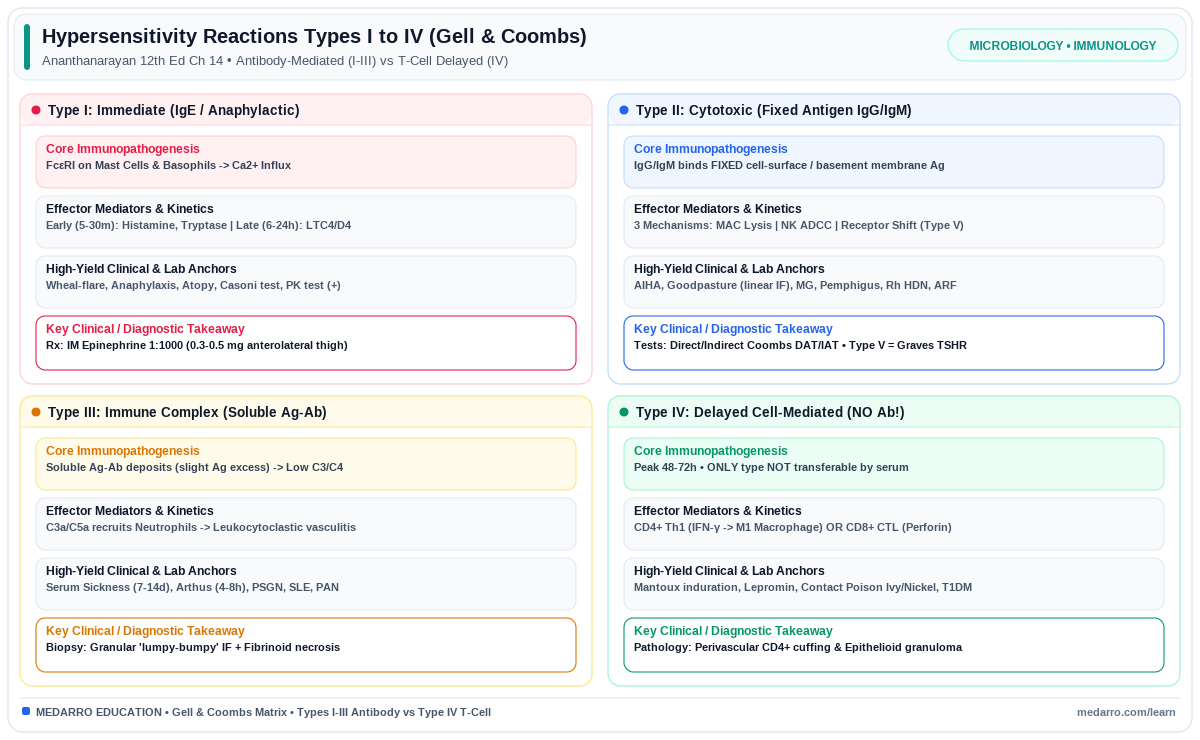
Type I (Immediate / Anaphylactic) is IgE-mediated via FcεRI cross-linking on mast cells & basophils: preformed histamine causes immediate (5-30 min) bronchospasm/vasodilation; leukotrienes (LTC4/LTD4) sustain the late-phase (6-24h) reaction.
Type II (Cytotoxic) involves IgG/IgM binding to FIXED intrinsic tissue or cell-surface antigens triggering complement MAC lysis, ADCC (NK cells), or receptor modulation (Graves TSHR stimulation = Type II subtype/Type V).
Type III (Immune Complex) involves SOLUBLE antigen-antibody complexes depositing in vessel walls/glomeruli, activating C3a/C5a anaphylatoxins and recruiting neutrophils (Arthus localized vs Serum Sickness systemic).
Type IV (Delayed-Type / DTH) is the ONLY antibody-independent hypersensitivity: sensitized CD4+ Th1 cells release IFN-γ to activate M1 macrophages (granulomas), OR CD8+ CTLs directly lyse targets (Contact dermatitis, Type 1 DM).
Ask Dr. Medarro about Microbiology
Instant NMC-grounded answers with standard textbook citations
High-Yield Gell & Coombs Anchors (Exam Mnemonic: ACID)
Type I (Allergic / IgE): Anaphylaxis, Atopy, Allergic rhinitis, Positive skin prick wheal-and-flare, Casoni test (immediate arm)
Type II (Cytotoxic / Fixed Ag): AIHA, Goodpasture syndrome, Myasthenia gravis, Pemphigus vulgaris, Rheumatic fever, Transfusion mismatch
Type III (Immune Complex) & Type IV (Delayed Cell-Mediated): PSGN/SLE/PAN/Arthus/Farmer's lung (III) vs PPD Mantoux/Lepromin/Contact Poison Ivy/SJS-TEN (IV)
Coombs & Gell Classification Matrix (Types I-IV)
| Parameter | Type I, II & III (Antibody-Mediated) | Type IV (T-Cell Mediated / Delayed) |
|---|---|---|
| Primary Mediator | I: IgE (Mast cells) | II: IgG/IgM (Fixed Ag) | III: IgG/IgM (Soluble Ag-Ab) | Sensitized CD4+ Th1 (IFN-γ) & CD8+ Cytotoxic T-cells (NO Antibody!) |
| Peak Onset Time | I: 15-30 min | II: Hours | III: Hours to 7-10 days (Serum Sickness) | 48-72 hours (Delayed macrophage/lymphocyte induration) |
| Transferable via Serum? | YES (I: Prausnitz-Kustner test; II/III: passive serum transfer) | NO (Requires adoptive transfer of living T-lymphocytes) |
| Complement Role | I: None | II: Classical pathway (MAC & C3b) | III: C3a/C5a chemotaxis | ZERO Complement involvement |
| Classic Pathology / Tests | Wheal & flare (Skin prick) | Coombs test (AIHA) | Fibrinoid necrosis & Leukocytoclastic vasculitis | Mantoux tuberculin induration, Patch test (Nickel/Poison Ivy), Caseating/Non-caseating granulomas |
Interactive Clinical Vignette Practice
Live Rule-Out EngineTen days after receiving equine anti-tetanus serum following a contaminated farm injury, a 28-year-old man develops fever, generalized urticarial rash, symmetrical knee and wrist arthralgia, tender cervical lymphadenopathy, and low serum C3 levels. Renal biopsy demonstrates subendothelial granular IgG and C3 deposits. What is the underlying immunological mechanism?
Unlock Complete Viva Traps & Additional Case Vignettes
Access model examiner answers, comprehensive rule-out breakdowns, and 4K spotter explanations.
Want 50+ Clinical Vignettes & 4K 3D Spotters on Microbiology?
Practice Spaced Repetition Decathlon, generate instant 7-day adaptive study plans, and upload your college PDFs into the personal vault.