
Cervical Cancer Screening (Pap Smear, HPV DNA, VIA) & FIGO Staging
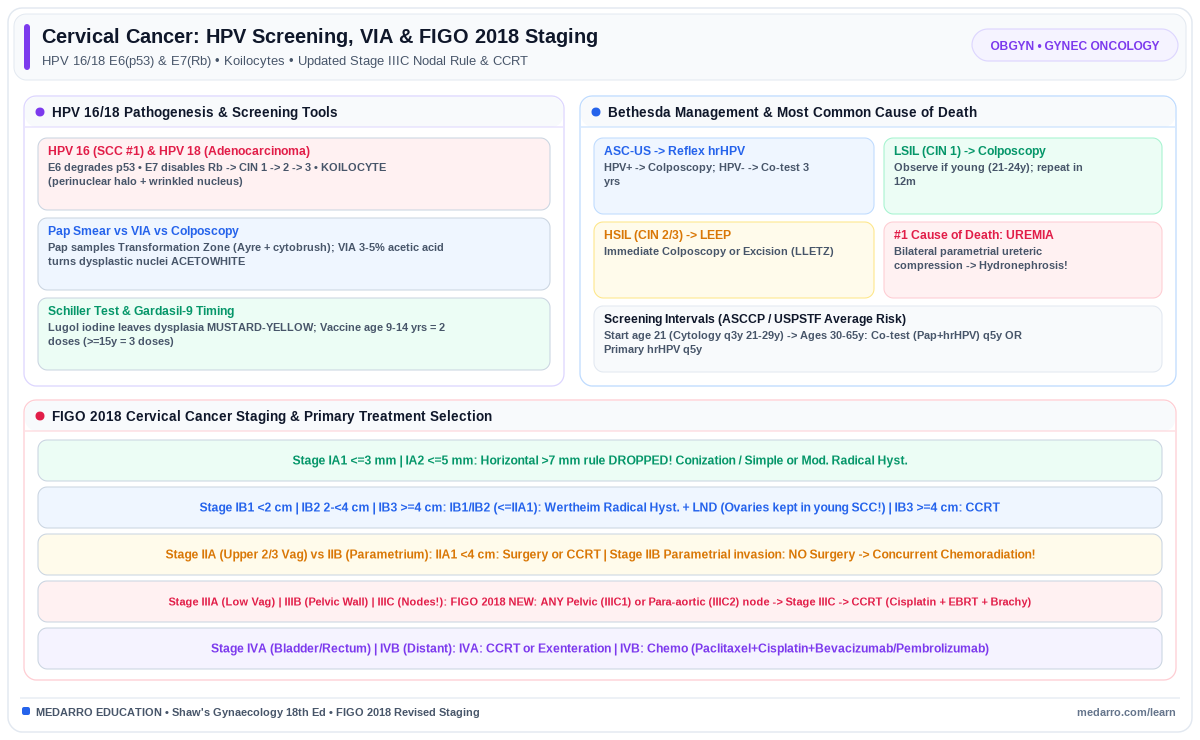
High-Yield Clinical Pearls & Exam Keys
High-risk HPV types 16 and 18 cause ~70% of cervical cancers (HPV 16 -> Squamous Cell Carcinoma [#1 overall]; HPV 18 -> Adenocarcinoma). Oncoproteins E6 degrades p53; E7 inactivates Rb (retinoblastoma) protein.
Pap smear samples the Transformation Zone (TZ — squamocolumnar junction where metaplastic squamous epithelium is vulnerable) using an Ayre spatula + endocervical cytobrush.
VIA (Visual Inspection with Acetic Acid, 3-5%): Acetic acid coagulates nuclear proteins of dysplastic cells causing dense, raised 'acetowhite' plaques near the TZ — WHO/NPCDCS screen-and-treat choice in low-resource settings.
Updated FIGO 2018 Cervical Cancer Staging incorporates imaging and pathology AND introduced Stage IIIC (IIIC1 pelvic nodes; IIIC2 para-aortic nodes) plus Stage IB1 (<2 cm), IB2 (2 to <4 cm), and IB3 (>=4 cm).
Early invasive disease (Stage IA2-IB2 / IIA1) is treated by Wertheim's Radical Hysterectomy (Piver Type III); Locally advanced disease (IB3, IIB, III, IVA) is treated definitively with Concurrent Chemoradiation (Cisplatin + EBRT + Brachytherapy).
Ask Dr. Medarro about Obstetrics & Gynaecology
Instant NMC-grounded answers with standard textbook citations
HPV Oncogenesis & Colposcopy Key Signs
Molecular Oncogenesis: HPV E6 inhibits p53 + HPV E7 inhibits Rb + Koilocytes (perinuclear halo + wrinkled 'raisinoid' nucleus)
Colposcopy Abnormalities: Dense Acetowhite Epithelium + Mosaicism / Punctations + Atypical Corkscrew Vessels (Schiller Lugol iodine: Mustard-yellow non-staining)
Most Common Cause of Death in Cervical Cancer: Uremia (from bilateral ureteric obstruction at parametrium / pelvic wall)
FIGO 2018 Cervical Cancer Staging & Primary Treatment
| FIGO 2018 Stage | Anatomical Extent | Standard Primary Treatment |
|---|---|---|
| Stage IA1 / IA2 | Microscopic invasion: IA1 <=3 mm depth; IA2 >3 to <=5 mm depth | IA1 without LVSI: Conization or simple hysterectomy; IA2: Modified radical hysterectomy + pelvic LND |
| Stage IB1 / IB2 / IB3 | Confined to cervix: IB1 <2 cm; IB2 2-<4 cm; IB3 >=4 cm | IB1/IB2: Radical hysterectomy (Wertheim) + pelvic LND; IB3 (>=4 cm): Concurrent Chemoradiation (CCRT) |
| Stage IIA vs IIB | IIA: Upper 2/3 vagina (no parametrium); IIB: Parametrial invasion (does not reach pelvic wall) | IIA1 (<4 cm): Radical hysterectomy or CCRT; IIB: Concurrent Chemoradiation (Cisplatin weekly + EBRT + ICRT) |
| Stage IIIA / IIIB / IIIC | IIIA: Lower 1/3 vagina; IIIB: Pelvic side wall / hydronephrosis; IIIC: Pelvic (C1) or Para-aortic (C2) nodes | Definitive Concurrent Chemoradiation (Cisplatin + EBRT + Brachytherapy; extended-field RT for IIIC2) |
| Stage IVA / IVB | IVA: Bladder or rectal mucosa invasion; IVB: Distant metastases (lungs, liver, bone) | IVA: CCRT or Pelvic Exenteration (selected central); IVB: Palliative systemic chemo + anti-VEGF / immunotherapy |
Interactive Clinical Vignette Practice
Live Rule-Out EngineA 46-year-old woman presents with postcoital bleeding and is diagnosed on punch biopsy with invasive squamous cell carcinoma of the cervix. Examination and MRI show a 3.2 cm cervical mass with early invasion into the medial left parametrium, no hydronephrosis, and two enlarged positive pelvic lymph nodes (no para-aortic nodes). According to updated FIGO 2018 staging, what is her stage and preferred primary treatment?
Unlock Complete Viva Traps & Additional Case Vignettes
Access model examiner answers, comprehensive rule-out breakdowns, and 4K spotter explanations.
Want 50+ Clinical Vignettes & 4K 3D Spotters on Obstetrics & Gynaecology?
Practice Spaced Repetition Decathlon, generate instant 7-day adaptive study plans, and upload your college PDFs into the personal vault.