
Ectopic Pregnancy Sites, Ultrasound Signs & Methotrexate Criteria
High-Yield Clinical Pearls & Exam Keys
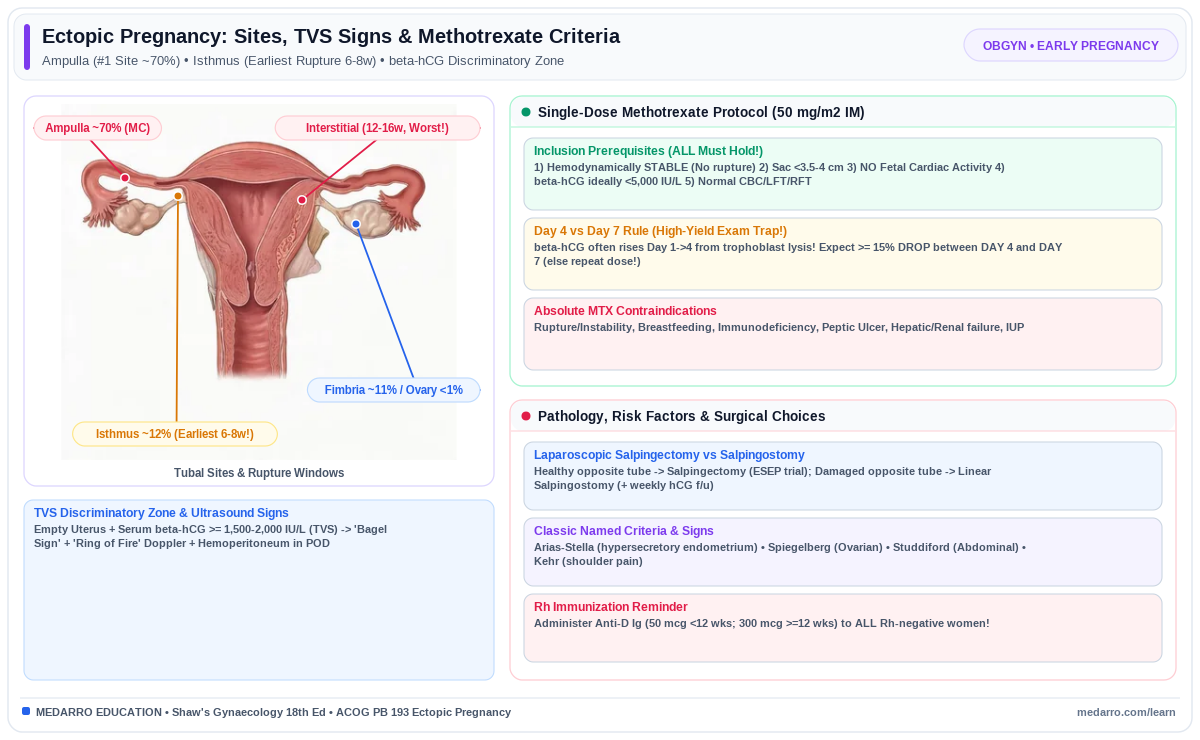
Overall most common site of ectopic pregnancy = Fallopian tube (95-98%), specifically the AMPULLA (~70%), followed by Isthmus (~12%), Fimbria (~11%), and Interstitial/Cornual (~2-3%).
Isthmic ectopic ruptures EARLIEST (6-8 weeks) due to narrow rigid lumen; Interstitial/cornual ectopic ruptures LATEST (12-16 weeks) with the most catastrophic hemorrhage (supplied by both uterine and ovarian arcades).
Discriminatory zone of serum beta-hCG for Transvaginal Sonography (TVS): ~1,500-2,000 IU/L (ACOG uses conservative >=3,500 IU/L to avoid harming an early normal IUP; Indian NEET-PG tests 1,500-2,000 IU/L for TVS and 6,000-6,500 IU/L for TAS).
Arias-Stella reaction is hypersecretory decidual-like endometrial atypia on histopathology without chorionic villi (suggestive of ectopic, though not strictly pathognomonic).
Spiegelberg criteria diagnose Primary Ovarian Pregnancy (ipsilateral tube intact; gestational sac in ovary position; sac connected to uterus by ovarian ligament; ovarian tissue in sac wall).
Ask Dr. Medarro about Obstetrics & Gynaecology
Instant NMC-grounded answers with standard textbook citations
Classic Ectopic Clinical & Ultrasound Triads
Clinical Triad (present in ~50%): Amenorrhea (6-8 wks) + Lower Abdominal/Pelvic Pain + Scanty Dark Vaginal Bleeding
TVS Signs: Empty Uterus (pseudogestational sac) + Adnexal 'Bagel Sign' (tubal ring) + 'Ring of Fire' on Color Doppler + Free Fluid in POD
Ruptured Signs: Cervical Motion Tenderness ('Chandelier sign') + Cullen Sign (periumbilical) + Kehr Sign (referred shoulder pain)
Medical (Methotrexate) vs Surgical Management of Ectopic Pregnancy
| Parameter / Criterion | Single-Dose Methotrexate (Medical) | Laparoscopy (Salpingostomy vs Salpingectomy) |
|---|---|---|
| Patient Stability | MUST be hemodynamically stable with NO signs of rupture or active intra-abdominal bleeding | Mandatory for ANY hemodynamic instability, acute abdomen, or suspected tubal rupture |
| Serum beta-hCG & Mass Size | Preferably <5,000 IU/L (ideal <1,500-3,000) and adnexal sac <3.5-4.0 cm WITHOUT fetal cardiac activity | Beta-hCG >5,000 IU/L, sac >=4 cm, OR presence of fetal cardiac activity (relative/absolute MTX failure) |
| Drug Dosing & Labs | IM Methotrexate 50 mg/m2 BSA on Day 1; check baseline CBC, LFT, RFT (normal Cr/AST) | Gold standard diagnosis + treatment; Salpingectomy if contralateral tube healthy (ESEP trial); Salpingostomy if single/damaged contralateral tube |
| Follow-Up Monitoring | Measure beta-hCG on Day 4 and Day 7: expect >=15% drop between Day 4 and Day 7 (else repeat dose) | Monitor weekly beta-hCG after salpingostomy to zero (rules out persistent trophoblastic tissue) |
| Absolute Contraindications | Rupture/instability, breastfeeding, immunodeficiency, peptic ulcer, severe hepatic/renal/hematologic disease, IUP | Avoid laparoscopic pneumoperitoneum if severe hemorrhagic shock prevents Trendelenburg positioning -> open laparotomy |
Interactive Clinical Vignette Practice
Live Rule-Out EngineA 27-year-old woman at 7 weeks amenorrhea with mild right iliac fossa pain has stable vitals (BP 118/74 mmHg, HR 78/min). Serum beta-hCG is 2,400 IU/L. TVS reveals an empty uterus and a 2.4 cm right adnexal ring without fetal cardiac activity and minimal free fluid. Renal and liver panels are normal. Which management plan is preferred?
Unlock Complete Viva Traps & Additional Case Vignettes
Access model examiner answers, comprehensive rule-out breakdowns, and 4K spotter explanations.
Want 50+ Clinical Vignettes & 4K 3D Spotters on Obstetrics & Gynaecology?
Practice Spaced Repetition Decathlon, generate instant 7-day adaptive study plans, and upload your college PDFs into the personal vault.