
Mendelian Inheritance Patterns & Pedigree Analysis Traps
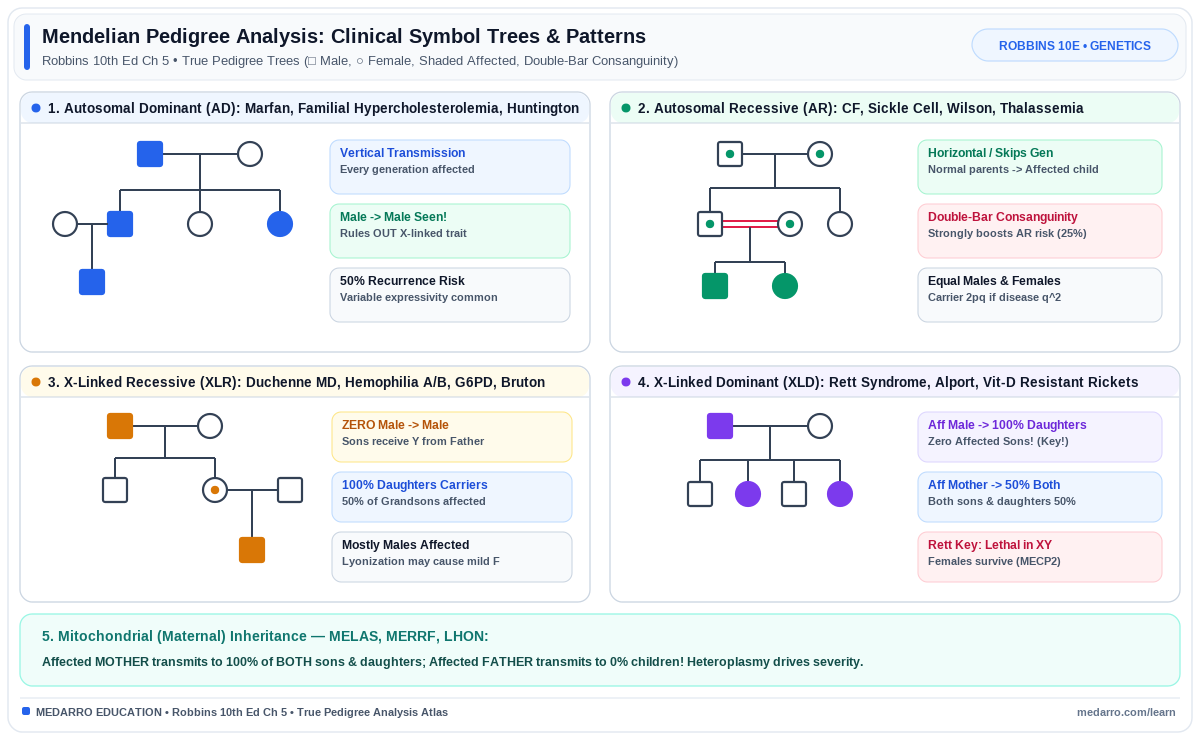
High-Yield Clinical Pearls & Exam Keys
GOLDEN PEDIGREE RULE FOR X-LINKED RECESSIVE (XLR): There is NEVER male-to-male transmission (fathers give Y to sons, never X), and unaffected carrier females transmit to 50% of their sons.
GOLDEN PEDIGREE RULE FOR X-LINKED DOMINANT (XLD): An affected Father transmits the disease to 100% of his DAUGHTERS and 0% of his SONS (Rett syndrome, Hypophosphatemic Rickets, Fragile X).
GOLDEN RULE FOR MITOCHONDRIAL INHERITANCE: An affected Mother transmits to 100% of ALL CHILDREN (both sons and daughters), while an affected Father transmits to 0% of offspring (Leber Hereditary Optic Neuropathy, MELAS).
Incomplete penetrance (skipped appearance in AD pedigree despite carrying allele, e.g., BRCA1) vs Variable expressivity (different severity in same mutation, e.g., Neurofibromatosis-1) is a classic NEET-PG distractor pair.
Ask Dr. Medarro about Pathology
Instant NMC-grounded answers with standard textbook citations
10-Second Pedigree Pattern Recognition Table
| Inheritance Mode | Key Pedigree Signature | High-Yield Exceptions / Traps |
|---|---|---|
| Autosomal Dominant | Every generation (Vertical); Male-to-Male present; 50% risk | Variable expressivity (NF1), Incomplete penetrance, Pleiotropy (Marfan) |
| Autosomal Recessive | Skips generations (Horizontal); Unaffected parents; Consanguinity | Enzyme deficiencies mostly (except Acute Intermittent Porphyria = AD!) |
| X-Linked Recessive | Almost only males; NO Male-to-Male transmission; Skips via carrier moms | Turner Syndrome (45,X) females or skewed X-inactivation can express XLR! |
| X-Linked Dominant | Affected dad -> ALL daughters affected, ZERO sons; No skipped gen | Rett syndrome (MECP2) is lethal in hemizygous males |
| Mitochondrial | Affected mom -> ALL children (100%); Affected dad -> ZERO children | Heteroplasmy explains varied organ severity across siblings |
| Genomic Imprinting | Phenotype depends on parent-of-origin allele silencing | 15q11-13 deletion: Paternal = Prader-Willi; Maternal = Angelman |
Interactive Clinical Vignette Practice
Live Rule-Out EngineA genetics clinic evaluates a large multi-generational family with progressive vision loss and myopathy. Every child (4 sons and 3 daughters) born to an affected mother manifests variable muscle weakness, whereas none of the 6 children fathered by two affected uncles display any clinical or biochemical abnormality. Mutations in which organelle genome explain this pedigree?
Unlock Complete Viva Traps & Additional Case Vignettes
Access model examiner answers, comprehensive rule-out breakdowns, and 4K spotter explanations.
Want 50+ Clinical Vignettes & 4K 3D Spotters on Pathology?
Practice Spaced Repetition Decathlon, generate instant 7-day adaptive study plans, and upload your college PDFs into the personal vault.