
First Order vs Zero Order Elimination Kinetics & Therapeutic Drug Monitoring (TDM)
High-Yield Clinical Pearls & Exam Keys
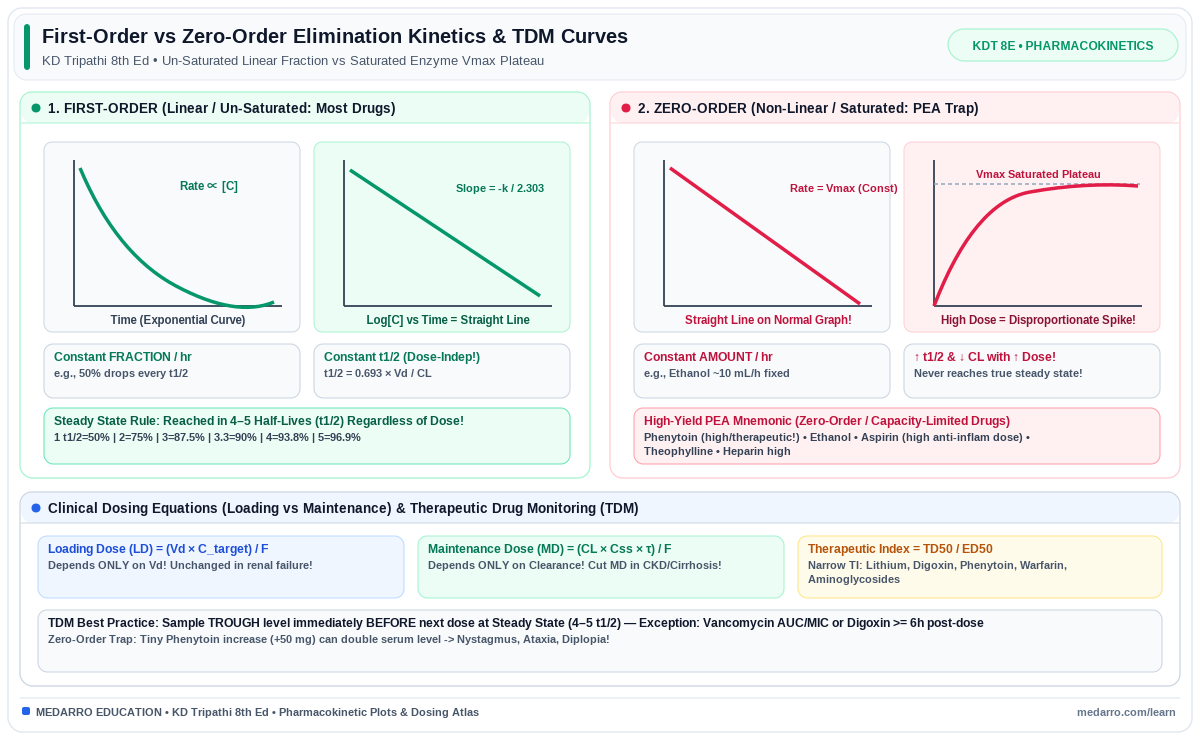
First-Order Kinetics: A constant FRACTION (%) of drug is eliminated per unit time; clearance (CL) and half-life (t1/2 = 0.693 × Vd / CL) remain CONSTANT regardless of dose!
Zero-Order (Capacity-Limited / Nonlinear) Kinetics: Metabolizing enzymes are saturated at Vmax, so a constant AMOUNT (e.g., mg/hr) is eliminated per unit time; t1/2 is directly proportional to concentration! Examples: ETHANOL, PHENYTOIN (within therapeutic range), High-dose ASPIRIN, Theophylline.
Steady-State Concentration (Css) takes strictly 4 to 5 half-lives to reach ~94-97% plateau regardless of dose size or dosing interval; giving a Loading Dose achieves therapeutic levels immediately WITHOUT shortening time to steady state!
Loading Dose = (Target Cp × Vd) / F — depends ONLY on Volume of Distribution (Vd), NOT on renal/hepatic clearance (even in renal failure!). Maintenance Dose = (Target Cp × CL × τ) / F — depends strictly on Clearance!
Ask Dr. Medarro about Pharmacology
Instant NMC-grounded answers with standard textbook citations
First-Order vs Zero-Order Elimination Kinetics (KD Tripathi)
| Pharmacokinetic Property | First-Order (Linear) Kinetics | Zero-Order (Saturation) Kinetics |
|---|---|---|
| Rate of Elimination | Directly proportional to plasma concentration [C] | Constant fixed amount eliminated per unit time |
| Fraction Eliminated / hr | Constant percentage per hour | Decreasing fraction as plasma concentration rises |
| Clearance (CL) | Constant (independent of plasma levels) | Decreases progressively as enzymes saturate |
| Half-Life (t1/2) | Constant (0.693 × Vd / CL) | Increases disproportionately with larger dose! |
| Dose vs Steady-State Cp | Linear proportional rise | Steep exponential spike risk with minor dose increase |
| Classic Clinical Drugs | Almost all drugs (Gentamicin, Propranolol, Metformin) | Ethanol, Phenytoin, High-dose Aspirin, Theophylline |
Interactive Clinical Vignette Practice
Live Rule-Out EngineA 38-year-old man with focal epilepsy is stabilized on Phenytoin 300 mg/day with a plasma trough concentration of 10 μg/mL, but still experiences breakthrough aura. His dose is increased modestly to 400 mg/day. Two weeks later he develops horizontal nystagmus, diplopia, and truncal ataxia, with a trough level of 34 μg/mL. Which pharmacokinetic phenomenon explains this disproportionate 3.4-fold jump?
Unlock Complete Viva Traps & Additional Case Vignettes
Access model examiner answers, comprehensive rule-out breakdowns, and 4K spotter explanations.
Want 50+ Clinical Vignettes & 4K 3D Spotters on Pharmacology?
Practice Spaced Repetition Decathlon, generate instant 7-day adaptive study plans, and upload your college PDFs into the personal vault.