
Cardiac Action Potential: Pacemaker Cells vs Ventricular Myocytes
High-Yield Clinical Pearls & Exam Keys
The SA node pacemaker prepotential (Phase 4 depolarization) is initiated by the 'funny current' (If), an inward mixed Na+/K+ current through HCN channels activated by hyperpolarization.
Fast voltage-gated Na+ channels (Nav1.5) are permanently inactivated in the SA and AV nodes due to their relatively depolarized resting potential (-55 mV), making them slow-response tissues.
The long plateau phase (Phase 2, ~200-300 ms) ensures a prolonged effective refractory period, preventing tetanic contraction and re-entrant arrhythmias in cardiac muscle.
Ask Dr. Medarro about Physiology
Instant NMC-grounded answers with standard textbook citations
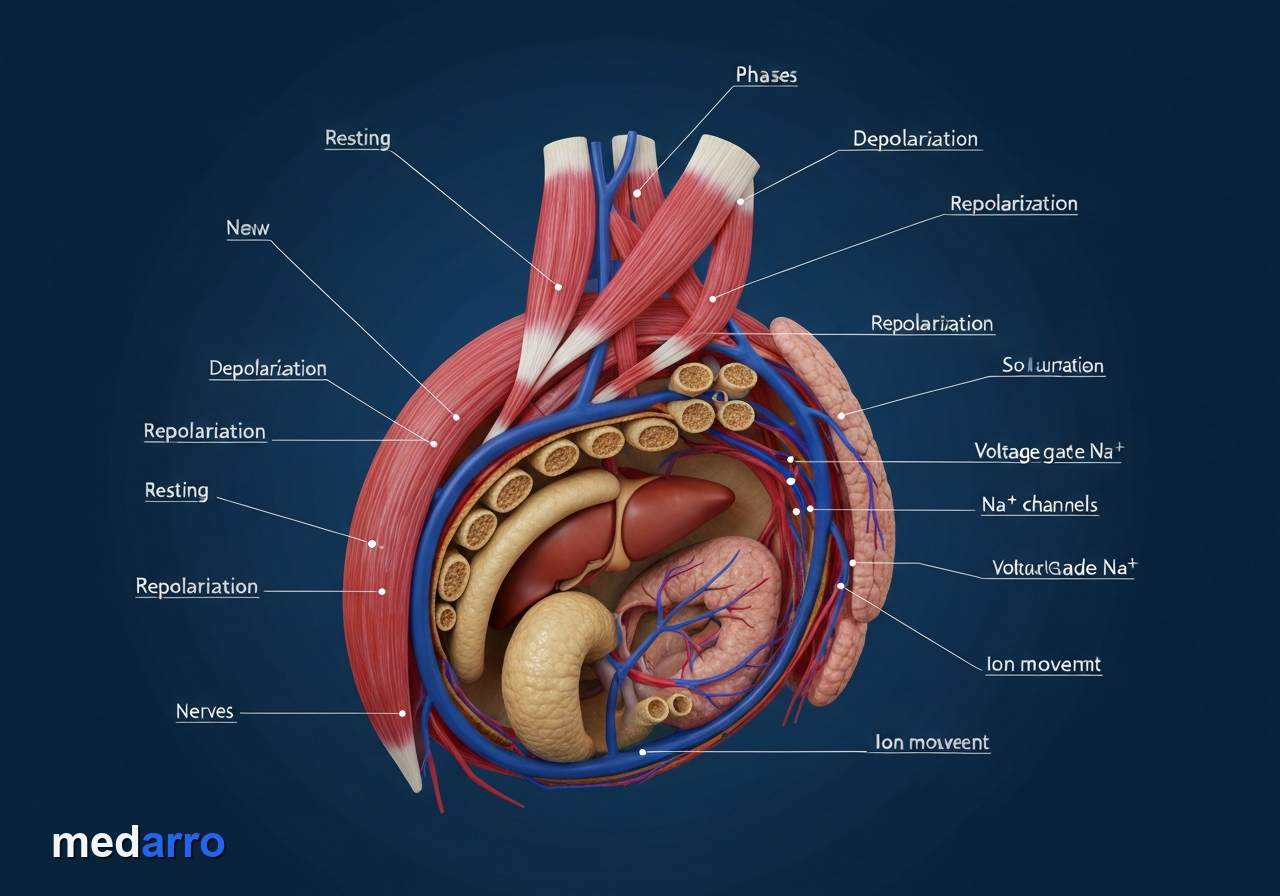
Phases of the Ventricular Fast-Response Action Potential
Phase 0 (Rapid Depolarization): Massive rapid Na+ influx through voltage-gated fast Na+ channels (Nav1.5)
Phase 1 & 2 (Early Repolarization & Plateau): Transient Ito K+ efflux followed by balanced L-type Ca2+ influx and delayed rectifier K+ efflux
Phase 3 & 4 (Rapid Repolarization & Resting Potential): Closure of Ca2+ channels, rapid IKr/IKs K+ efflux, returning to resting potential (-90 mV) maintained by IK1
Pacemaker (Slow-Response) vs Ventricular (Fast-Response) Action Potential
| Electrophysiological Feature | SA Nodal Pacemaker Action Potential | Ventricular Myocyte Action Potential |
|---|---|---|
| Resting Membrane Potential | Unstable resting potential (maximum diastolic potential -55 to -60 mV) | Stable resting membrane potential at -90 mV maintained by IK1 inward rectifier K+ channels |
| Phase 0 Depolarization Ion | Slow Ca2+ influx via L-type (Cav1.2) and T-type Ca2+ channels (Fast Na+ channels permanently inactivated) | Rapid Na+ influx via voltage-gated fast Nav1.5 channels |
| Phase 4 Spontaneous Automaticity | Present; spontaneous prepotential driven by 'Funny' current (If, HCN channels) & T-type Ca2+ | Absent; flat baseline, requires external electrical stimulus to depolarize |
Interactive Clinical Vignette Practice
Live Rule-Out EngineA 58-year-old man with stable angina pectoris and heart failure with reduced ejection fraction (LVEF 30%) has a resting heart rate of 88 bpm despite maximally tolerated beta-blocker therapy. His physician adds Ivabradine. Which of the following ionic currents is selectively inhibited by this medication?
Unlock Complete Viva Traps & Additional Case Vignettes
Access model examiner answers, comprehensive rule-out breakdowns, and 4K spotter explanations.
Want 50+ Clinical Vignettes & 4K 3D Spotters on Physiology?
Practice Spaced Repetition Decathlon, generate instant 7-day adaptive study plans, and upload your college PDFs into the personal vault.