
Countercurrent Multiplier and Exchanger System in Kidney
High-Yield Clinical Pearls & Exam Keys
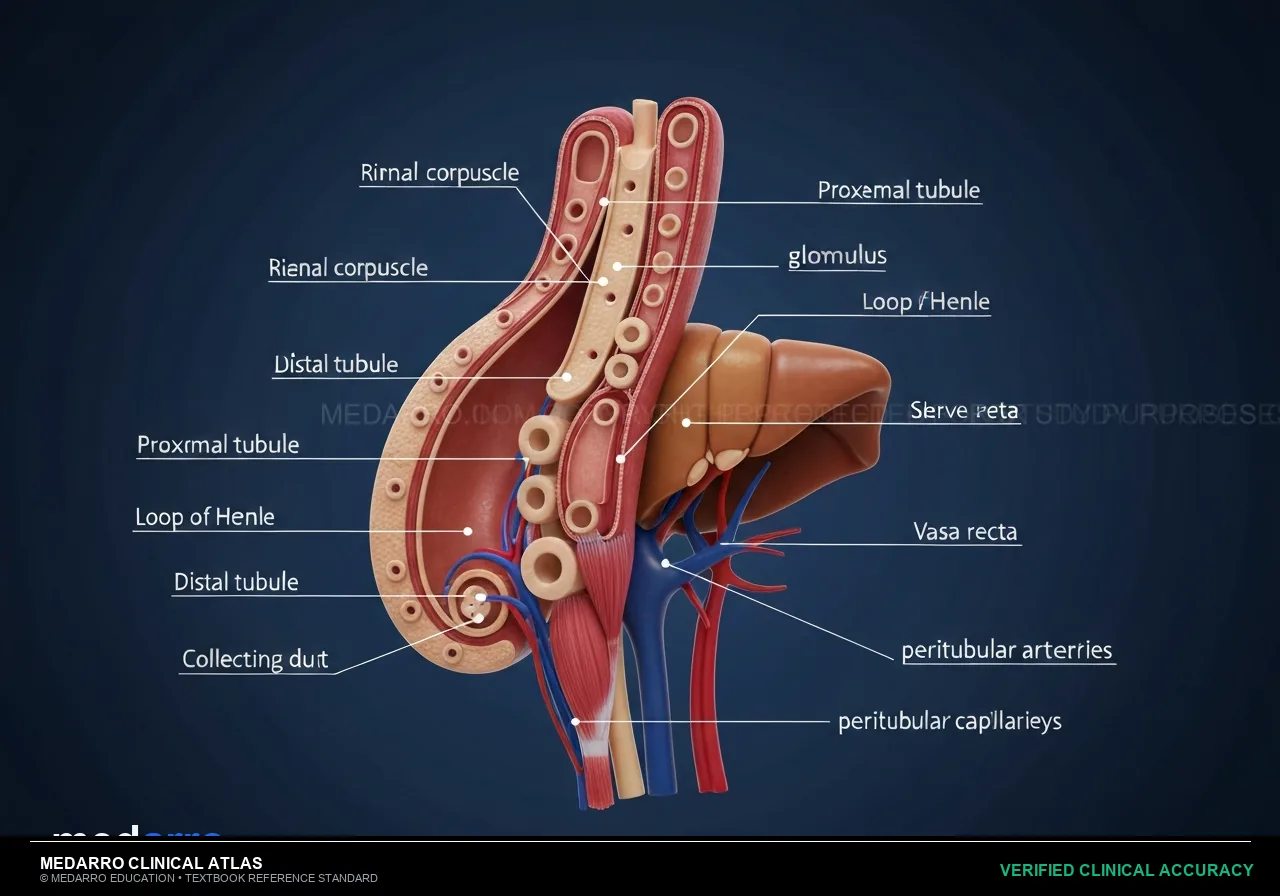
Countercurrent MULTIPLIER: Performed by the Loop of Henle of juxtamedullary nephrons; establishes the corticomedullary osmotic gradient (from 300 mOsm/L at cortex to 1200 mOsm/L at inner medulla).
Descending Thin Limb: Highly permeable to WATER via Aquaporin-1 (AQP1); impermeable to NaCl and urea. Tubular fluid becomes progressively concentrated/hypertonic (up to 1200 mOsm/L at the bend).
Ascending Thick Limb (TAL): Highly IMPERMEABLE to water; actively reabsorbs solutes via the Na+-K+-2Cl- cotransporter (NKCC2). Known as the 'DILUTING SEGMENT' of the nephron because fluid leaving TAL is hypotonic (~100-150 mOsm/L).
Loop Diuretics (Furosemide, Torsemide): Inhibit NKCC2 in the thick ascending limb, abolishing the medullary hyperosmotic gradient and preventing water reabsorption in the collecting ducts.
Countercurrent EXCHANGER: Performed passively by the Vasa Recta; preserves and maintains the medullary hyperosmolar gradient without washing it out due to slow, hairpin-loop blood flow.
Urea Recycling: Contributes ~50% of inner medullary hyperosmolarity via ADH-stimulated UT-A1/UT-A3 transporters in the inner medullary collecting duct.
Ask Dr. Medarro about Physiology
Instant NMC-grounded answers with standard textbook citations
Countercurrent Multiplier vs Countercurrent Exchanger
| Feature | Countercurrent Multiplier (Loop of Henle) | Countercurrent Exchanger (Vasa Recta) |
|---|---|---|
| Anatomical Structure | Juxtamedullary Loop of Henle | Hairpin capillary loops of Vasa Recta |
| Primary Role | GENERATES and MULTIPLIES the medullary osmotic gradient | MAINTAINS and PRESERVES the gradient (prevents solute washout) |
| Energy Requirement | Active transport (ATP-driven Na+/K+ pump powering NKCC2) | Purely passive diffusion of water and solutes |
| Water Permeability | Descending limb permeable; Ascending limb completely impermeable | Both descending and ascending capillary limbs permeable to water and solutes |
| Clinical Target | Inhibited by Loop Diuretics (Furosemide at NKCC2) | Disrupted in Sickle Cell Nephropathy (sickling in hypertonic medulla) |
Interactive Clinical Vignette Practice
Live Rule-Out EngineA patient with refractory pulmonary edema is treated with intravenous furosemide. By what direct molecular mechanism does this loop diuretic abolish the kidney's ability to concentrate urine?
Unlock Complete Viva Traps & Additional Case Vignettes
Access model examiner answers, comprehensive rule-out breakdowns, and 4K spotter explanations.
Want 50+ Clinical Vignettes & 4K 3D Spotters on Physiology?
Practice Spaced Repetition Decathlon, generate instant 7-day adaptive study plans, and upload your college PDFs into the personal vault.