
Psychological Defense Mechanisms: Mature, Neurotic, Immature & Psychotic Vignettes
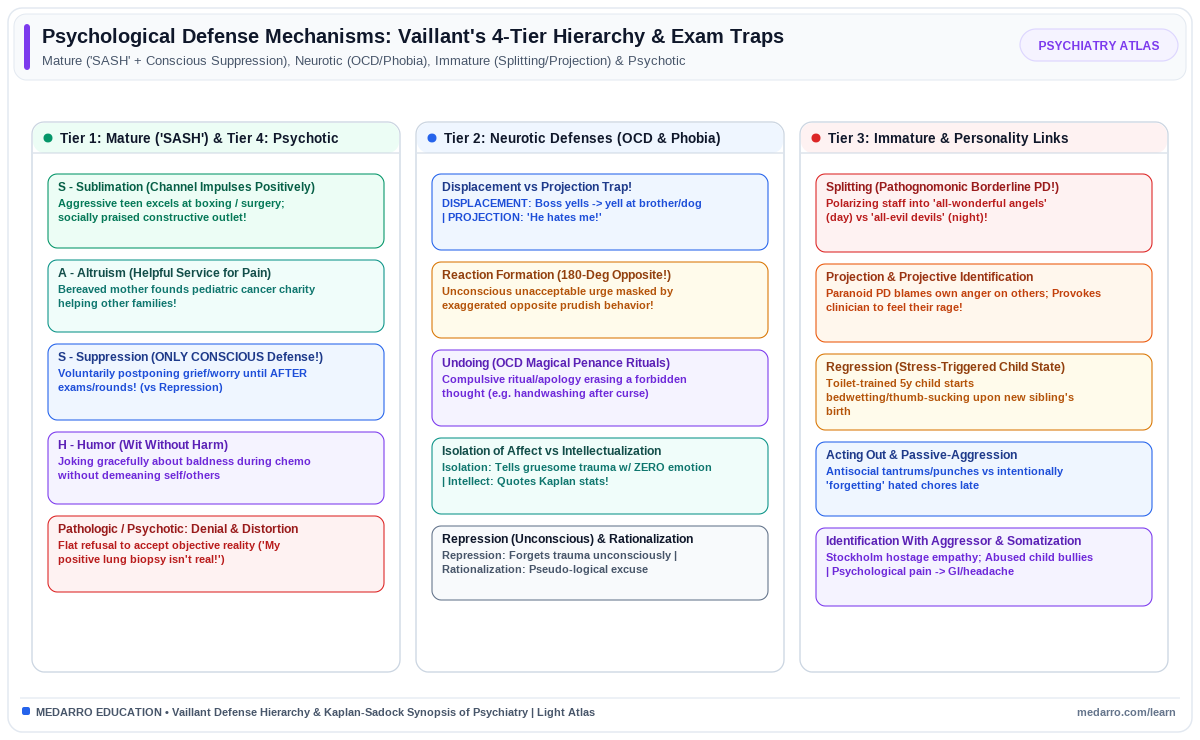
High-Yield Clinical Pearls & Exam Keys
Suppression is the ONLY Mature defense mechanism that operates CONSCIOUSLY/semi-consciously (intentionally shelving grief until after finishing an exam!), whereas Repression operates purely UNCONSCIOUSLY (completely forgetting traumatic event)!
Splitting is the pathognomonic immature defense of Borderline Personality Disorder ('You are the only doctor who truly cares; every nurse on night shift is cruel!') — counter by clear team communication & unified boundaries!
Differentiate Projection vs Displacement: In Projection, the patient disowns the feeling completely and sees it coming FROM someone else ('He wants to kill me!'); in Displacement, the patient knows they are angry, just aims it at a safer substitute target (yelling at junior after boss yelled!).
Differentiate Intellectualization vs Isolation of Affect: Isolation of Affect describes a vivid terrible trauma clinically with ZERO emotion ('My family burned alive; then I checked my watch'); Intellectualization hides personal anxiety behind dense medical textbooks/statistics ('Survival odds for Stage IV glioblastoma are 4.2% at 5 years').
Differentiate Sublimation vs Reaction Formation: A furious teen who takes up competitive kickboxing is using SUBLIMATION (impulse expressed constructively); a man disgusted by his own secret attraction who becomes an aggressive anti-romance activist is using REACTION FORMATION (flipped into pure opposite!).
Ask Dr. Medarro about Psychiatry
Instant NMC-grounded answers with standard textbook citations
High-Yield Exam Keys: Psychological Defense Mechanisms
Suppression is the ONLY Mature defense mechanism that operates CONSCIOUSLY/semi-consciously (intentionally shelving grief until after finishing an exam!), whereas Repression operates purely UNCONSCIOUSLY (completely forgetting traumatic event)!
Splitting is the pathognomonic immature defense of Borderline Personality Disorder ('You are the only doctor who truly cares; every nurse on night shift is cruel!') — counter by clear team communication & unified boundaries!
Differentiate Projection vs Displacement: In Projection, the patient disowns the feeling completely and sees it coming FROM someone else ('He wants to kill me!'); in Displacement, the patient knows they are angry, just aims it at a safer substitute target (yelling at junior after boss yelled!).
Top 6 Exam Trap Pairs in Ego Defense Mechanisms
| Trap Pair | Mechanism A (Definition + Example) | Mechanism B (Definition + Example) |
|---|---|---|
| Suppression vs Repression | Suppression (Mature): Consciously setting worries aside until after rounds | Repression (Neurotic): Unconscious complete blocking of childhood trauma |
| Sublimation vs Reaction Formation | Sublimation (Mature): Aggressive urges channeled into surgical career or boxing | Reaction Formation (Neurotic): Hostility masked by exaggerated sugary kindness |
| Projection vs Displacement | Projection (Immature): 'My supervisor is furious at me' (hiding own anger) | Displacement (Neurotic): Kicking the cat after being scolded by supervisor |
| Isolation vs Intellectualization | Isolation of Affect: Describing assault calmly with zero facial/vocal emotion | Intellectualization: Reciting pathophysiology papers after terminal diagnosis |
| Undoing vs Reaction Formation | Undoing: Washing hands 10x or apologizing excessively after violent thought | Reaction Formation: Chronic rigid opposing attitude without ritual penance |
| Rationalization vs Denial | Rationalization: Making excuses ('The exam was unfair anyway') | Denial: Refusing reality ('I definitely don't have cancer despite biopsy') |
Interactive Clinical Vignette Practice
Live Rule-Out EngineA 26-year-old medical resident feels intense anger toward an overly critical attending surgeon during morning rounds. Rather than confronting the surgeon, she returns home and yells harshly at her younger brother for leaving a cup in the sink. Which defense mechanism is she exhibiting?
Unlock Complete Viva Traps & Additional Case Vignettes
Access model examiner answers, comprehensive rule-out breakdowns, and 4K spotter explanations.
Want 50+ Clinical Vignettes & 4K 3D Spotters on Psychiatry?
Practice Spaced Repetition Decathlon, generate instant 7-day adaptive study plans, and upload your college PDFs into the personal vault.