
Epidemiological Study Designs Hierarchy (Case-Control, Cohort, RCT) & Bias
High-Yield Clinical Pearls & Exam Keys
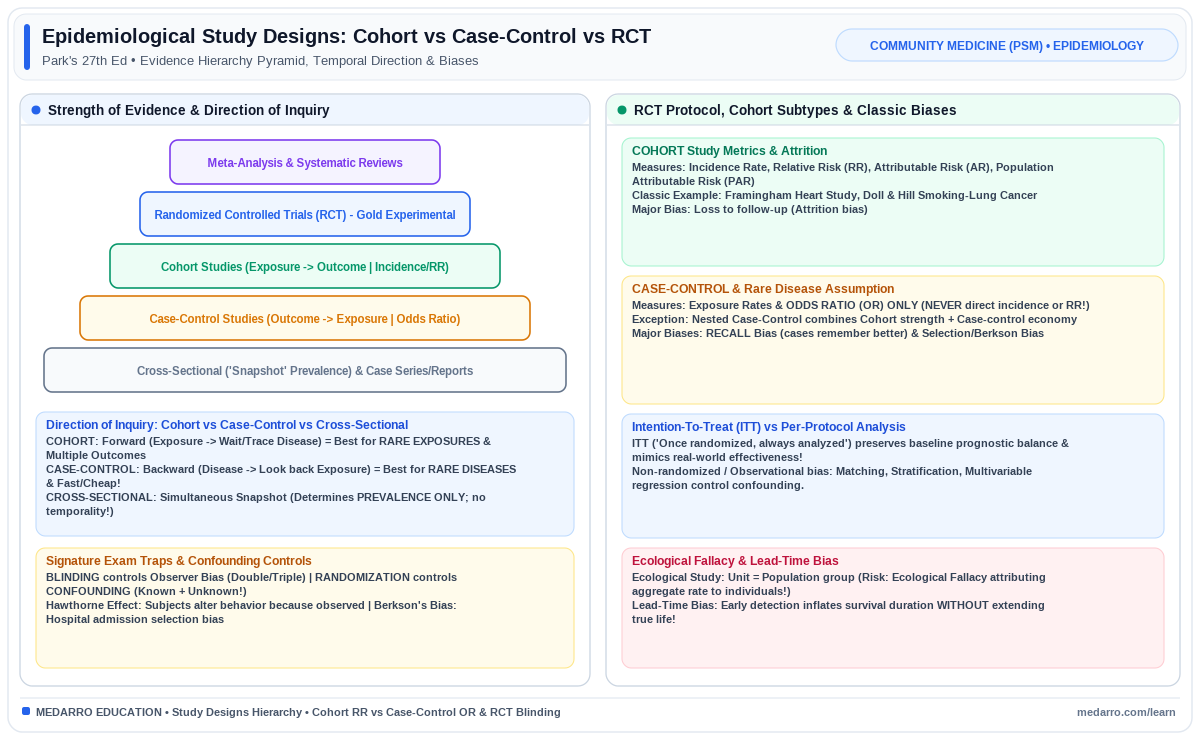
Observational Analytical Studies: Case-Control starts with OUTCOME (Cases vs Controls -> looks BACKWARD for risk factors, estimates Odds Ratio, ideal for RARE diseases with long latency); Cohort starts with EXPOSURE (Exposed vs Unexposed -> follows FORWARD for Incidence & Relative Risk, ideal for RARE exposures!).
Cross-Sectional Study ('Prevalence Study' — Snapshot in time): Measures Prevalence (NOT Incidence!) and cannot prove temporality ('which came first, chicken or egg?'). Ecological study uses POPULATIONS/aggregate countries rather than individuals -> prone to Ecological Fallacy.
Randomized Controlled Trial (RCT) Randomization eliminates Selection Bias and balances KNOWN AND UNKNOWN confounders across arms! Allocation Concealment (SNOSE sealed envelopes) prevents investigator bias BEFORE enrollment; Blinding (Double = Participant + Investigator; Triple = + Analyst!) prevents ascertainment/performance bias AFTER allocation.
Non-compliance / Protocol Violation Rule: Analyze RCTs strictly using INTENTION-TO-TREAT (ITT — 'Once randomized, always analyzed' in original arm!) to preserve randomization balance and avoid attrition distortion; Per-protocol analyzes only completers.
Ask Dr. Medarro about Community Medicine (PSM)
Instant NMC-grounded answers with standard textbook citations
High-Yield Epidemiological Biases (Guaranteed MCQ Traps)
Berkson's Bias: Hospital admission-rate selection distortion in Case-Control studies comparing hospitalized cases/controls (rates differ cleanly from general community)
Neyman Bias (Prevalence-Incidence Bias): Selecting only surviving prevalent cases misses rapidly fatal early cases (underestimates lethality/exposure link)
Hawthorne Effect: Subjects temporarily alter behavior/improve simply because they KNOW they are being observed under study; Pygmalion = Researcher expectation influences subject outcome!
Case-Control Study vs Cohort Study vs Randomized Controlled Trial
| Epidemiological Feature | Case-Control Study | Cohort Study |
|---|---|---|
| Starting Point & Direction | Cases (Diseased) vs Controls -> BACKWARD to Exposure | Exposed vs Unexposed (Disease-FREE at start!) -> FORWARD to Disease |
| Direct Measure of Incidence? | NO! Estimates Odds Ratio (ad/bc) ONLY | YES! Direct Incidence Rate -> Relative Risk (RR), Attributable Risk, NNT |
| Best Suited For | RARE diseases, multiple exposures, quick outbreak etiology | RARE exposures (nuclear fallout, new occupational toxins), multiple outcomes from 1 exposure |
| Major Threat / Biases | Recall Bias, Selection Bias (Berkson's), Confounding | Loss to Follow-up (Attrition Bias), Healthy Worker Effect, Expensive & Time-Consuming |
| Evidence Pyramid & Confounder Control | Matching controls (age/sex -> beware Overmatching!) | RCT (Experimental) > Cohort > Case-Control > Cross-Sectional > Case Series; Confounding fixed by Randomization, Stratification, Regression |
Interactive Clinical Vignette Practice
Live Rule-Out EngineResearchers at an oncology center investigate an extremely rare biliary tract cancer (incidence 1 per 100,000/year) suspected to correlate with contaminated mustard oil ingestion 15 years earlier. Which observational design is most efficient, and what summary statistic does it yield?
Unlock Complete Viva Traps & Additional Case Vignettes
Access model examiner answers, comprehensive rule-out breakdowns, and 4K spotter explanations.
Want 50+ Clinical Vignettes & 4K 3D Spotters on Community Medicine (PSM)?
Practice Spaced Repetition Decathlon, generate instant 7-day adaptive study plans, and upload your college PDFs into the personal vault.