
Measures of Disease Association: Relative Risk (RR), Odds Ratio (OR) & Attributable Risk
High-Yield Clinical Pearls & Exam Keys
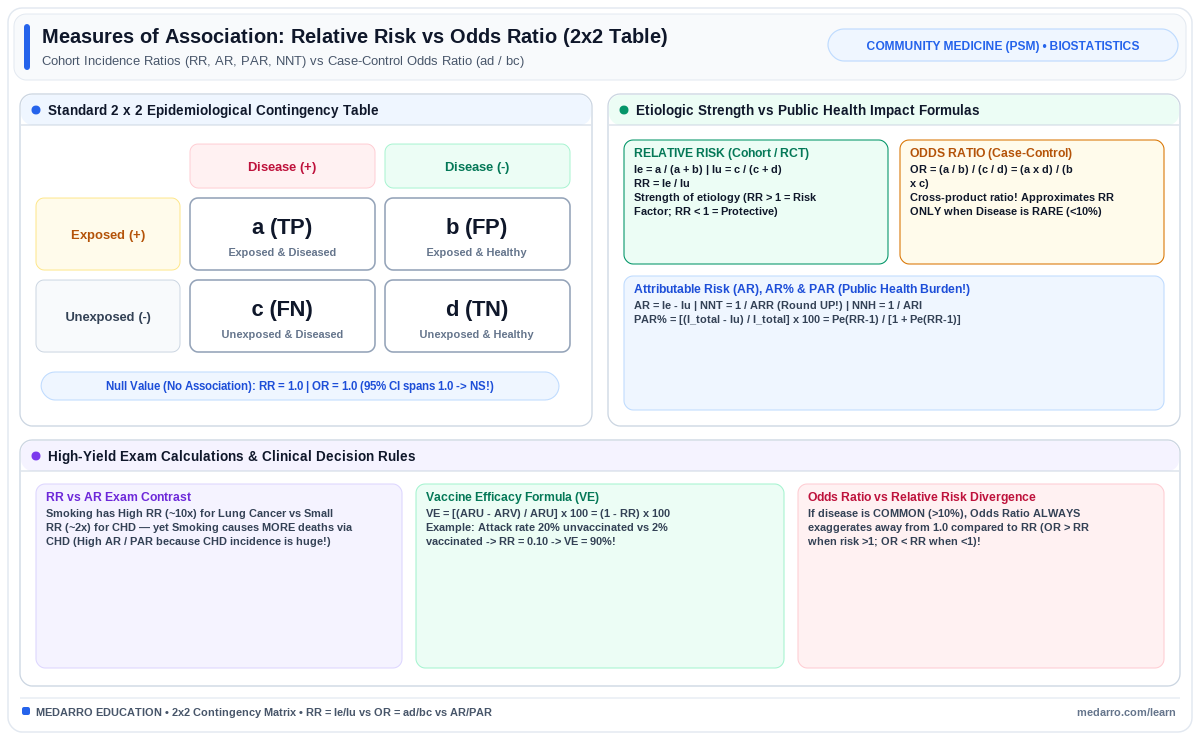
2x2 Table Layout (Standard PSM Convention): Rows = Exposure (Top: Exposed [a=Diseased, b=Healthy], Bottom: Unexposed [c=Diseased, d=Healthy]). Incidence in Exposed (Ie) = a/(a+b); Incidence in Unexposed (Iu) = c/(c+d).
RELATIVE RISK (RR = Ie / Iu): Calculated strictly in COHORT & RCT studies (measures STRENGTH of causal association: e.g., RR = 1 means NO association; RR > 1 = Risk factor; RR < 1 = Protective!).
ODDS RATIO (OR = [a × d] / [b × c], 'Cross-Product Ratio'): Used in CASE-CONTROL studies (approaches true Relative Risk closely ONLY when disease is RARE [<5-10% prevalence], known as the Rare-Disease Assumption!).
ATTRIBUTABLE RISK (AR% = [Ie - Iu] / Ie × 100): Quantifies % of disease among EXPOSED people attributable to that risk factor (etiological fraction); POPULATION ATTRIBUTABLE RISK (PAR% = [Itotal - Iu] / Itotal × 100): Guides Public Health Policy on how much TOTAL community disease disappears if exposure is eliminated!
Ask Dr. Medarro about Community Medicine (PSM)
Instant NMC-grounded answers with standard textbook citations
High-Yield Calculation Anchors (Park's Instant Solve)
Number Needed to Treat (NNT) = 1 / Absolute Risk Reduction (ARR = |Control Event Rate - Treatment Event Rate|). Always ROUND UP NNT to next whole patient! Number Needed to Harm (NNH) = 1 / ARI
Null Value Trap: For Ratio measures (RR, OR, Hazard Ratio), NO Effect / Null = 1.0 (if 95% CI spans 1.0, p > 0.05 NOT statistically significant!). For Difference measures (AR, ARR, Mean Diff), Null = 0.0!
Etiological Strength vs Public Health Priority: High RR guides individual risk counseling (e.g. mesothelioma & asbestos); High PAR% guides National Health Missions (e.g. smoking/HTN due to huge population prevalence!).
Strength vs Potential Impact: RR vs OR vs AR vs PAR vs NNT
| Measure | Exact Mathematical Formula | Design Used & Clinical Interpretation |
|---|---|---|
| Relative Risk (Risk Ratio, RR) | Ie / Iu = [a/(a+b)] / [c/(c+d)] | Cohort / RCT | Times more likely exposed develop disease vs unexposed (Null = 1) |
| Odds Ratio (OR) | (a × d) / (b × c) | Case-Control (or Logistic Regression) | Approximates RR under Rare-Disease Assumption |
| Attributable Risk (AR & AR%) | AR = Ie - Iu | AR% = [(Ie - Iu)/Ie] × 100 | Cohort | Excess disease among EXPOSED preventable by stopping exposure (Null = 0) |
| Population Attributable Risk (PAR%) | [(Itotal - Iu) / Itotal] × 100 | Cohort + Population Prevalence | Total burden prevented across ENTIRE nation if removed |
| Absolute Risk Reduction & NNT | ARR = CER - EER | NNT = 1 / ARR | RCT Therapy | Patients needed to treat to prevent 1 extra bad outcome (Lower NNT = stronger clinical utility!) |
Interactive Clinical Vignette Practice
Live Rule-Out EngineIn a 10-year prospective cohort of 1,000 factory workers, 400 workers exposed to silica dust developed 40 cases of lung disease, whereas 600 unexposed workers developed 15 cases. Calculate the Relative Risk (RR) and Attributable Risk Percentage (AR%) among the exposed workers:
Unlock Complete Viva Traps & Additional Case Vignettes
Access model examiner answers, comprehensive rule-out breakdowns, and 4K spotter explanations.
Want 50+ Clinical Vignettes & 4K 3D Spotters on Community Medicine (PSM)?
Practice Spaced Repetition Decathlon, generate instant 7-day adaptive study plans, and upload your college PDFs into the personal vault.