
Types of Sampling (Probability vs Non-Probability) & Sample Size Determination
High-Yield Clinical Pearls & Exam Keys
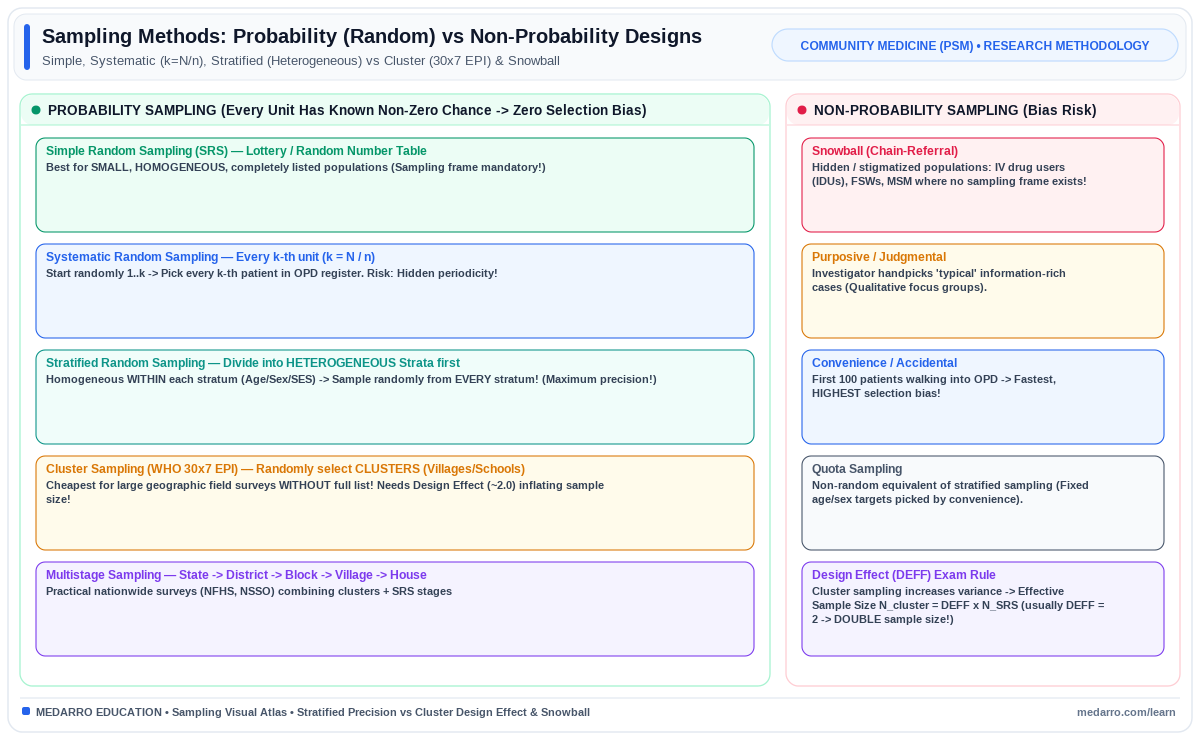
PROBABILITY SAMPLING (Every individual has a known >0 chance of selection -> eliminates selection bias!): 1) Simple Random (Lottery / random table; needs complete sampling frame); 2) Systematic Random (Every kth element where Sampling Interval k = N/n after 1 random start; beware periodic cycles!); 3) Stratified Random (Divide HETEROGENEOUS population into HOMOGENEOUS strata like Urban/Rural or Age BEFORE randomly picking from EVERY stratum!).
CLUSTER SAMPLING (Opposite of Stratified! Population already sits in naturally occurring HETEROGENEOUS clusters like villages/wards -> randomly select SOME clusters, then sample ALL/subset inside ONLY selected clusters!): E.g., WHO Immunization Coverage Survey (30 Clusters × 7 Children = 210, Design Effect DEFF = 2 -> doubles required sample size!).
NON-PROBABILITY SAMPLING (Zero random selection -> prone to selection bias!): Snowball Sampling (Chain-referral: ideal for HIDDEN hard-to-reach groups like IV drug users, commercial sex workers, undocumented migrants!), Convenience, Purposive (Judgmental), Quota Sampling.
SAMPLE SIZE FORMULAS: Qualitative prevalence n = (Z_α² × p × q) / L² [At 95% confidence Z=1.96 ≈ 2, so n ≈ 4pq / L², where q = 100-p and L = Allowable Error; maximum sample needed when p=50%, q=50%!]; Quantitative continuous mean n = 4σ² / L².
Ask Dr. Medarro about Community Medicine (PSM)
Instant NMC-grounded answers with standard textbook citations
Stratified vs Cluster & Sample Size Traps (Must-Know Exams)
Stratified = Population grouped into HOMOGENEOUS strata -> pick SOME from ALL strata -> HIGHEST precision, LOWER sample size!
Cluster = Population grouped into HETEROGENEOUS natural clusters (villages/schools) -> pick SOME clusters, sample ALL inside chosen clusters -> CHEAPEST geographically, YET LESS precise (needs multiplying n by Design Effect ~1.5-2.0)!
Effect of Changing Parameters on n = 4pq / d²: Halving allowable error d (precision doubled!) QUADRUPLES sample size (4x)! Raising confidence 95% -> 99% INCREASES n (Z goes 1.96 -> 2.58)!
Probability vs Non-Probability Sampling Techniques
| Sampling Method | Core Mechanism & Best Setting | Key Advantage vs Pitfall / Design Effect |
|---|---|---|
| Simple Random Sampling | Lottery / random numbers; equal chance for all N units | Unbiased gold standard ONLY when full sampling frame exists; impractical across whole country |
| Systematic Sampling | Select 1 random start <=k, then every kth person (k = N/n) | Easy in OPD queues / household rows; FAILS if list has hidden periodic cycling! |
| Stratified Random Sampling | Split into homogeneous subgroups (Age/SES), random sample EVERY stratum | Guarantees minority subgroup representation + SMALLEST variance! |
| Cluster / Multistage Sampling | Pick random whole villages/wards (WHO 30x7 EPI = 210); Multistage samples inside chosen units | NO nation-wide list needed & saves travel cost; Higher sampling error (multiply n × Design Effect 2!) |
| Snowball Sampling (Non-Prob) | Existing subject recruits acquaintances from hidden social network | ONLY practical way to reach IV drug users / MSM / hidden HIV risk groups (Selection bias!) |
Interactive Clinical Vignette Practice
Live Rule-Out EnginePublic health researchers want to study needle-sharing behaviors among underground injecting drug users (IDUs) in a metropolitan city where no registry exists. Initial participants recruit friends from their drug-use network until 150 participants are enrolled. Which sampling method is used?
Unlock Complete Viva Traps & Additional Case Vignettes
Access model examiner answers, comprehensive rule-out breakdowns, and 4K spotter explanations.
Want 50+ Clinical Vignettes & 4K 3D Spotters on Community Medicine (PSM)?
Practice Spaced Repetition Decathlon, generate instant 7-day adaptive study plans, and upload your college PDFs into the personal vault.