
CSOM: Tubotympanic (Safe) vs Atticoantral (Unsafe) & Cholesteatoma Complications
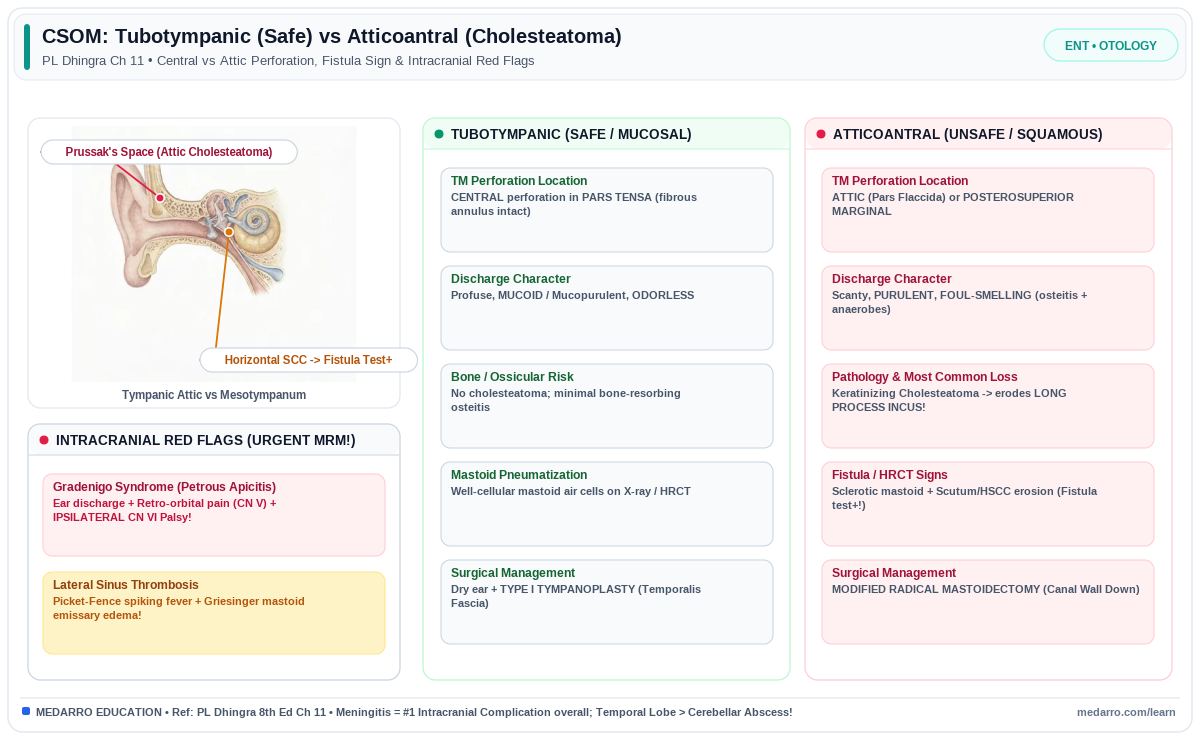
High-Yield Clinical Pearls & Exam Keys
Tubotympanic ('Safe' / Mucosal) CSOM: Affects anteroinferior Eustachian tube/mesotympanum -> CENTRAL perforation in PARS TENSA (surrounded all around by fibrous annulus!), profuse MUCOID/mucopurulent ODORLESS discharge, NO bone erosion, rare intracranial complications -> Medical drying + MYRINGOPLASTY / TYMPANOPLASTY!
Atticoantral ('Unsafe' / Squamous) CSOM: Cholesteatoma ('skin in the wrong place' — keratinizing squamous epithelium with collagenase/osteoclast bone destruction!) -> ATTIC (Pars Flaccida) or POSTEROSUPERIOR MARGINAL perforation, Scanty FOUL-SMELLING purulent discharge, Granulation/Aural polyp!
Fistula Test Positive: Tragal pressure induces vertigo + nystagmus toward same ear -> Erosion of HORIZONTAL (LATERAL) SEMICIRCULAR CANAL! (False negative if labyrinth completely dead or cholesteatoma plugs fistula; False positive in Congenital Syphilis 'Hennebert sign' & hypermobile stapes!).
Most Common Intracranial Complication of CSOM overall = EXTRADURAL ABSCESS / MENINGITIS (Meningitis most common overall; Brain Abscess: Temporal lobe > Cerebellum; Lateral Sinus Thrombosis shows 'Picket-Fence' spiking fever + Griesinger's sign = mastoid emissary vein edema!).
Ask Dr. Medarro about ENT (Otorhinolaryngology)
Instant NMC-grounded answers with standard textbook citations
Gradenigo Triad (Petrous Apicitis) & Cholesteatoma Theories
GRADENIGO SYNDROME (Petrous Apicitis): Retro-orbital deep ear PAIN (CN V irritation) + IPSILATERAL CN VI palsy (Diplopia in Dorello's canal) + Persistent EAR DISCHARGE
WITTMAACK'S INVAGINATION THEORY (Retraction pocket in Pars Flaccida from negative middle-ear pressure — MOST ACCEPTED theory for Primary Acquired Cholesteatoma!)
TOBEY-AYER & CROWE-BECK TESTS: Diagnosed Lateral Sinus Thrombosis classically via absent CSF pressure rise on IJV compression (today replaced by MR Venography showing Delta sign!)
Tubotympanic (Safe / Mucosal) vs Atticoantral (Unsafe / Squamous) CSOM
| Clinical Feature | Tubotympanic (Safe / Mucosal) | Atticoantral (Unsafe / Squamous) |
|---|---|---|
| Perforation Site | CENTRAL perforation in PARS TENSA (annulus intact) | ATTIC (Pars Flaccida) or Posterosuperior MARGINAL (annulus eroded) |
| Ear Discharge Quality | Profuse, MUCOID/mucopurulent, ODORLESS | Scanty, PURULENT, FOUL-SMELLING (osteitis + anaerobes) |
| Granulations & Polyp | Uncommon; polyp is pale edematous mucosa | Common; fleshy red bleeding granulations & cholesteatoma pearly flakes |
| X-ray Mastoid / HRCT | Cellular mastoid with clouding; NO bone destruction | SCLEROTIC mastoid with bony cavity erosion ('key in lock' / scutum erosion!) |
| Definitive Management | Aural toilet + Antibiotic drops -> TYPE I TYMPANOPLASTY (Temporalis fascia) | CANAL WALL DOWN (Modified Radical Mastoidectomy) or Intact Canal Wall surgery! |
Interactive Clinical Vignette Practice
Live Rule-Out EngineA 22-year-old man with chronic foul-smelling left ear discharge develops high swinging 'picket-fence' fever with chills, neck tenderness along the sternocleidomastoid, and tender edema over the posterior mastoid region. Otoscopy reveals a posterosuperior marginal perforation with pearly white debris. What complication has developed?
Unlock Complete Viva Traps & Additional Case Vignettes
Access model examiner answers, comprehensive rule-out breakdowns, and 4K spotter explanations.
Want 50+ Clinical Vignettes & 4K 3D Spotters on ENT (Otorhinolaryngology)?
Practice Spaced Repetition Decathlon, generate instant 7-day adaptive study plans, and upload your college PDFs into the personal vault.