
DKA vs HHS: Diagnostic Criteria, Fluid-Insulin-Potassium Rules & Euglycemic DKA
High-Yield Clinical Pearls & Exam Keys
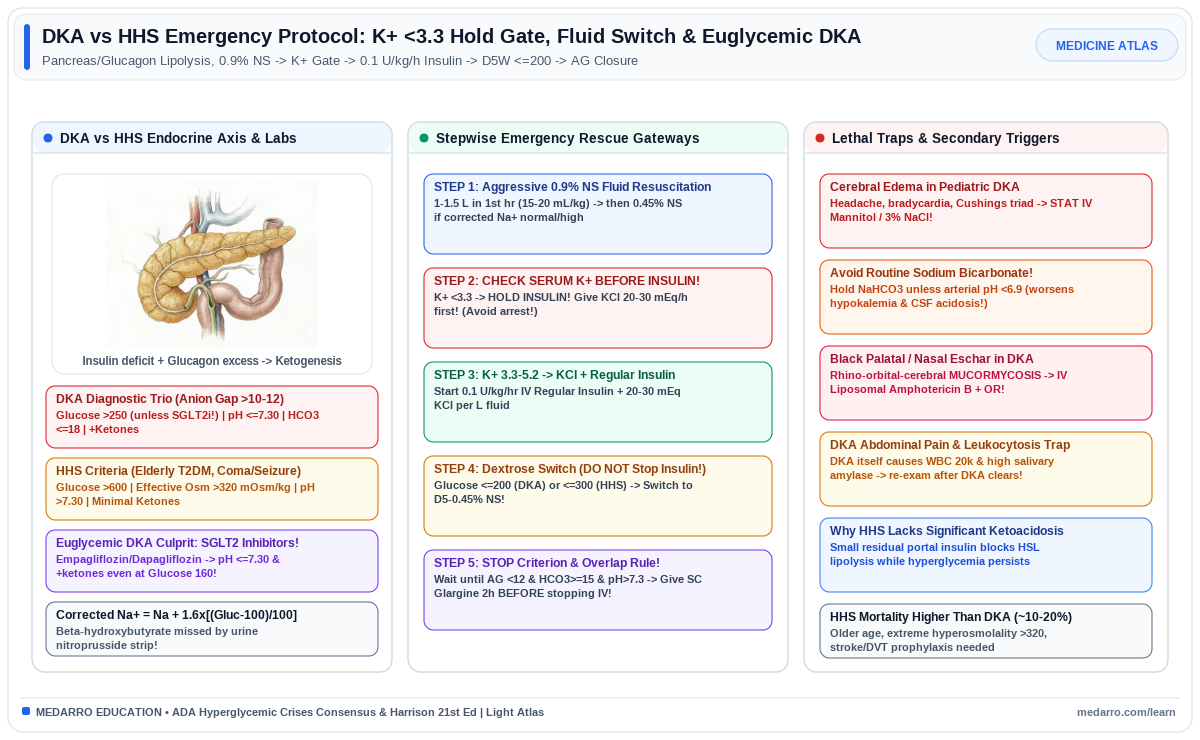
NEVER start IV Insulin if serum K+ <3.3 mEq/L! Insulin rapidly drives extracellular K+ into cells, precipitating catastrophic hypokalemic ventricular arrhythmia/cardiac arrest.
STOP criterion for DKA insulin drip is NOT normalization of blood glucose — it is closure of the Anion Gap (<12 mEq/L) and HCO3- >=15-18 + pH >7.30! Once Glucose drops to <=200 mg/dL, switch fluid to D5-0.45% NS to keep insulin running.
Give Subcutaneous long-acting basal Insulin (e.g., Glargine) 2 hours BEFORE discontinuing the IV Regular Insulin infusion (Overlap Rule) to prevent rebound ketoacidosis!
Urine Nitroprusside ketone strips ONLY detect Acetoacetate and Acetone — they MISS Beta-hydroxybutyrate (ratio rises 10:1 in severe DKA), so serum beta-hydroxybutyrate can paradoxically appear to rise during recovery as it converts back to acetoacetate!
Sodium Bicarbonate is generally CONTRAINDICATED in DKA unless arterial pH <6.9 (causes paradoxical CSF acidosis, hypokalemia, and shifts O2 curve left -> cerebral edema risk in children!).
Ask Dr. Medarro about General Medicine
Instant NMC-grounded answers with standard textbook citations
High-Yield Exam Keys: DKA vs HHS
NEVER start IV Insulin if serum K+ <3.3 mEq/L! Insulin rapidly drives extracellular K+ into cells, precipitating catastrophic hypokalemic ventricular arrhythmia/cardiac arrest.
STOP criterion for DKA insulin drip is NOT normalization of blood glucose — it is closure of the Anion Gap (<12 mEq/L) and HCO3- >=15-18 + pH >7.30! Once Glucose drops to <=200 mg/dL, switch fluid to D5-0.45% NS to keep insulin running.
Give Subcutaneous long-acting basal Insulin (e.g., Glargine) 2 hours BEFORE discontinuing the IV Regular Insulin infusion (Overlap Rule) to prevent rebound ketoacidosis!
Diabetic Ketoacidosis (DKA) vs Hyperosmolar Hyperglycemic State (HHS)
| Parameter | DKA (Mild / Mod / Severe) | HHS (Hyperosmolar State) |
|---|---|---|
| Typical Patient & Precipitant | T1DM (or ketosis-prone T2DM); infection, missed insulin, SGLT2i | Elderly T2DM; pneumonia, UTI, stroke, poor water intake |
| Plasma Glucose | >250 mg/dL (can be <200 in Euglycemic SGLT2i DKA!) | Typically >600 mg/dL (often >800-1000 mg/dL) |
| Arterial pH & HCO3- | pH <=7.30 (<7.0 severe); HCO3- <=18 (<10 severe) | pH >7.30; HCO3- >18 mEq/L |
| Serum / Urine Ketones | Elevated (beta-hydroxybutyrate >> acetoacetate) | Negative or weakly trace |
| Effective Serum Osmolality | Variable (typically <320 mOsm/kg) | >320 mOsm/kg (causes obtundation / seizures / focal deficits) |
| Fluid Deficit & Dextrose Switch | 5-7 L deficit; add D5W when Glucose <=200 mg/dL | 8-10 L deficit; add D5W when Glucose <=300 mg/dL |
Interactive Clinical Vignette Practice
Live Rule-Out EngineA 21-year-old man with T1DM presents with vomiting, abdominal pain, and Kussmaul breathing after skipping insulin for 2 days. Labs show Glucose 490 mg/dL, pH 7.14, HCO3- 10 mEq/L, Na+ 132, Cl- 96, and Serum K+ 3.0 mEq/L. After starting 1 L 0.9% Normal Saline IV bolus, what is the immediate mandatory pharmacologic step?
Unlock Complete Viva Traps & Additional Case Vignettes
Access model examiner answers, comprehensive rule-out breakdowns, and 4K spotter explanations.
Want 50+ Clinical Vignettes & 4K 3D Spotters on General Medicine?
Practice Spaced Repetition Decathlon, generate instant 7-day adaptive study plans, and upload your college PDFs into the personal vault.