
Hyperkalemia vs Hypokalemia: ECG Progression, Pseudohyperkalemia & Emergency Protocol
High-Yield Clinical Pearls & Exam Keys
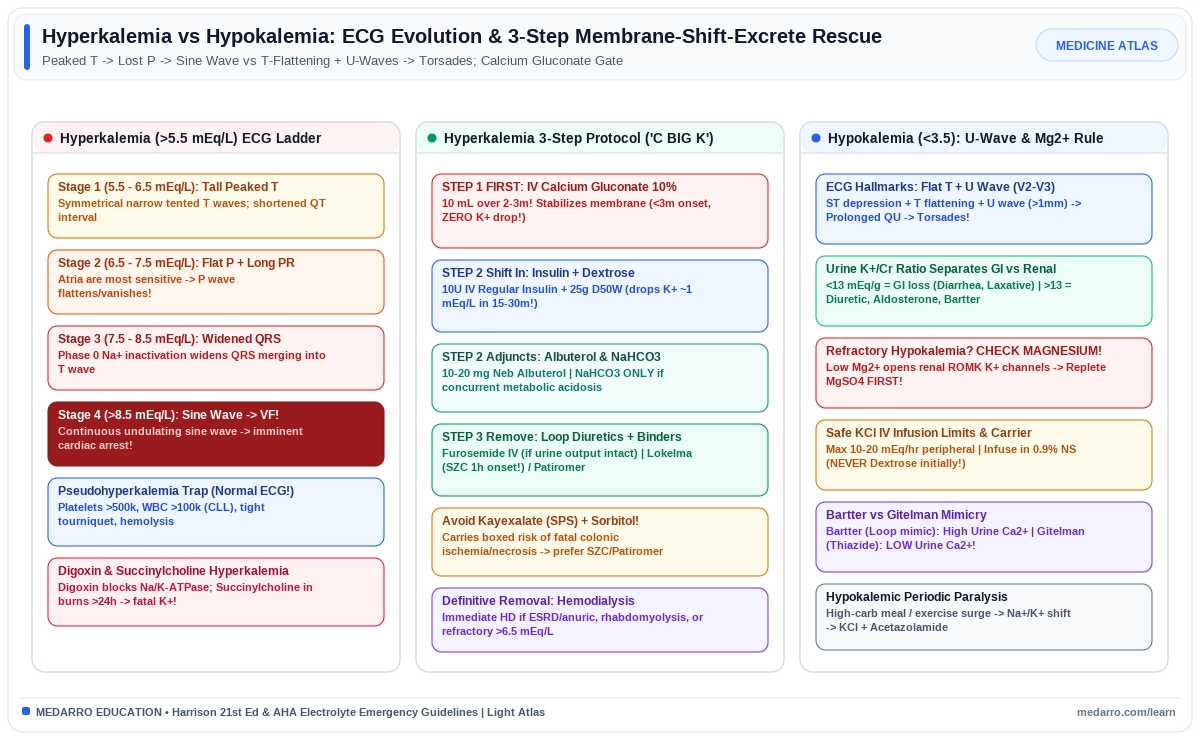
IV Calcium Gluconate is the SINGLE FIRST drug given when hyperkalemia shows ECG changes (peaked T waves or widened QRS); onset <3 minutes, duration 30-60 minutes, zero effect on serum potassium concentration.
Always check Magnesium in refractory hypokalemia! Low Mg2+ impairs Na+/K+-ATPase and prevents closure of renal ROMK channels, causing continuous renal K+ wasting until Mg2+ is repleted.
Pseudohyperkalemia: Elevated serum K+ WITHOUT ECG changes in thrombocytosis (>500,000), extreme leukocytosis (>100,000 in CLL), tight fist-clenching tourniquet, or hemolyzed sample — verify with heparinized plasma K+!
Never administer potassium faster than 10-20 mEq/hr via peripheral IV (pain/phlebitis) or in Dextrose-containing fluids initially (insulin surge worsens acute hypokalemia!); use Normal Saline carrier.
Succinylcholine is strictly contraindicated in burn victims (>24h), crush injuries, or hyperkalemia because upregulated extrajunctional nicotinic receptors cause massive K+ efflux & cardiac arrest.
Ask Dr. Medarro about General Medicine
Instant NMC-grounded answers with standard textbook citations
High-Yield Exam Keys: Hyperkalemia vs Hypokalemia
IV Calcium Gluconate is the SINGLE FIRST drug given when hyperkalemia shows ECG changes (peaked T waves or widened QRS); onset <3 minutes, duration 30-60 minutes, zero effect on serum potassium concentration.
Always check Magnesium in refractory hypokalemia! Low Mg2+ impairs Na+/K+-ATPase and prevents closure of renal ROMK channels, causing continuous renal K+ wasting until Mg2+ is repleted.
Pseudohyperkalemia: Elevated serum K+ WITHOUT ECG changes in thrombocytosis (>500,000), extreme leukocytosis (>100,000 in CLL), tight fist-clenching tourniquet, or hemolyzed sample — verify with heparinized plasma K+!
Hyperkalemia vs Hypokalemia: Etiology, ECG & Urgent Action
| Feature | Hyperkalemia (K+ >5.5) | Hypokalemia (K+ <3.5) |
|---|---|---|
| Primary ECG Morphology | Tall tented T waves -> Flat P -> Wide QRS -> Sine wave | Flat T waves, ST depression, prominent U wave, prolonged QU |
| Life-Threatening Rhythm | Sine wave -> Asystole / Ventricular Fibrillation | Torsades de pointes (Polymorphic VT) |
| Immediate Membrane Stabilizer | IV Calcium Gluconate 10% (10 mL over 2-3 min) | IV Magnesium Sulfate 2 g if Torsades or concurrent low Mg2+ |
| Intracellular Shift Drivers | Acidemia, Insulin deficiency, Beta-blockers, Digoxin toxicity | Alkalemia, Insulin surge, Beta-2 agonists, Refeeding |
| Key Drug Contraindications | Succinylcholine, ACEi/ARB, Spironolactone, Trimethoprim | Digoxin (binds competitive site -> worsens toxicity!), Dextrose infusion alone |
Interactive Clinical Vignette Practice
Live Rule-Out EngineA 68-year-old man with diabetic nephropathy who takes Lisinopril and Spironolactone presents with generalized weakness. Labs reveal serum Potassium 7.4 mEq/L, Creatinine 4.1 mg/dL, HCO3- 16 mEq/L. ECG demonstrates absent P waves, QRS duration 160 ms, and tall peaked T waves. What is the single most appropriate NEXT step in management?
Unlock Complete Viva Traps & Additional Case Vignettes
Access model examiner answers, comprehensive rule-out breakdowns, and 4K spotter explanations.
Want 50+ Clinical Vignettes & 4K 3D Spotters on General Medicine?
Practice Spaced Repetition Decathlon, generate instant 7-day adaptive study plans, and upload your college PDFs into the personal vault.