
Cataract Types (Senile Cortical vs Nuclear) & Complications of Cataract Surgery
High-Yield Clinical Pearls & Exam Keys
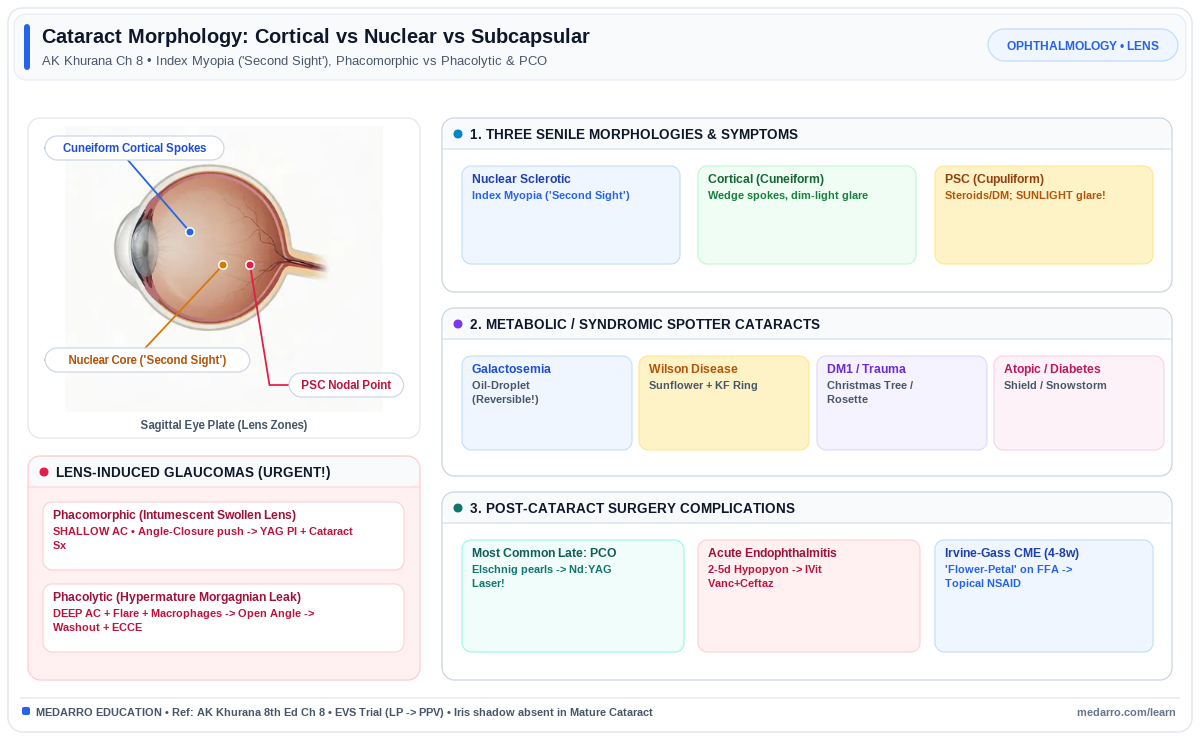
Cortical Cataract Stages: Lamellar separation -> Incipient (cuneiform wedge-shaped spokes, uniocular polyopia) -> Intumescent (swollen lens pushing iris -> Phacomorphic glaucoma!) -> Mature (pearly white, ZERO iris shadow!) -> Hypermature Morgagnian (liquefied cortex lets brown nucleus SINK inferiorly -> Phacolytic glaucoma!).
Nuclear Cataract increases central lens refractive index -> MYOPIC SHIFT ('Second Sight' — elderly presbyopic patient suddenly reads without near glasses!) + severe glare in dim light & poor distant vision; progresses to amber/brown/black (cataracta brunescens / nigra).
Posterior Subcapsular Cataract (Cupuliform) sits right at the NODAL POINT -> causes earliest severe near-vision & bright-sunlight/headlight glare disability (classic causes: systemic/topical STEROIDS, Diabetes, Ionizing Radiation, Retinitis Pigmentosa).
Phacomorphic vs Phacolytic Glaucoma: Phacomorphic is secondary ANGLE-CLOSURE (intumescent swollen lens pushing iris forward -> shallow AC); Phacolytic is OPEN-ANGLE macrophage obstruction by leaking high-MW lens proteins across hypermature capsule (deep AC + flare + pseudohypopyon!).
Ask Dr. Medarro about Ophthalmology
Instant NMC-grounded answers with standard textbook citations
Distinctive Metabolic / Drug Cataracts (Instant Exam Spotters)
Galactosemia (GALT deficiency) -> 'OIL-DROPLET' Cataract (dulcitol/galactitol osmotic swelling; REVERSIBLE early if milk excluded!)
Wilson's Disease -> 'SUNFLOWER' Cataract (copper deposition in anterior subcapsular cortex) + Kayser-Fleischer ring in Descemet's membrane
Myotonic Dystrophy & Blunt Trauma -> 'CHRISTMAS-TREE' Polychromatic Cataract (DM1) vs 'VOSSEIUS RING' / 'ROSETTE' (Flower-shaped) Cataract (Blunt trauma!)
Senile Cortical vs Nuclear vs Posterior Subcapsular Cataract & Surgery
| Parameter / Feature | Cortical & Hypermature Cataract | Nuclear Sclerotic & PSC Cataract |
|---|---|---|
| Primary Glare / Lighting Effect | Worse in twilight/dilated pupil; Cuneiform spoke opacities start inferonasally | PSC/Cupuliform worst in BRIGHT light / constricted pupil (near reading impaired early!) |
| Refractive Shift | Minimal or mild hyperopic shift early; later opaque white reflex | INDEX MYOPIA ('Second Sight' elderly reads fine print unaided, distant blurs!) |
| Iris Shadow Test | Present in Immature cataract; ABSENT in Mature / Complete cataract | Absent only when dense mature brunescent opacity fills whole lens depth |
| Lens-Induced Glaucoma Risk | Intumescent -> Phacomorphic (Shallow AC); Hypermature Morgagnian -> Phacolytic (Deep AC) | Rare compared to mature/hypermature swollen cortical stages |
| Post-Op Cystoid Macular Edema / PCO | Aftercataract (PCO — Elschnig pearls) = MOST COMMON late complication overall -> Nd:YAG laser capsulotomy! | Acute Endophthalmitis (within 1-7d, Staph epidermidis MOST common!) -> Intravitreal Vancomycin + Ceftazidime stat! |
Interactive Clinical Vignette Practice
Live Rule-Out EngineA 72-year-old man who needed +2.50 D reading glasses for 20 years notices that over the past 6 months he can suddenly read newspaper print clearly without glasses, though distant TV captions now look hazy and doubled. Distant acuity improves partially with a minus lens. Which lens change explains this phenomenon?
Unlock Complete Viva Traps & Additional Case Vignettes
Access model examiner answers, comprehensive rule-out breakdowns, and 4K spotter explanations.
Want 50+ Clinical Vignettes & 4K 3D Spotters on Ophthalmology?
Practice Spaced Repetition Decathlon, generate instant 7-day adaptive study plans, and upload your college PDFs into the personal vault.