
Errors of Refraction (Myopia, Hypermetropia, Astigmatism, Presbyopia) Correction
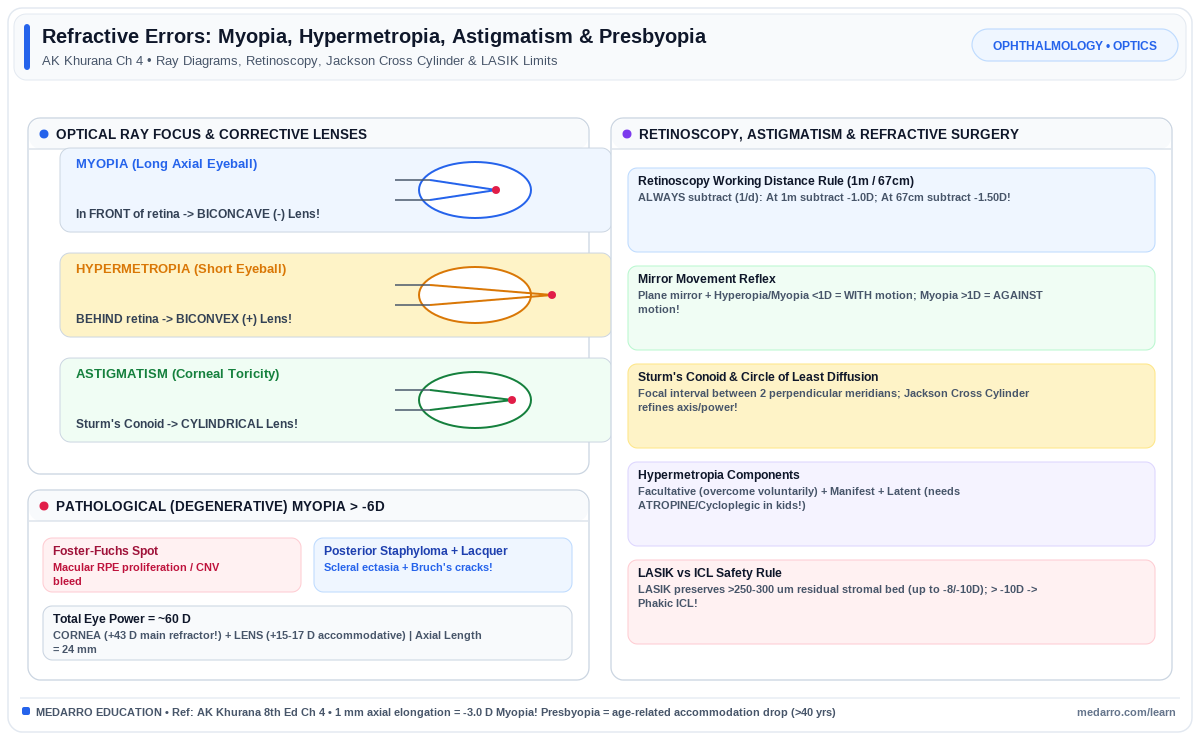
High-Yield Clinical Pearls & Exam Keys
Optics Sum: Normal human eye total refractive power = +60 D (Cornea ~ +43-45 D [MAIN static refractor!] + Lens ~ +15-18 D [variable via accommodation!]). Axial length = 24 mm (1 mm change alters power by ~3 D!).
MYOPIA ('Nearsighted' — rays focus IN FRONT of retina): Long eyeball (>24mm) or steep cornea -> Diverging CONCAVE (-) Minus lens (Lowest minus lens giving best 6/6 vision! Watch: Foster-Fuchs spot, Lacquer cracks & RD risk in Pathological Myopia > -6 D!).
HYPERMETROPIA ('Farsighted' — rays focus BEHIND retina): Short eyeball (<24mm) -> Converging CONVEX (+) Plus lens (HIGHEST plus lens tolerated! Causes Accommodative Esotropia in kids & Acute Angle-Closure Glaucoma in elders! Note: True total hypermetropia uncovered ONLY under Atropine/Cycloplegic refraction in kids!).
ASTIGMATISM (Unequal refraction across perpendicular meridians -> STURM'S CONOID focal interval!): Corrected by CYLINDRICAL / Toric lenses (axis placed 90° away from power meridian!). Regular (With-the-Rule vertical steep 90° -> Common in youth; Against-the-Rule 180° -> Elderly!) vs Irregular (Keratoconus 'Scissor reflex' -> Rigid Gas Permeable / Rose-K lens!).
Ask Dr. Medarro about Ophthalmology
Instant NMC-grounded answers with standard textbook citations
Retinoscopy Neutralization & Surgical Refractive Rules
Retinoscopy at 1 Meter working distance: Subtract 1.00 D from raw lens neutralization value! 'AGAINST' movement = High Myopia (> -1 D); 'WITH' movement = Emmetropia, Hyperopia, or Low Myopia (< -1 D)!
Presbyopia (Loss of lens elasticity after age ~40 yrs — NOT a refractive error!): Amplitude of accommodation drops -> Near reading add needed (+1.0 D @40y -> +2.5/+3.0 D @60y; Remember: A -2.5 D Myope simply takes off glasses to read!).
Corneal Keratorefractive Surgery: LASIK (Microkeratome/Femto flap -> excimer ablates stroma: flattens center for Myopia, steepens for Hyperopia; NEVER do LASIK in Keratoconus or Thin Cornea <480 µm -> causes Ectasia!) vs SMILE / ICL (Phakic IOL for high myopia > -8 to -10 D!).
Refractive Errors Optical Physics, Lenses & Clinical Complications
| Refractive State | Focal Point & Optical Cause | Correction Lens & Signature Complications |
|---|---|---|
| Myopia (Nearsightedness) | Focuses IN FRONT of retina (Axial length >24 mm / Index sclerosis) | Concave (-) Minus lens (prescribe WEAKEST minus!) | Pathological Myopia: Tilted disc, Fuchs macular spot, Lattice + RD! |
| Hypermetropia (Farsightedness) | Focuses BEHIND retina (Axial length <24 mm / Shallow AC) | Convex (+) Plus lens (prescribe STRONGEST plus!) | Accommodative Esotropia (kids) & Acute Angle-Closure Glaucoma! |
| Regular Astigmatism (Sturm's Conoid) | Two perpendicular focal lines (Circle of Least Confusion best focus) | Cylindrical / Spherocylindrical lens (With-the-Rule: vertical steepest 90° -> minus cyl @180°) |
| Irregular Astigmatism / Keratoconus | Non-perpendicular warped meridians ('Scissor reflex' + Munson sign!) | Spectacles FAIL! -> Rigid Gas Permeable (RGP) Contact Lens, Corneal Cross-Linking (C3R Riboflavin+UVA) -> DALK! |
| Presbyopia (>40-45 yrs Physiological) | Rigid aging lens loses accommodative amplitude (Near point recedes >25cm) | Convex (+) Near Add (+1.00 @40y, +2.00 @50y, +2.50 @60y) Bifocal/Progressive |
Interactive Clinical Vignette Practice
Live Rule-Out EngineA 17-year-old boy with frequent eye rubbing reports rapidly worsening blurred vision uncorrectable by new thick glasses. Streak retinoscopy shows a 'scissor reflex', slit lamp reveals fine vertical Vogt striae in posterior stroma and a brownish Fleischer epithelial iron ring, and downgaze indents the lower eyelid into a V-shape (Munson sign). Which intervention HALTS disease progression permanently?
Unlock Complete Viva Traps & Additional Case Vignettes
Access model examiner answers, comprehensive rule-out breakdowns, and 4K spotter explanations.
Want 50+ Clinical Vignettes & 4K 3D Spotters on Ophthalmology?
Practice Spaced Repetition Decathlon, generate instant 7-day adaptive study plans, and upload your college PDFs into the personal vault.