
Newborn Respiratory Distress: RDS (HMD) vs TTN vs Meconium Aspiration (MAS)
High-Yield Clinical Pearls & Exam Keys
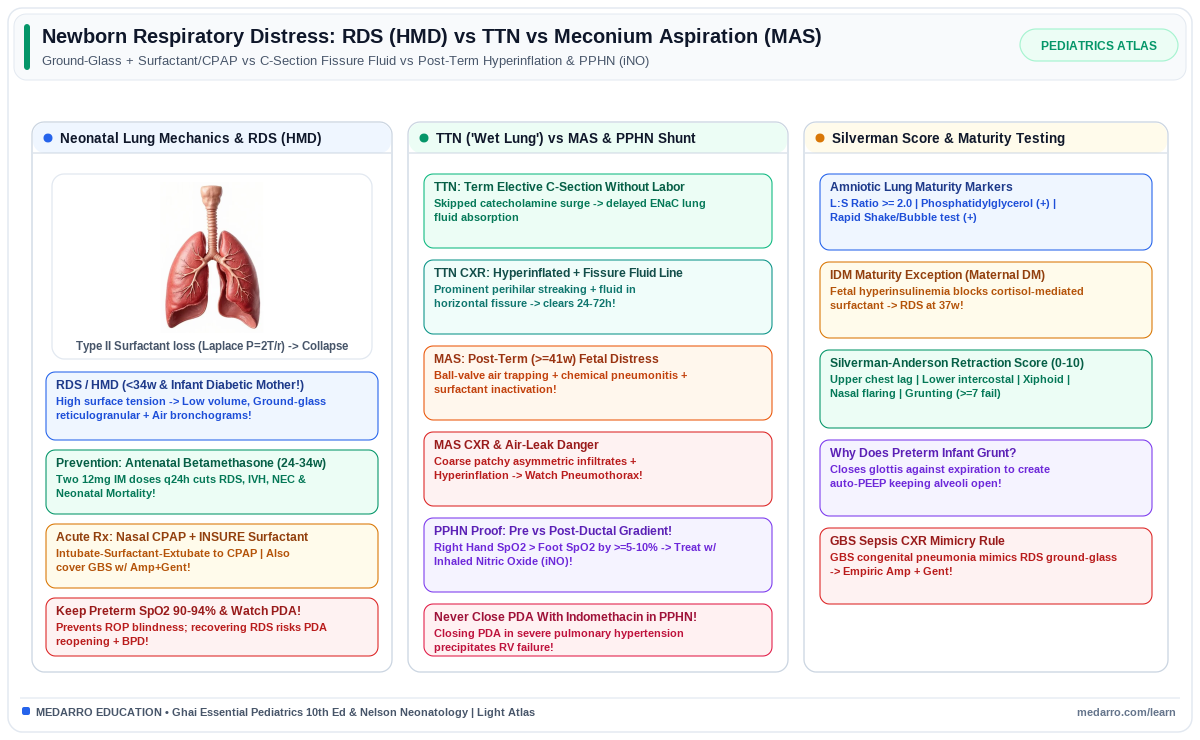
Remember Maternal Diabetes delays fetal lung maturation! Even a 37-week Infant of Diabetic Mother (IDM) is at high risk of RDS because fetal hyperinsulinemia blocks cortisol-driven surfactant gene expression.
Lecithin-to-Sphingomyelin (L:S) Ratio >= 2.0 (or positive Shake/Bubble test / Phosphatidylglycerol presence) in amniotic fluid confirms fetal lung maturity.
Antenatal Betamethasone (two 12 mg IM doses 24h apart) for preterm labor at 24-34 weeks reduces not ONLY Neonatal RDS by ~50%, but ALSO Intraventricular Hemorrhage (IVH) and Necrotizing Enterocolitis (NEC)!
Look out for Patent Ductus Arteriosus opening up in recovering RDS preemies! Hypoxia closes less, oxygen/dropped PVR reveals a bounding-pulse L->R shunt causing apnea & weaning failure -> treat with Ibuprofen/Indomethacin.
Chronic oxygen toxicity + barotrauma in <32 week preemies causes two classic iatrogenic disasters: Bronchopulmonary Dysplasia (O2 requirement >28 days / 36w PMA) and Retinopathy of Prematurity (keep SpO2 strictly 90-94%!).
Ask Dr. Medarro about Pediatrics
Instant NMC-grounded answers with standard textbook citations
High-Yield Exam Keys: Newborn Respiratory Distress
Remember Maternal Diabetes delays fetal lung maturation! Even a 37-week Infant of Diabetic Mother (IDM) is at high risk of RDS because fetal hyperinsulinemia blocks cortisol-driven surfactant gene expression.
Lecithin-to-Sphingomyelin (L:S) Ratio >= 2.0 (or positive Shake/Bubble test / Phosphatidylglycerol presence) in amniotic fluid confirms fetal lung maturity.
Antenatal Betamethasone (two 12 mg IM doses 24h apart) for preterm labor at 24-34 weeks reduces not ONLY Neonatal RDS by ~50%, but ALSO Intraventricular Hemorrhage (IVH) and Necrotizing Enterocolitis (NEC)!
Newborn Respiratory Distress Syndromes Side-by-Side
| Feature | Neonatal RDS (Hyaline Membrane) | TTN ('Wet Lung') / Meconium Aspiration (MAS) |
|---|---|---|
| Typical Gestation & Risk | Preterm (<34w); Male; IDM; Maternal C-section w/o labor | TTN ('Wet Lung'): Term / Late Preterm Elective C-Section (no labor surge!) | Meconium Aspiration (MAS): Post-term (>=41w); Fetal distress / placental insufficiency |
| Root Mechanism | Deficient Type II pneumocyte Surfactant (high surface tension) | TTN ('Wet Lung'): Delayed alveolar fluid clearance via ENaC (absent catecholamines) | Meconium Aspiration (MAS): Meconium aspiration -> ball-valve obstruction + surfactant inactivation |
| Chest X-Ray Signature | Low lung volumes, Ground-glass opacity, Air bronchograms | TTN ('Wet Lung'): Hyperinflation, Perihilar radial streaking, Fluid in minor fissure | Meconium Aspiration (MAS): Coarse patchy infiltrates + Hyperinflation (+/- Pneumothorax!) |
| Natural Course | Peaks at 48-72h then resolves (risks: PDA, BPD, IVH) | TTN ('Wet Lung'): Benign; self-resolves within 24-72 hours | Meconium Aspiration (MAS): High risk of PPHN (differential cyanosis!) & air-leak syndromes |
| Definitive Management | Prevention: Betamethasone; Rx: Nasal CPAP + INSURE Surfactant | TTN ('Wet Lung'): Supportive O2 (FiO2 <40%), keep NPO if RR >60 | Meconium Aspiration (MAS): Gentle ventilation, iNO for PPHN, Surfactant lavage, ECMO standby |
Interactive Clinical Vignette Practice
Live Rule-Out EngineA 38-week term neonate delivered via scheduled repeat Cesarean section without labor develops tachypnea (RR 74/min), mild grunting, and nasal flaring at 2 hours of life. He requires 30% FiO2 via hood to maintain SpO2 95%. Chest X-ray reveals hyperinflated lung fields, prominent perihilar vascular markings, and a crisp fluid line in the right horizontal fissure. Symptoms completely resolve by 36 hours. What was the underlying defect?
Unlock Complete Viva Traps & Additional Case Vignettes
Access model examiner answers, comprehensive rule-out breakdowns, and 4K spotter explanations.
Want 50+ Clinical Vignettes & 4K 3D Spotters on Pediatrics?
Practice Spaced Repetition Decathlon, generate instant 7-day adaptive study plans, and upload your college PDFs into the personal vault.