
Neonatal Resuscitation (NRP 8th Ed): Golden Minute, PPV, 3:1 Compressions & Meconium
High-Yield Clinical Pearls & Exam Keys
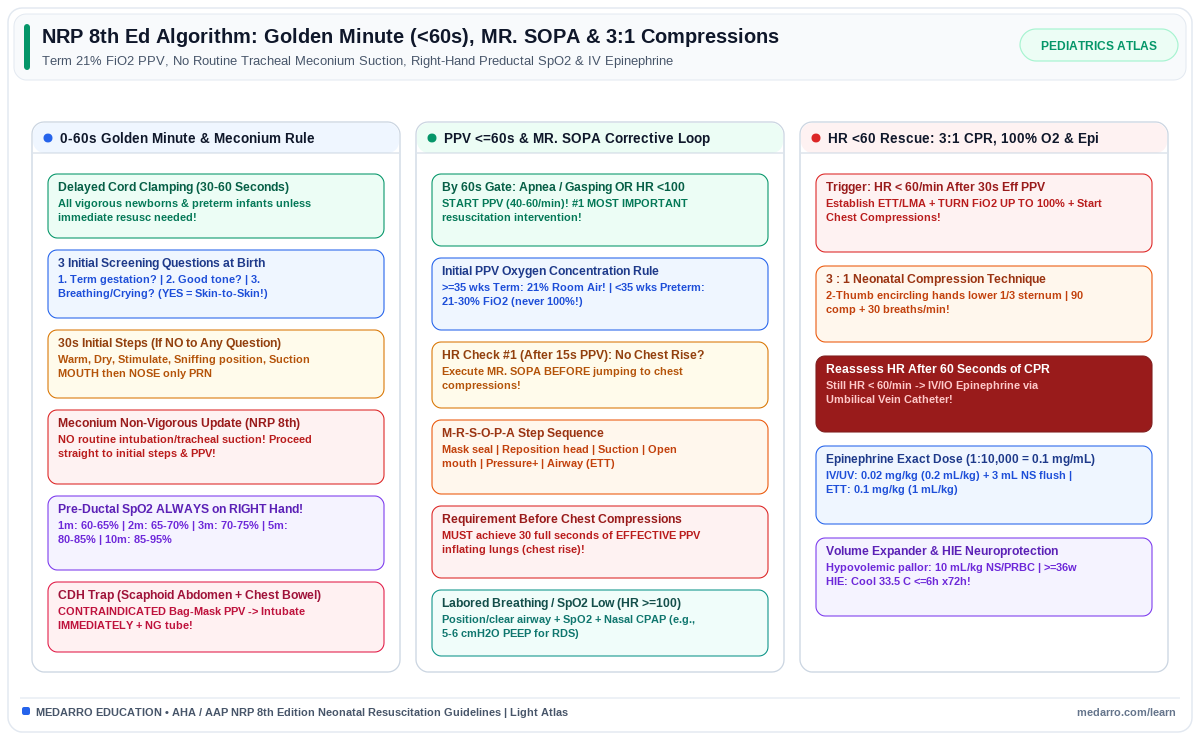
THE SINGLE MOST EFFECTIVE STEP in neonatal resuscitation is effective VENTILATION (PPV) of the lungs — 90%+ of bradycardic newborns recover purely with lung aeration!
Meconium-Stained Amniotic Fluid Update (NRP 7th/8th Ed): Do NOT perform routine direct tracheal intubation & suctioning for non-vigorous meconium babies! Start routine initial steps and initiate PPV by 60 seconds if apneic or HR <100!
Never start Term neonatal resuscitation with 100% Oxygen (causes hyperoxic brain/retinal/lung injury!) -> ALWAYS start Term (>=35w) PPV at 21% Room Air and titrate to Pre-ductal (Right wrist/hand!) SpO2 targets!
ONLY switch FiO2 up to 100% immediately when Chest Compressions are initiated (HR <60/min despite 30s of effective ventilating PPV with chest rise!).
Chest compression-to-ventilation ratio in Neonates is strictly 3:1 (120 events/min: 90 compressions + 30 breaths) via 2-thumb encircling lower-third sternum technique — unlike 15:2 in 2-rescuer pediatric CPR or 30:2 in adults!
Ask Dr. Medarro about Pediatrics
Instant NMC-grounded answers with standard textbook citations
High-Yield Exam Keys: Neonatal Resuscitation (NRP 8th Ed)
THE SINGLE MOST EFFECTIVE STEP in neonatal resuscitation is effective VENTILATION (PPV) of the lungs — 90%+ of bradycardic newborns recover purely with lung aeration!
Meconium-Stained Amniotic Fluid Update (NRP 7th/8th Ed): Do NOT perform routine direct tracheal intubation & suctioning for non-vigorous meconium babies! Start routine initial steps and initiate PPV by 60 seconds if apneic or HR <100!
Never start Term neonatal resuscitation with 100% Oxygen (causes hyperoxic brain/retinal/lung injury!) -> ALWAYS start Term (>=35w) PPV at 21% Room Air and titrate to Pre-ductal (Right wrist/hand!) SpO2 targets!
NRP 8th Ed Corrective Sequence (MR. SOPA) & Pediatric vs Neonatal CPR
| Resuscitation Parameter | Neonatal (NRP 8th Ed) | Pediatric 2-Rescuer PALS |
|---|---|---|
| Primary Cause of Arrest | Almost always Respiratory/Hypoxic failure | Respiratory / Shock progression |
| Compression Trigger HR | HR < 60/min despite 30s effective PPV | Pulseless OR HR <60/min with poor perfusion |
| Compression : Ventilation Ratio | 3 : 1 (90 compressions + 30 breaths = 120 events/min) | 15 : 2 (two rescuers) / 30 : 2 (single rescuer) |
| Initial FiO2 for PPV | 21% Room Air (>=35 wks) / 21-30% (<35 wks) | 100% O2 during cardiac arrest resuscitation |
| IV Epinephrine Concentration & Dose | 1:10,000 (0.1 mg/mL) -> 0.02 mg/kg (0.2 mL/kg) UV/IO! | 1:10,000 -> 0.01 mg/kg (0.1 mL/kg) IV/IO |
Interactive Clinical Vignette Practice
Live Rule-Out EngineA term newborn is delivered through thick meconium-stained amniotic fluid limp, hypotonic, and apneic. At 25 seconds after warming, drying, gentle bulb suction of the mouth/nose, and tactile stimulation, the baby remains apneic with a heart rate of 76/min. What is the single most appropriate NEXT step?
Unlock Complete Viva Traps & Additional Case Vignettes
Access model examiner answers, comprehensive rule-out breakdowns, and 4K spotter explanations.
Want 50+ Clinical Vignettes & 4K 3D Spotters on Pediatrics?
Practice Spaced Repetition Decathlon, generate instant 7-day adaptive study plans, and upload your college PDFs into the personal vault.