
Neonatal Jaundice: Physiological vs Pathological, Kramer's Rule, Phototherapy & Kernicterus
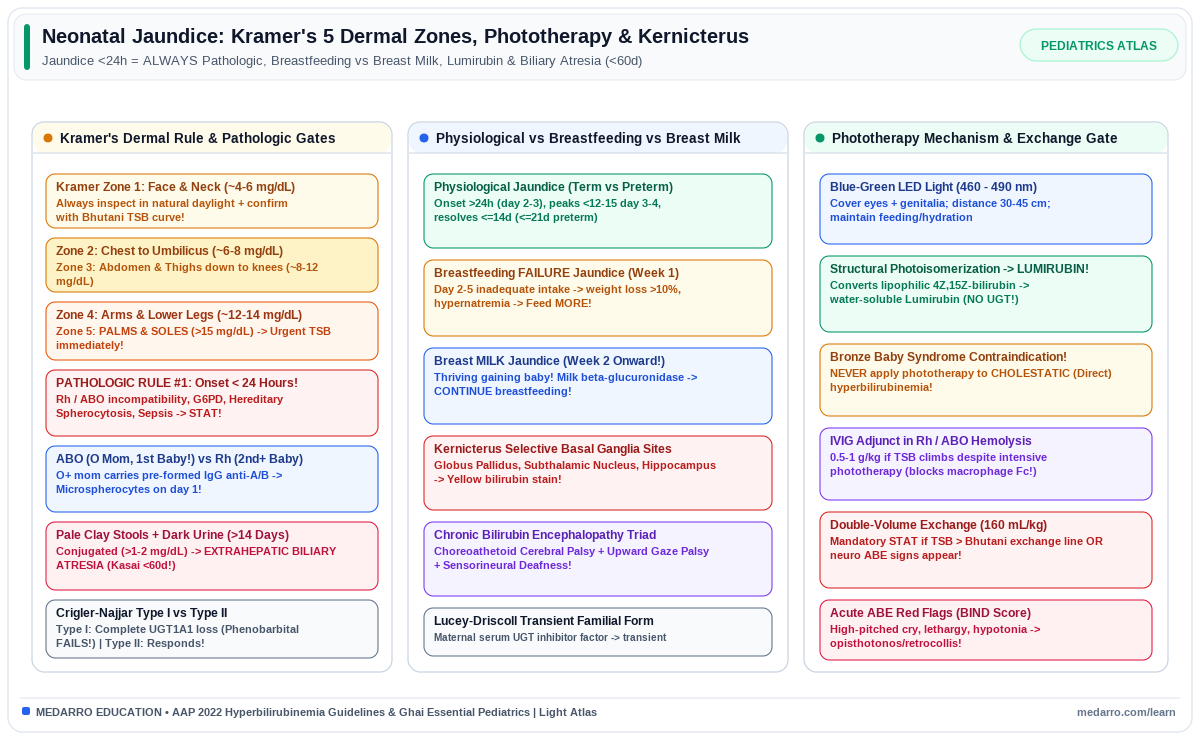
High-Yield Clinical Pearls & Exam Keys
ANY pale/acholic clay-colored stool + dark urine staining diapers in a jaundiced newborn (>2 weeks old) = Direct (Conjugated) Hyperbilirubinemia -> STAT Ultrasound ('Triangular Cord Sign') & HIDA scan to rule out Extrahepatic Biliary Atresia (must perform Kasai <60 days of age!).
Breastfeeding Failure Jaundice (Week 1, Day 2-5) = insufficient milk intake -> weight loss, dehydration, increased enterohepatic circulation -> Rx: Optimize frequent latching! Breast Milk Jaundice (Week 2+) = healthy thriving baby, beta-glucuronidase in milk -> Benign, continue breastfeeding!
Phototherapy mechanism of choice (quantitative driver of bilirubin clearance): Structural photoisomerization converting insoluble 4Z,15Z-bilirubin into water-soluble LUMIRUBIN (irreversible)!
Bronze Baby Syndrome occurs ONLY if Phototherapy is mistakenly applied to a baby with CHOLESTATIC (Conjugated/Direct) hyperbilirubinemia!
Exchange Transfusion (Double-volume = 160 mL/kg) is mandatory immediately if Total Serum Bilirubin crosses Bhutani exchange threshold OR ANY signs of Acute Bilirubin Encephalopathy (high-pitched cry, opisthotonus, lethargy, poor feeding) appear!
Ask Dr. Medarro about Pediatrics
Instant NMC-grounded answers with standard textbook citations
High-Yield Exam Keys: Neonatal Jaundice
ANY pale/acholic clay-colored stool + dark urine staining diapers in a jaundiced newborn (>2 weeks old) = Direct (Conjugated) Hyperbilirubinemia -> STAT Ultrasound ('Triangular Cord Sign') & HIDA scan to rule out Extrahepatic Biliary Atresia (must perform Kasai <60 days of age!).
Breastfeeding Failure Jaundice (Week 1, Day 2-5) = insufficient milk intake -> weight loss, dehydration, increased enterohepatic circulation -> Rx: Optimize frequent latching! Breast Milk Jaundice (Week 2+) = healthy thriving baby, beta-glucuronidase in milk -> Benign, continue breastfeeding!
Phototherapy mechanism of choice (quantitative driver of bilirubin clearance): Structural photoisomerization converting insoluble 4Z,15Z-bilirubin into water-soluble LUMIRUBIN (irreversible)!
Physiological vs Breastfeeding vs Breast Milk vs Pathological Jaundice
| Feature | Physiological | Breastfeeding (Lack) / Breast Milk & Pathological / Cholestatic |
|---|---|---|
| Onset Timing | > 24 hrs (Day 2-3) | Breastfeeding (Lack): Days 2-5 (Week 1) | Breast Milk: After Day 7 (peaks Wk 2-3) | Pathological / Cholestatic: < 24 hrs OR persistent >14d (>21d preterm) |
| Peak / Lab Clue | <12-15 mg/dL; Unconjugated | Breastfeeding (Lack): >10% wt loss, few wet diapers | Breast Milk: Thriving infant; normal weight gain | Pathological / Cholestatic: Rate >5 mg/dL/day; or Direct >1-2 mg/dL |
| Primary Mechanism | Immature UGT1A1 + high HbF | Breastfeeding (Lack): Poor intake -> enterohepatic reabsorption | Breast Milk: Milk beta-glucuronidase / pregnanediol | Pathological / Cholestatic: Hemolysis (Rh/ABO/G6PD/HS) or Biliary Atresia |
| Management | Observe; feed frequently | Breastfeeding (Lack): Lactation support + frequent feeds | Breast Milk: Reassure; continue breastfeeding! | Pathological / Cholestatic: Intensive Phototherapy / IVIG / Exchange / Kasai |
| Phototherapy / Urgent Rule | Observe; feed q2-3h; Phototherapy >= Bhutani threshold | Lactation / Keep feeding (Milk); NEVER Phototherapy if Direct/Cholestatic (Bronze Baby -> Urgent Kasai <60d!) |
Interactive Clinical Vignette Practice
Live Rule-Out EngineA 14-hour-old term male newborn (blood group A+) born to a healthy O+ primigravida mother is noted to have yellow sclerae and jaundice over his face and upper chest. Total serum bilirubin is 10.8 mg/dL (direct 0.4 mg/dL), Hemoglobin 13.8 g/dL, reticulocytes 8%, and peripheral smear shows numerous microspherocytes. Which statement best explains this condition?
Unlock Complete Viva Traps & Additional Case Vignettes
Access model examiner answers, comprehensive rule-out breakdowns, and 4K spotter explanations.
Want 50+ Clinical Vignettes & 4K 3D Spotters on Pediatrics?
Practice Spaced Repetition Decathlon, generate instant 7-day adaptive study plans, and upload your college PDFs into the personal vault.