
Antiarrhythmic Drugs Vaughan Williams Classification & Mechanism of Action
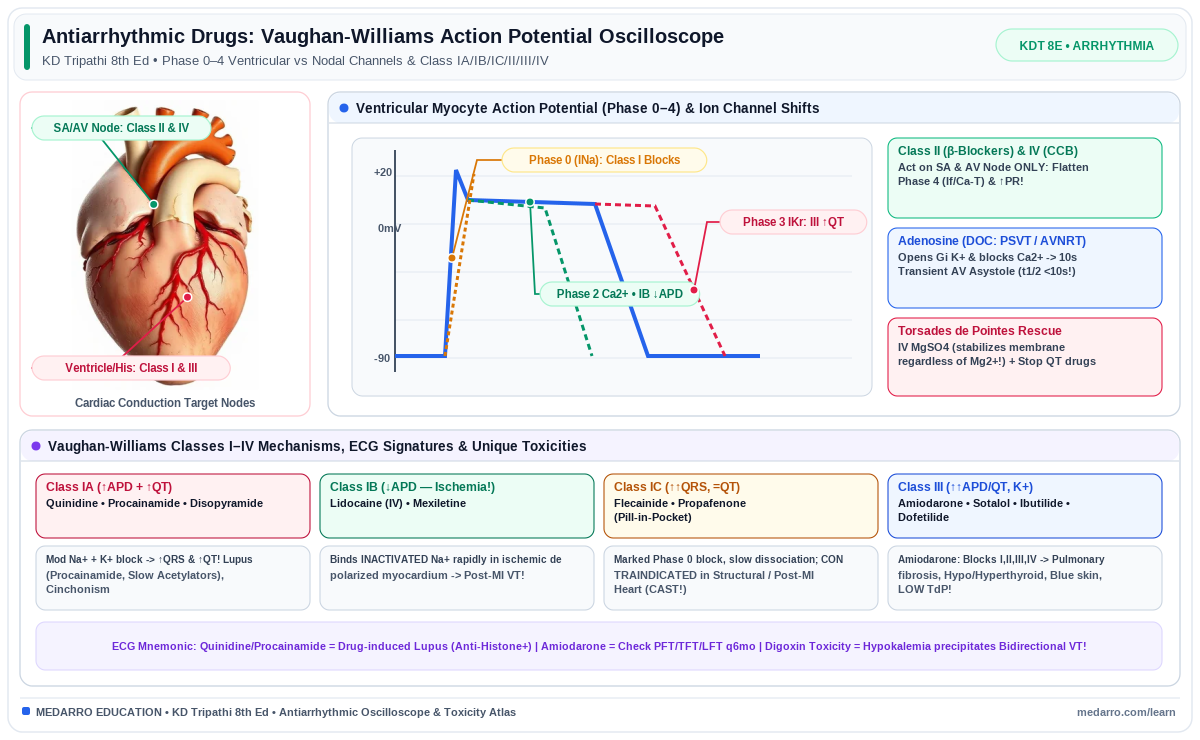
High-Yield Clinical Pearls & Exam Keys
Class I Subclass Effects on Action Potential Duration (APD): Class Ia PROLONGS APD/QT (Quinidine, Procainamide -> Torsades!); Class Ib SHORTENS APD (Lidocaine -> ischemic ventricle); Class Ic ZERO effect on APD (Flecainide -> markedly slows Phase 0 QRS, CONTRAINDICATED post-MI per CAST trial!).
AMIODARONE (Class III) is ~37-40% organic iodine by weight and exhibits massive tissue binding (t1/2 25-100 days): Monitor LFTs, PFTs (Pulmonary Fibrosis #1 lethal), TFTs (Hypo- OR Hyperthyroidism!), Corneal microdeposits, and Blue-gray skin — YET shows the LOWEST incidence of Torsades de pointes among all Class III agents!
ADENOSINE (IV 6 mg rapid push followed by saline flush) is the DOC for acute AV nodal Re-entrant PSVT: triggers Gi-coupled A1 activation -> opens K+ efflux + inhibits Ca2+ influx -> brief 3-6 second asystole breaking the circuit! Antagonized by Theophylline/Caffeine; potentiated by Dipyridamole.
MAGNESIUM SULFATE (IV 2 g) is the Drug of Choice for acute Polymorphic VT / TORSADES DE POINTES (triggered by Quinidine, Sotalol, Dofetilide, Erythromycin, Haloperidol, or hypokalemia).
Ask Dr. Medarro about Pharmacology
Instant NMC-grounded answers with standard textbook citations
Vaughan Williams Classification & Signature Toxicities
| Class & Prototype | Electrophysiology & AP Effect | Unique Indications / Toxicities |
|---|---|---|
| Ia: Quinidine, Procainamide, Disopyramide | Moderate Na+ block + ↓IK -> ↑QRS & ↑↑APD/QT | Quinidine: Cinchonism, ↑Digoxin. Procainamide: Drug-induced SLE (slow acetylators) |
| Ib: Lidocaine, Mexiletine | Weak Na+ block -> SHORTENS Phase 3 APD (fast unbinding) | DOC Post-MI ventricular tachycardia (ischemic depolarized tissue!); CNS tremors/seizures |
| Ic: Flecainide, Propafenone | POTENT Na+ block (slowest unbinding) -> ↑↑QRS, NO QT Δ | 'Pill-in-pocket' AF without structural CAD. Contraindicated Post-MI (↑Mortality!) |
| II: Propranolol, Esmolol, Metoprolol | β1 blockade -> ↓SA/AV Phase 4 depolarization slope -> ↑PR | Prevent SCD post-MI, AF/Atrial flutter rate control, Thyrotoxic SVT |
| III: Amiodarone, Sotalol, Ibutilide | IKr K+ channel block -> Prolongs Phase 3 & ERP (↑QT) | Amiodarone safe in structural CAD/HF! Sotalol/Ibutilide carry high Torsades risk |
| IV: Verapamil, Diltiazem | L-type Ca2+ block at SA & AV nodes -> ↑PR interval | PSVT prophylaxis, AF rate control. CI in WPW pre-excited AF & HFrEF! |
Interactive Clinical Vignette Practice
Live Rule-Out EngineA 68-year-old man with recurrent refractory ventricular tachycardia treated chronically with oral Amiodarone presents with progressive dry cough, exertional dyspnea, and bilateral interstitial reticular infiltrates on chest CT. Besides discontinuing Amiodarone, which additional organ toxicity should routinely be screened in patients taking this agent due to its high iodine content and tissue binding?
Unlock Complete Viva Traps & Additional Case Vignettes
Access model examiner answers, comprehensive rule-out breakdowns, and 4K spotter explanations.
Want 50+ Clinical Vignettes & 4K 3D Spotters on Pharmacology?
Practice Spaced Repetition Decathlon, generate instant 7-day adaptive study plans, and upload your college PDFs into the personal vault.