
Skeletal Muscle Contraction Sliding Filament Theory & Rigor Mortis
High-Yield Clinical Pearls & Exam Keys
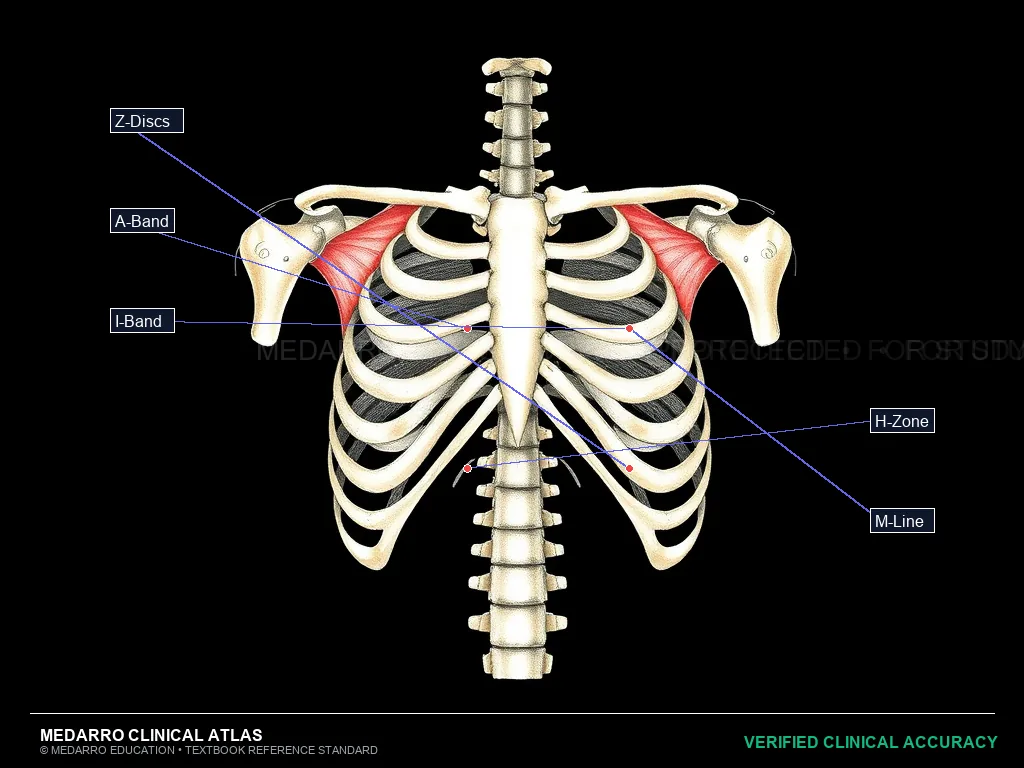
Sarcomere is the functional contractile unit extending from one Z-disc to the adjacent Z-disc.
Band Changes DURING MUSCLE CONTRACTION:
- A-band (Anisotropic, thick myosin filaments): LENGTH REMAINS CONSTANT ('A-band Always constant').
- I-band (Isotropic, thin actin filaments alone): SHORTENS / NARROWS.
- H-zone (thick myosin filaments alone, center of A-band): SHORTENS / DISAPPEARS.
- Z-discs: Move CLOSER together.
Excitation-Contraction Coupling: T-tubule depolarization activates Dihydropyridine Receptors (DHPR, L-type voltage sensors) -> physically unplugs Ryanodine Receptors (RyR1) on terminal cisternae of Sarcoplasmic Reticulum -> massive Ca2+ release into sarcoplasm.
Calcium binding: Ca2+ binds to Troponin C (4 binding sites) -> induces conformational shift in Troponin-Tropomyosin complex -> pulls Tropomyosin away from active binding sites on Actin.
Cross-Bridge Cycle & Rigor Mortis:
- Myosin head binds Actin -> release of Inorganic Phosphate (Pi) triggers the POWER STROKE (myosin neck rotates 45°, pulling actin toward M-line) -> ADP is released.
- ATP BINDING is required for DETACHMENT of the myosin head from the actin filament.
- Rigor Mortis: Following death, cellular ATP synthesis ceases. Without ATP, myosin cannot detach from actin, locking cross-bridges in a state of sustained rigid contracture (begins 2-4 hours postmortem, peaks at 12 hours).
Ask Dr. Medarro about Physiology
Instant NMC-grounded answers with standard textbook citations
Sarcomere Band Behavior During Contraction vs Relaxation
| Sarcomere Landmark | Composition | Contraction Phase Behavior |
|---|---|---|
| A-band | Full length of thick Myosin filaments (overlaps actin) | REMAINS CONSTANT in length (does not change) |
| I-band | Thin Actin filaments only (bisected by Z-disc) | SHORTENS / NARROWS progressively |
| H-zone | Central region of A-band containing Myosin only | SHORTENS and completely disappears at maximum contraction |
| Z-line (Z-disc) | Alpha-actinin anchor holding thin filaments | Distance between adjacent Z-discs DECREASES |
| M-line | Myomesin protein anchoring thick filaments in center | Remains stationary in center of sarcomere |
Interactive Clinical Vignette Practice
Live Rule-Out EngineDuring the cross-bridge cycle of skeletal muscle contraction, which specific biochemical step is directly responsible for causing detachment of the myosin head from the actin active site?
Unlock Complete Viva Traps & Additional Case Vignettes
Access model examiner answers, comprehensive rule-out breakdowns, and 4K spotter explanations.
Want 50+ Clinical Vignettes & 4K 3D Spotters on Physiology?
Practice Spaced Repetition Decathlon, generate instant 7-day adaptive study plans, and upload your college PDFs into the personal vault.