
ATLS Primary Survey (ABCDE), GCS Score, Cushing's Reflex & Head Injury
High-Yield Clinical Pearls & Exam Keys
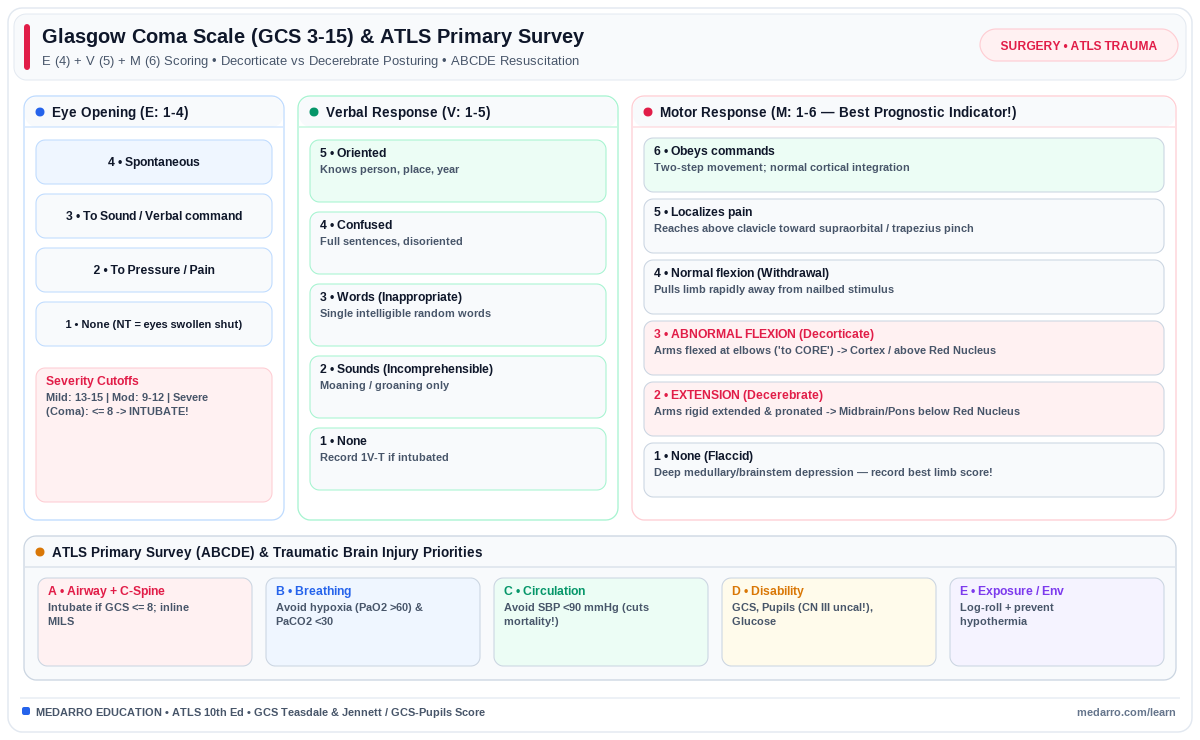
ATLS ABCDE STRICT PRIORITY: A (Airway + Cervical Spine immobilization!) -> B (Breathing: Tension Pneumothorax = Clinical diagnosis, NEVER wait for CXR!) -> C (Circulation + hemorrhage control!) -> D (Disability: GCS + Pupils + Glucose!) -> E (Exposure + Prevent Hypothermia!).
GCS GLASGOW COMA SCALE (Min 3, Max 15): E4 (Spontaneous 4, Voice 3, Pain 2, None 1) + V5 (Oriented 5, Confused 4, Inappropriate words 3, Incomprehensible sounds 2, None 1) + M6 (Obeys 6, Localizes 5, Withdraws 4, Decorticate flexion 3 [above red nucleus!], Decerebrate extension 2 [below red nucleus!], None 1). 'GCS 8, INTUBATE!'
ATLS 10th ED TENSION PNEUMOTHORAX UPDATE: Perform Needle Decompression in ADULTS at the 4th or 5th Intercostal Space slightly ANTERIOR to Midaxillary Line (NOT 2nd ICS midclavicular, though 2nd ICS MCL stays standard in Pediatrics!).
MASSIVE HEMOTHORAX (>1,500 mL immediate blood upon chest tube OR >200 mL/hr x 2-4 hrs): Immediate Urgent THORACOTOMY indication!
CUSHING'S TRIAD OF RAISED ICP (Late Pre-Herniation Sign): HYPERTENSION (widening pulse pressure!) + BRADYCARDIA + IRREGULAR RESPIRATION -> Avoid hypotonic fluids, raise head 30 deg, brief hyperventilation (PaCO2 30-35), IV Mannitol / 3% Hypertonic Saline!
Ask Dr. Medarro about General Surgery
Instant NMC-grounded answers with standard textbook citations
Cerebral Herniation Syndromes & Basilar Skull Fracture Signs
Uncal (Transtentorial) Herniation: Ipsilateral Fixed Dilated Pupil (CN III compression) + Contralateral Hemiparesis (or IPSILATERAL Kernohan Notch phenomenon!) -> Emergency Burr hole / Craniectomy!
Basilar Skull Fracture Signs: Raccoon eyes (periorbital ecchymosis), Battle sign (mastoid ecchymosis), Hemotympanum, CSF rhinorrhea/otorrhea ('Double Ring/Halo' test) -> AVOID Nasotracheal/NG tube (insert Orogastric instead!).
GCS-P (Revised GCS): Subtract 2 if BOTH pupils unreactive to light, 1 if ONE pupil unreactive, 0 if both react!
ATLS Primary Survey Thoracic Killers & GCS Motor Posturing
| Trauma / Neuro Finding | Clinical Signature & Immediate Trap | Definitive Lifesaving Intervention |
|---|---|---|
| Tension Pneumothorax | Hypotension + Distended neck veins + Absent breath sounds + Tracheal shift AWAY | NEVER wait for CXR! Needle/Finger decompression 4th-5th ICS ant-axillary -> Chest tube |
| Open ('Sucking') Pneumothorax | Chest wall defect >2/3 tracheal diameter preferentially draws air | Three-sided occlusive dressing (acts as flutter valve!) -> Chest tube separate site |
| Massive Hemothorax | Hypotension + FLAT neck veins (vs Tamponade!) + Dull percussion | Large-bore Chest Tube + Volume; Thoracotomy if >1,500 mL stat or >200 mL/h x2-4h |
| Decorticate (M3) vs Decerebrate (M2) | M3: Arms flexed up over 'CORE' (lesion ABOVE midbrain Red Nucleus) | M2: Rigid extension arms/legs (lesion AT/BELOW Red Nucleus -> worse prognosis!) |
| Mild vs Moderate vs Severe TBI | Mild: GCS 13-15 | Moderate: GCS 9-12 | Severe: GCS <= 8 | GCS <= 8 = Secure Definitive Airway (Intubation) + Urgent NCCT Head! |
Interactive Clinical Vignette Practice
Live Rule-Out EngineA 27-year-old woman arrives after an assault with blunt right head trauma. Upon painful nail-bed pressure, she opens her eyes briefly, utters groaning incomprehensible sounds, and sharply pulls her arm back away from the stimulus without crossing the midline toward the examiner's hand. Her pupils are equal and reactive. What is her exact Glasgow Coma Scale (GCS) score and most appropriate immediate action?
Unlock Complete Viva Traps & Additional Case Vignettes
Access model examiner answers, comprehensive rule-out breakdowns, and 4K spotter explanations.
Want 50+ Clinical Vignettes & 4K 3D Spotters on General Surgery?
Practice Spaced Repetition Decathlon, generate instant 7-day adaptive study plans, and upload your college PDFs into the personal vault.