
Surgical Sutures & Needles: Absorbable vs Non-Absorbable, USP Size & Removal
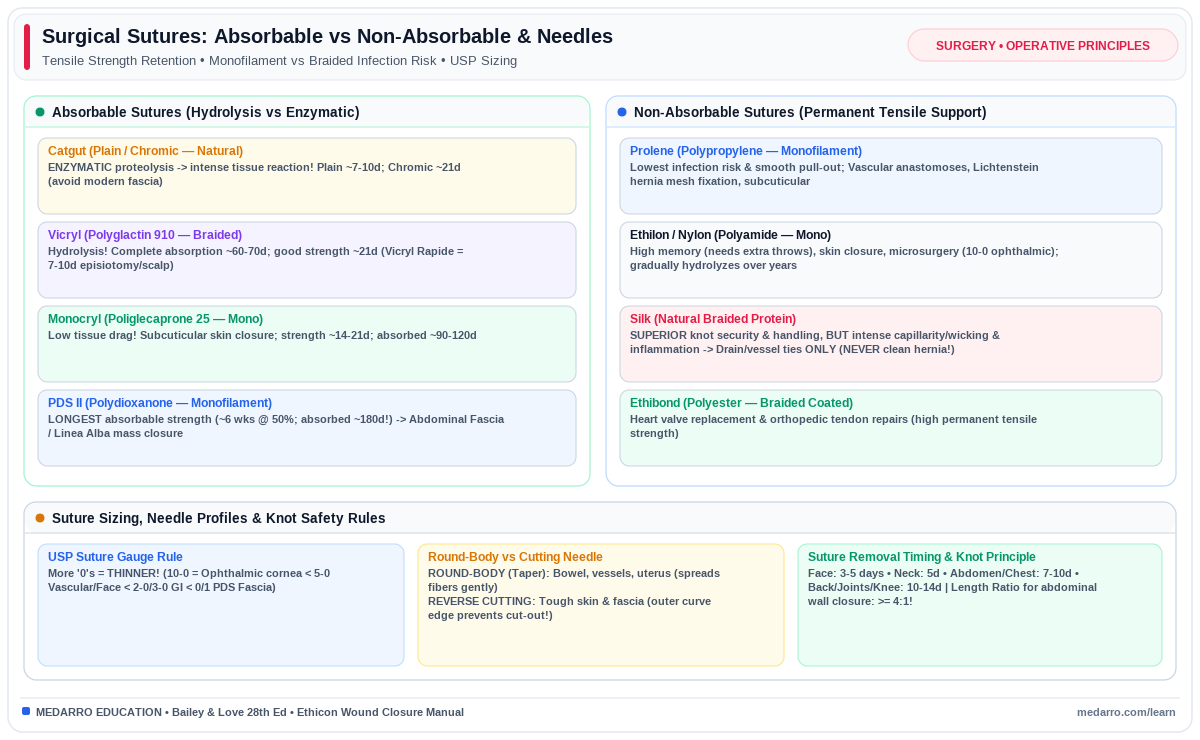
High-Yield Clinical Pearls & Exam Keys
ABSORPTION MECHANISMS MATTER: NATURAL sutures (Plain/Chromic Catgut, Silk) elicit intense inflammation & absorb via PROTEOLYTIC ENZYMES (fastest breakdown in infected/acidic GI secretions!); SYNTHETIC sutures (Vicryl, Monocryl, PDS) absorb cleanly via predictable HYDROLYSIS with minimal tissue reaction!
MONOFILAMENT vs BRAIDED (MULTIFILAMENT): Monofilaments (Prolene, Nylon/Ethilon, Monocryl, PDS) glide smoothly with LOWEST infection/wicking risk (NEED 5-6 throws due to memory!) -> MANDATORY for Vascular Anastomoses (Prolene!) & Contaminated wounds! Braided (Silk, Vicryl) handle/knot easily (3 throws!) but harbor bacteria in interstices!
USP SUTURE GAUGE SIZING TRAP: More zeros = THINNER suture! 10-0 (ophthalmic/microsurgery!) < 6-0 (facial plastics!) < 4-0 (skin subcuticular) < 2-0 < 0 < 1 < 2 (orthopedic/fascia!).
FASCIA CLOSURE (MIDLINE LAPAROTOMY): Close rectus sheath with slow-absorbing monofilament PDS (Polydioxanone — holds tensile strength >4-6 weeks!) or non-absorbable Prolene/Nylon using a 4:1 Suture-Length-to-Wound-Length ratio (Jenkins Rule — small 5mm x 5mm bites cut incisional hernia & dehiscence!).
SUTURE REMOVAL TIMING BY ANATOMICAL SITE: Face/Eyelids = 3-5 DAYS (avoid 'railroad-track' cross-hatch scars!) | Neck = 5 days | Scalp = 7-10 days | Trunk/Abdomen = 7-10 days | Extremities = 10-14 days | Over Joints/High tension = 14 days!
Ask Dr. Medarro about General Surgery
Instant NMC-grounded answers with standard textbook citations
High-Yield Suture & Needle Matching Scenarios
Reverse Cutting Needle (Triangle with sharp edge on OUTER convex curve -> resists pulling out through tough dermis!) = SKIN; Taper/Round-Body Needle (no cutting edges, spreads fibers cleanly!) = Bowel, Vessel, Fascia, Nerve!
Biliary & Urinary Tract Rule: NEVER leave permanent non-absorbable sutures (Silk/Prolene) inside lumen of gallbladder, CBD, or bladder — they act as a nidus for GALLSTONE / BLADDER STONE formation! Use Absorbable (Vicryl/PDS/Monocryl)!
Chromic Catgut vs Plain Catgut: Plain absorbs in ~7 days (fast mucosa/lip); Chromic salts delay absorption to ~14-21 days (historically used in OBGYN/oral — avoid near pancreatic/gastric acid!).
Clinical Surgical Sutures Master Reference Table
| Suture Name (Generic) | Structure & Absorption Timing | Top Surgical Indication & Trap |
|---|---|---|
| Vicryl (Polyglactin 910) | Braided Synthetic Absorbable (60-70 days complete; strength ~3 wks) | Bowel anastomosis, Subcutaneous fat, Peritoneum, Muscle, OBGYN; avoid inside infected abscess! |
| PDS II (Polydioxanone) | Monofilament Synthetic Absorbable (180-210d; keeps 60% at 6 wks!) | GOLD STANDARD for Midline Fascia closure (Jenkins 4:1), Infected fascia, Pediatric vascular! |
| Monocryl (Poliglecaprone 25) | Monofilament Synthetic Absorbable (~90-120d; fast tensile drop 2 wks) | Best for Cosmetic Subcuticular Skin Closure (4-0/3-0) — minimal tissue drag & scar! |
| Prolene (Polypropylene) | Monofilament Synthetic NON-Absorbable (Permanent!) | GOLD STANDARD for Vascular Anastomoses (inert, zero thrombosis!), Hernia mesh fix, Tendons! |
| Nylon (Ethilon) vs Silk | Nylon: Monofilament Non-abs (low infection) | Silk: Braided Natural Non-abs | Nylon: Interrupted skin sutures, microsurgery | Silk: Securing drains / vessel ties (HIGH tissue reaction — NEVER vascular/UTI!) |
Interactive Clinical Vignette Practice
Live Rule-Out EngineA vascular surgeon constructs an end-to-side femoral-popliteal bypass anastomosis using a synthetic, inert, non-absorbable monofilament suture paired with a non-cutting needle so the vessel wall is punctured smoothly without tearing or inducing luminal thrombosis, while retaining permanent tensile strength indefinitely. Which suture-needle combination was used?
Unlock Complete Viva Traps & Additional Case Vignettes
Access model examiner answers, comprehensive rule-out breakdowns, and 4K spotter explanations.
Want 50+ Clinical Vignettes & 4K 3D Spotters on General Surgery?
Practice Spaced Repetition Decathlon, generate instant 7-day adaptive study plans, and upload your college PDFs into the personal vault.