
Mallampati Classification & Cormack-Lehane Grading for Difficult Airway
High-Yield Clinical Pearls & Exam Keys
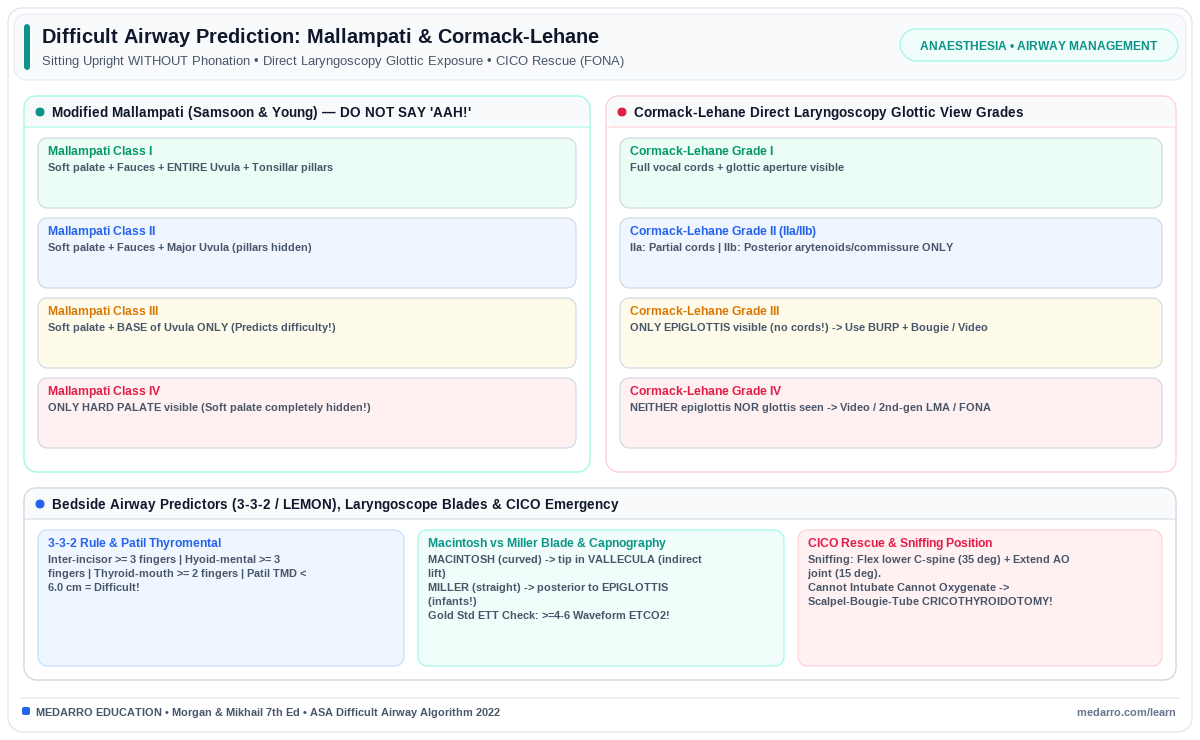
Modified Mallampati Score (Samsoon & Young) is assessed with the patient SITTING upright, head neutral, mouth maximally open, tongue maximally protruded, and STRICTLY WITHOUT PHONATION ('Do not say Aah!' — phonation artificially improves class).
Mallampati Class III (only soft palate + base of uvula visible) and Class IV (ONLY hard palate visible; soft palate not visible) strongly predict difficult laryngoscopy/intubation.
Cormack-Lehane Classification grades the actual view obtained during DIRECT LARYNGOSCOPY (Grade I = full glottis; Grade II = posterior commissure/arytenoids; Grade III = ONLY epiglottis visible; Grade IV = neither epiglottis nor glottis visible).
Mnemonic 'LEMON' & '3-3-2 Rule' bedside predictors: Inter-incisor gap >= 3 fingers, Hyoid-mental distance >= 3 fingers, Thyroid-to-floor-of-mouth >= 2 fingers; Thyromental distance (Patil test) < 6.0-6.5 cm predicts difficult intubation.
In 'Cannot Intubate, Cannot Oxygenate' (CICO) emergency, perform emergency FRONT-OF-NECK ACCESS (FONA) via Scalpel-Bougie-Tube Cricothyroidotomy.
Ask Dr. Medarro about Anaesthesia
Instant NMC-grounded answers with standard textbook citations
Airway Assessment & Crisis Triggers
Sniffing Position (Magill): Flex lower cervical spine (~35 deg) + Extend atlanto-occipital joint (~15 deg) -> aligns Oral, Pharyngeal & Laryngeal axes
MOANS Difficult Mask Ventilation Predictors: Mask seal, Obesity/Obstruction, Age >55, No teeth (edentulous), Stiff lungs
Gold Standard Confirming Endotracheal Tube Placement: Sustained Waveform Capnography (ETCO2 >= 4-6 normal square waves; excludes esophageal intubation)
Modified Mallampati (Pre-Op) vs Cormack-Lehane (Direct Laryngoscopy)
| Class / Grade | Modified Mallampati (Samsoon-Young) | Cormack-Lehane Direct Laryngoscopy View |
|---|---|---|
| Class / Grade I | Soft palate, fauces, entire uvula, anterior & posterior tonsillar pillars visible | Complete visualization of entire glottic opening & true vocal cords (Easy) |
| Class / Grade II | Soft palate, fauces, & major portion of uvula visible (pillars hidden) | IIa: Partial view of vocal cords; IIb: ONLY posterior arytenoids/commissure visible |
| Class / Grade III | Soft palate and ONLY the base of the uvula visible (Difficult predictor) | ONLY epiglottis visible (no portion of glottis/cords seen; use BURP + Bougie / Video) |
| Class / Grade IV | Soft palate completely invisible; ONLY hard palate visible (High risk) | Neither glottis NOR epiglottis visible (only soft palate/tongue base -> Video/SGA/FONA) |
| Clinical Timing & Action | Bedside pre-op screening; >Class III prompts awake fiberoptic or video laryngoscopy prep | Intra-op direct view; Grade III-IV triggers gum-elastic bougie, video laryngoscope, or LMA rescue |
Interactive Clinical Vignette Practice
Live Rule-Out EngineDuring pre-anaesthetic evaluation, a 48-year-old man sits upright, opens his mouth wide, protrudes his tongue without phonating, and the examiner visualizes ONLY his hard palate (soft palate and uvula cannot be seen). On subsequent direct laryngoscopy under anaesthesia, ONLY the tip of the epiglottis is visible with no vocal cords seen. How are these two findings classified respectively?
Unlock Complete Viva Traps & Additional Case Vignettes
Access model examiner answers, comprehensive rule-out breakdowns, and 4K spotter explanations.
Want 50+ Clinical Vignettes & 4K 3D Spotters on Anaesthesia?
Practice Spaced Repetition Decathlon, generate instant 7-day adaptive study plans, and upload your college PDFs into the personal vault.