
Malignant Hyperthermia Genetics (RYR1), Trigger Agents & Dantrolene Protocol
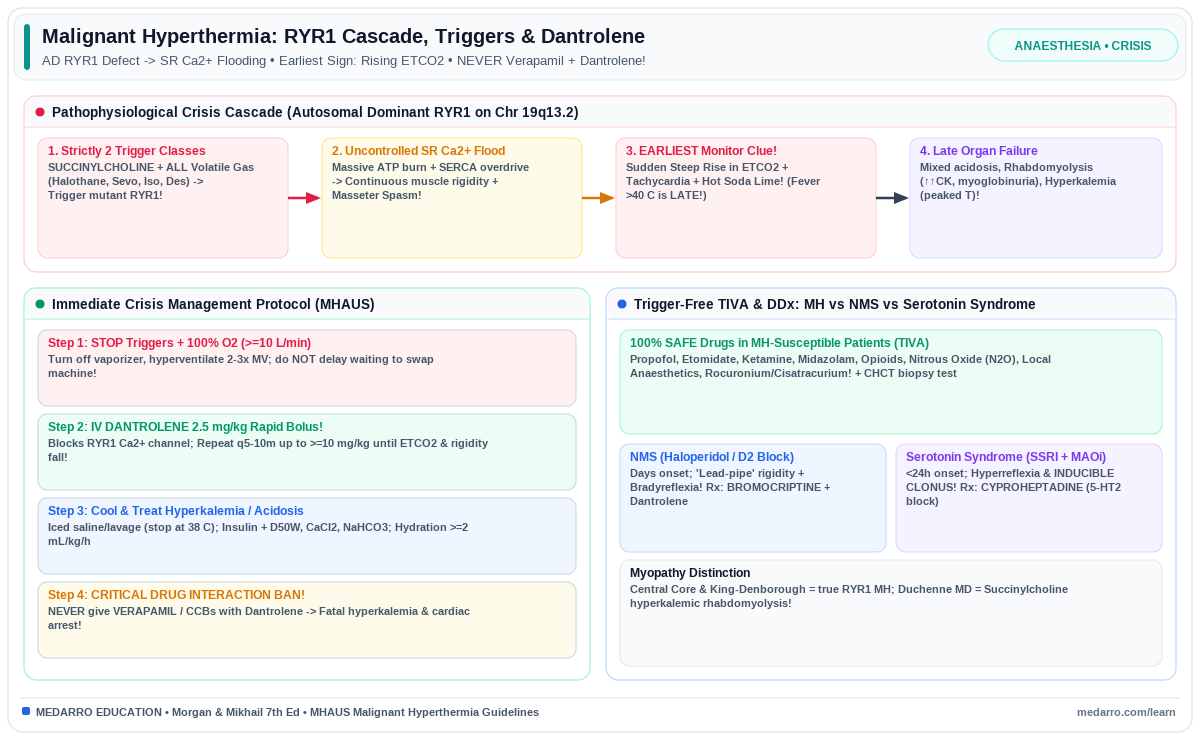
High-Yield Clinical Pearls & Exam Keys
Autosomal Dominant mutation in RYR1 (Ryanodine Receptor 1 on chromosome 19q13.2 encoding skeletal muscle sarcoplasmic reticulum Ca2+ release channel; rarely CACNA1S) -> uncontrolled Ca2+ flood into myoplasm!
Trigger Agents are STRICTLY TWO classes: (1) Depolarizing neuromuscular blocker SUCCINYLCHOLINE and (2) ALL potent VOLATILE INHALATIONAL ANAESTHETICS (Halothane [strongest], Isoflurane, Sevoflurane, Desflurane). Nitrous oxide and ALL IV drugs (Propofol, Ketamine, Etomidate, Opioids, Rocuronium) are 100% SAFE!
EARLIEST most sensitive intraoperative warning sign of MH: Unexplained abrupt progressive rise in End-Tidal CO2 (ETCO2) despite increased minute ventilation, accompanied by sinus tachycardia and masseter muscle rigidity!
Hyperthermia (>39-42 C) is a RELATIVELY LATE sign — do NOT wait for fever to diagnose or treat MH!
Drug of Choice / Specific Antidote: IV DANTROLENE SODIUM 2.5 mg/kg rapid bolus immediately, repeated every 5-10 min until crisis subsides.
Ask Dr. Medarro about Anaesthesia
Instant NMC-grounded answers with standard textbook citations
Malignant Hyperthermia Trigger & Clinical Crisis Triad
Earliest Intra-Op Signs: Rapidly Rising ETCO2 (hypercapnia + exhausted/hot soda lime canister) + Unexplained Tachycardia + Masseter Spasm / Generalized Rigidity
Metabolic Cascade: Severe Mixed Respiratory & Lactic Acidosis + Hyperkalemia + Rhabdomyolysis (Myoglobinuria / Raised CK)
Confirmatory Gold-Standard Test: Caffeine-Halothane Contracture Test (CHCT) on fresh skeletal muscle biopsy (vastus lateralis)
MH vs Neuroleptic Malignant Syndrome vs Serotonin Syndrome
| Feature | Malignant Hyperthermia (MH) | NMS vs Serotonin Syndrome |
|---|---|---|
| Trigger Agents | Volatile anaesthetics (Halothane/Sevo/Iso/Des) +/- Succinylcholine | NMS: Dopamine antagonists (Haloperidol); Serotonin Syn: SSRIs + MAOi/Linezolid |
| Genetics & Pathophysiology | Autosomal dominant RYR1 / CACNA1S defect -> SR Ca2+ flooding | NMS: Central D2 blockade (days-weeks onset); SS: Excess 5-HT2A activation (<24h) |
| Neuromuscular Hallmark | Masseter spasm + Generalized skeletal rigidity + rising ETCO2 | NMS: Diffuse 'lead-pipe' rigidity, bradyreflexia; SS: Hyperreflexia & inducible CLONUS |
| Specific Antidote / Drug Rx | IV DANTROLENE 2.5 mg/kg (blocks RYR1 Ca2+ release) | NMS: Bromocriptine (D2 agonist) + Dantrolene; SS: Cyproheptadine (5-HT2 blocker) |
| Safe Anaesthesia (TIVA) | Trigger-free TIVA: Propofol, Opioids, Midazolam, N2O, Rocuronium/Cisatracurium | Manage underlying offending psychiatric drug cessation + supportive cooling |
Interactive Clinical Vignette Practice
Live Rule-Out EngineTen minutes after induction with Sevoflurane and Succinylcholine for an appendectomy in a 22-year-old man, the anaesthetist notes jaw rigidity, heart rate rising to 148 bpm, ETCO2 surging from 36 to 78 mmHg despite doubling minute ventilation, and a warm CO2 absorber canister. Temperature is currently 37.8 C. What is the single most critical immediate pharmacological intervention alongside stopping Sevoflurane?
Unlock Complete Viva Traps & Additional Case Vignettes
Access model examiner answers, comprehensive rule-out breakdowns, and 4K spotter explanations.
Want 50+ Clinical Vignettes & 4K 3D Spotters on Anaesthesia?
Practice Spaced Repetition Decathlon, generate instant 7-day adaptive study plans, and upload your college PDFs into the personal vault.