
General & Local Anaesthetics Mechanism, Minimum Alveolar Concentration (MAC) & Ester vs Amide
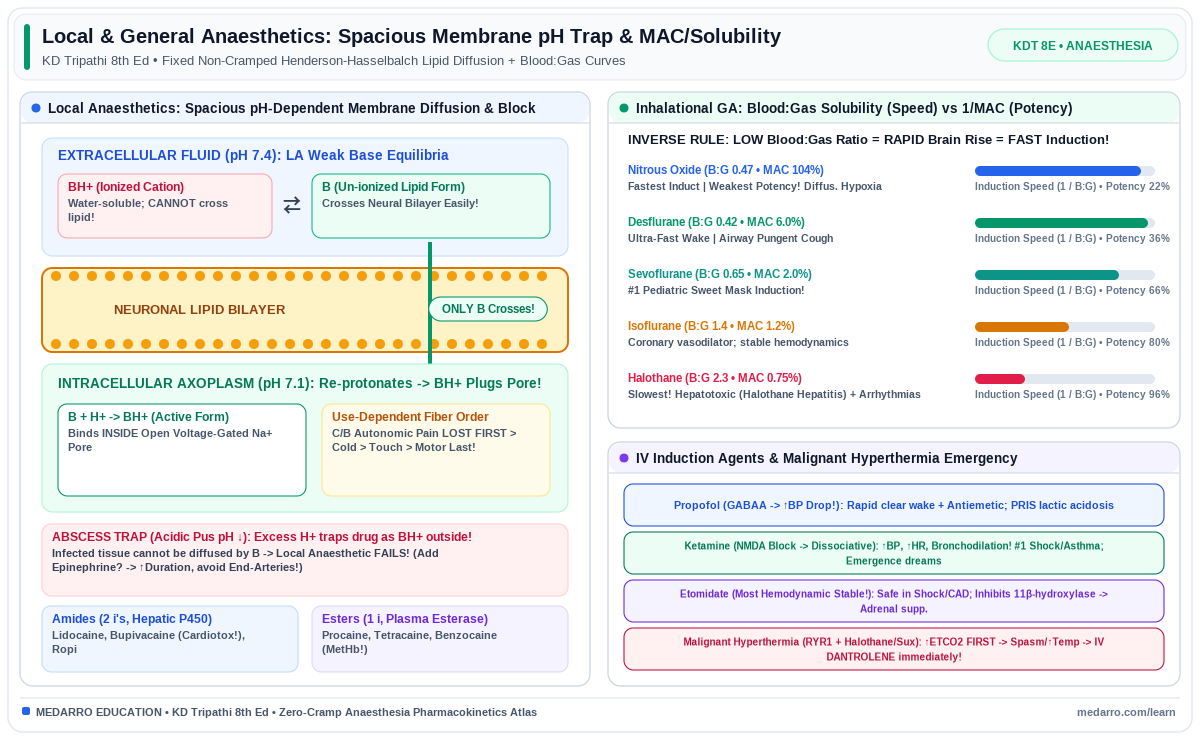
High-Yield Clinical Pearls & Exam Keys
INHALED ANAESTHETIC CORE LAWS: (1) Potency is INVERSELY proportional to MAC (MAC = ED50: Halothane 0.75% very potent vs N2O 104% weak). (2) Speed of Induction/Recovery is INVERSELY proportional to Blood:Gas Partition Coefficient (LOW solubility saturates blood instantly -> FAST induction: Desflurane 0.42 < N2O 0.47 < Sevoflurane 0.65 < Halothane 2.3!).
MALIGNANT HYPERTHERMIA EMERGENCY: Autosomal dominant RYR1 (Ryanodine receptor) mutation triggered by Halothane/Sevoflurane + Succinylcholine -> sudden ↑↑ETCO2, masseter spasm, rigidity, rhabdomyolysis, hyperkalemia, fever -> DOC = Immediate IV DANTROLENE!
LOCAL ANAESTHETIC ABSCESS FAILURE TRAP: Only the LIPOPHILIC UNIONIZED free base (B) penetrates axonal lipid bilayers, then re-ionizes inside the neuron to active cation (BH+) to block the INTRACELLULAR pore of Voltage-Gated Na+ channels! Infected inflamed tissues have low acidic pH (~5.5) trapping LA outside as BH+ -> Anesthesia FAILS!
Ester vs Amide 'Rule of Two i's': Amide local anesthetics ALWAYS have TWO 'i's in their generic name (Lignocaine, Bupivacaine, Ropivacaine, Prilocaine, Mepivacaine -> Hepatic CYP450, rare allergy). Esters have ONE 'i' (Procaine, Tetracaine, Cocaine, Benzocaine -> Plasma Pseudocholinesterase, PABA allergy!).
Ask Dr. Medarro about Pharmacology
Instant NMC-grounded answers with standard textbook citations
Esters vs Amides & Inhaled/IV Anaesthetics Quick Comparison
| Agent / Class | Pharmacokinetics & Mechanism | Signature Uses & Lethal Toxicities |
|---|---|---|
| Amides (Lignocaine, Bupivacaine) | Hepatic CYP450 amidase cleavage; Two 'i's in spelling | Bupivacaine = MOST CARDIOTOXIC (Rx: 20% IV Lipid Emulsion). Prilocaine = Methemoglobinemia! |
| Esters (Procaine, Benzocaine, Cocaine) | Plasma Pseudocholinesterase hydrolysis; One 'i' | Produces PABA -> High hypersensitivity; Cocaine = ONLY intrinsic vasoconstrictor LA! |
| Sevoflurane vs Desflurane | Sevoflurane: B:G 0.65 (sweet); Desflurane: B:G 0.42 (pungent) | Sevoflurane = DOC Pediatric mask induction! Desflurane triggers laryngospasm; lowest B:G! |
| Nitrous Oxide (N2O) | MAC 104%, B:G 0.47; Non-irritant NMDA + Opioid agonist | Second Gas Effect; Diffusion Hypoxia (flush with 100% O2!); Expands pneumothorax; Inactivates Vit B12! |
| IV Agents (Propofol / Ketamine / Etomidate) | Propofol & Etomidate: GABA_A ↑Cl-; Ketamine: NMDA block | Ketamine = Dissociative + Bronchodilation + ↑BP/ICP. Etomidate = Cardiac/Shock stable (↓11β-OHase)! |
Interactive Clinical Vignette Practice
Live Rule-Out EngineDuring knee arthroscopy under epidural anesthesia using Bupivacaine, accidental intravascular migration of the catheter triggers sudden tinnitus, metallic taste, generalized tonic-clonic seizures, and rapid deterioration into refractory ventricular fibrillation unresponsive to standard ACLS epinephrine and amiodarone boluses. Besides airway management, which targeted infusion rescues myocardial Na+ channels?
Unlock Complete Viva Traps & Additional Case Vignettes
Access model examiner answers, comprehensive rule-out breakdowns, and 4K spotter explanations.
Want 50+ Clinical Vignettes & 4K 3D Spotters on Pharmacology?
Practice Spaced Repetition Decathlon, generate instant 7-day adaptive study plans, and upload your college PDFs into the personal vault.