
Spinal vs Epidural Anaesthesia Landmarks, Spaces & PDPH Management
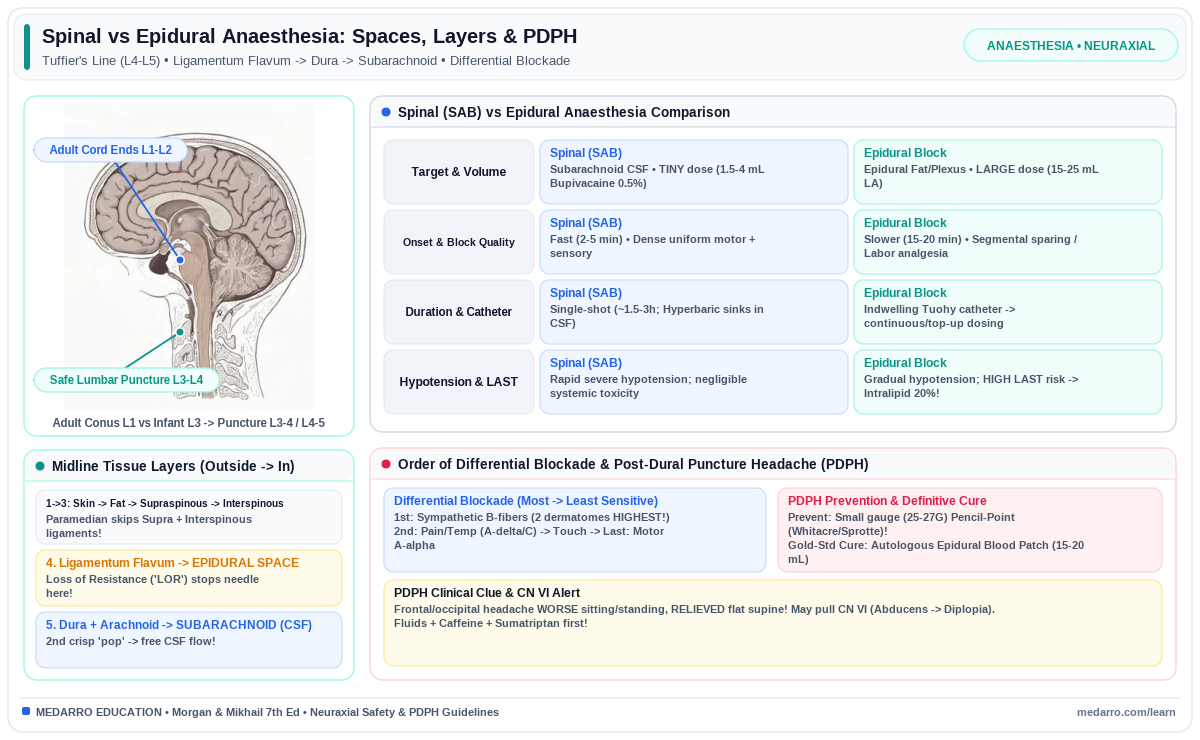
High-Yield Clinical Pearls & Exam Keys
Tuffier's Line (Intercristal line connecting tops of both iliac crests) intersects the L4 spinous process or L4-L5 interspace. Adult spinal cord ends at L1-L2 (infant/neonate at L3!) — perform adult spinal puncture at L3-L4 or L4-L5.
Layers pierced from skin to subarachnoid space (midline approach): Skin -> Subcutaneous tissue -> Supraspinous ligament -> Interspinous ligament -> Ligamentum flavum (first distinct 'give'/loss of resistance) -> Epidural space -> Dura mater (2nd pop!) -> Arachnoid mater -> Subarachnoid space (CSF).
Order of Differential Blockade (earliest to latest onset): Sympathetic B-fibers (highest block level by 2 dermatomes) -> Pain/Temperature (A-delta/C) -> Touch/Proprioception -> Motor (A-alpha, lowest block level!).
Post-Dural Puncture Headache (PDPH) results from CSF leak lowering intracranial CSF pressure: classically frontal-occipital, WORSE on sitting/standing, RELIEVED completely by lying supine.
Prevention of PDPH: Use smaller gauge (25G-27G) non-cutting PENCIL-POINT (Whitacre / Sprotte) needles rather than cutting Quincke needles! Gold-standard treatment if conservative therapy fails: Autologous Epidural Blood Patch (15-20 mL blood).
Ask Dr. Medarro about Anaesthesia
Instant NMC-grounded answers with standard textbook citations
Neuraxial Safety & PDPH Signatures
PDPH Triad: Postural Headache (worse upright, better supine within 15m) + Neck Stiffness / Photophobia + Diplopia (CN VI abducens stretch!)
Absolute Contraindications to Neuraxial Block: Patient refusal, Severe coagulopathy/anticoagulation, Severe hypovolemia, Raised ICP, Local skin sepsis
High/Total Spinal First Signs: Ascending paresthesia in hands -> Dyspnea (phrenic C3-5) -> Profound hypotension, bradycardia & apnea
Spinal (Subarachnoid) vs Epidural Anaesthesia
| Parameter | Spinal Anaesthesia (SAB) | Epidural Anaesthesia |
|---|---|---|
| Target Space & Drug Volume | Subarachnoid space (CSF); Small volume 1.5-4 mL (e.g., Hyperbaric Bupivacaine 0.5%) | Epidural space (loss-of-resistance to saline/air); Large volume 15-25 mL |
| Onset & Block Density | Rapid onset (2-5 min); dense, uniform sensory + motor block | Slower onset (15-20 min); segmental block; differential sensory sparing possible |
| Catheter / Duration Extension | Usually single-shot (fixed 1.5-3 hours); continuous spinal rare | Indwelling catheter routinely placed -> indefinite redosing / labor analgesia |
| Hypotension & PDPH Risk | Abrupt severe hypotension (rapid sympathectomy); higher PDPH risk if dura pierced | Gradual milder hypotension; NO PDPH unless inadvertent 'wet tap' dural puncture |
| Systemic Toxicity (LAST) Risk | Negligible systemic toxicity (tiny drug dose) | Significant LAST risk if inadvertent intravascular injection of 20 mL bupivacaine |
Interactive Clinical Vignette Practice
Live Rule-Out EngineA 24-year-old parturient develops a severe throbbing occipital headache 36 hours after labor epidural placement complicated by an inadvertent dural puncture ('wet tap') with an 18G Tuohy needle. The headache disappears completely when she lies flat and returns within minutes of standing. Conservative IV fluids, analgesics, and caffeine fail for 48 hours. What is the definitive gold-standard treatment?
Unlock Complete Viva Traps & Additional Case Vignettes
Access model examiner answers, comprehensive rule-out breakdowns, and 4K spotter explanations.
Want 50+ Clinical Vignettes & 4K 3D Spotters on Anaesthesia?
Practice Spaced Repetition Decathlon, generate instant 7-day adaptive study plans, and upload your college PDFs into the personal vault.