
Stages of Normal Labor, Friedman Curve & Modified WHO Partograph Interpretation
High-Yield Clinical Pearls & Exam Keys
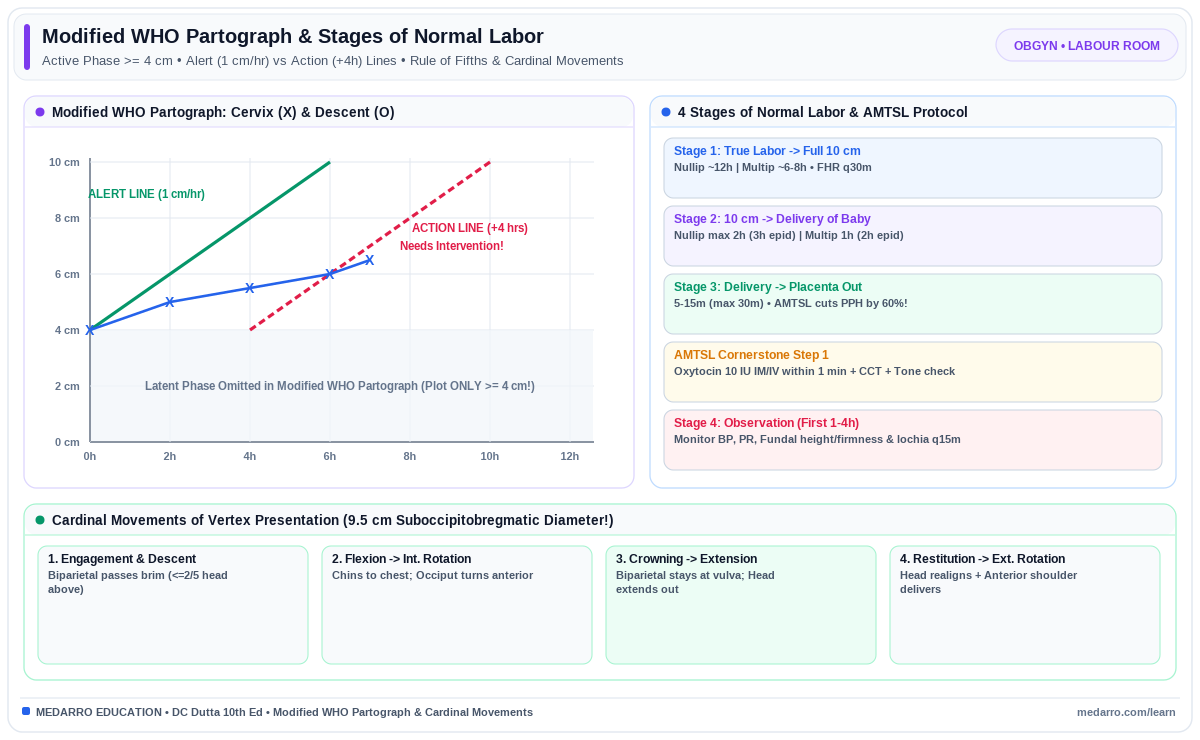
Modified WHO Partograph begins plotting ONLY in the active phase of the first stage (cervical dilatation >= 4 cm; WHO Labour Care Guide 2018 uses >= 5 cm, while MBBS/NEET-PG exams test Modified WHO Partograph starting at 4 cm).
Alert line is plotted at a minimum normal rate of 1 cm/hour from 4 cm to 10 cm dilatation; the Action line runs parallel and 4 hours to the right of the Alert line.
Crossing the Alert line calls for reassessment and referral from PHC/CHC to an FRU/CEmOC facility; reaching or crossing the Action line indicates protracted or obstructed labor requiring active intervention (amniotomy, oxytocin augmentation, or LSCS).
Cardinal movements of normal vertex labor follow the sequence: Engagement -> Descent -> Flexion -> Internal rotation -> Crowning -> Extension -> Restitution -> External rotation -> Expulsion.
Active Management of Third Stage of Labor (AMTSL) reduces PPH risk by ~60%: Oxytocin 10 IU IM/IV within 1 minute of delivery (cornerstone), controlled cord traction (modified Brandt-Andrews), and uterine tone check.
Ask Dr. Medarro about Obstetrics & Gynaecology
Instant NMC-grounded answers with standard textbook citations
Normal Labor vs Obstructed Labor Triads
First Stage Phases: Latent (0-3 cm, <20 h nullip / <14 h multip) -> Active (>=4-10 cm, >=1.2 cm/h nullip, >=1.5 cm/h multip)
Second Stage Max Normal Duration: Nullipara 2 h (3 h with epidural); Multipara 1 h (2 h with epidural)
Bandl's Ring Sign: Pathological retraction ring between upper & lower uterine segments + tender LUS + absent FHR = Impending Rupture
Four Stages of Labor & Clinical Management Benchmarks
| Stage of Labor | Boundaries & Average Duration | Key Physiological & Clinical Management |
|---|---|---|
| Stage 1 (Cervical) | Onset of true labor pains to full cervical dilatation (10 cm); Nullip ~12 h, Multip ~6-8 h | Latent phase (effacement & early dilatation) + Active phase (rapid dilatation); monitor FHR q30m & cervical exam q4h on Partograph |
| Stage 2 (Expulsive) | Full dilatation (10 cm) to complete delivery of fetus; Nullip ~2 h, Multip ~30-60 min | Propulsive phase (descent to pelvic floor) + Expulsive phase (maternal bearing-down); cardinal movements & controlled perineal support |
| Stage 3 (Placental) | Delivery of baby to complete expulsion of placenta & membranes; 5-15 min (max 30 min) | Schultze (central, shiny fetal side) vs Matthews-Duncan (marginal) separation; perform AMTSL with Oxytocin 10 IU IM immediately |
| Stage 4 (Observation) | First 1-4 hours immediately following placental delivery | Golden hour monitoring for primary PPH: check vitals q15m, uterine contraction firmness, bladder emptiness, & lochia loss |
| Partograph Alert vs Action Line | Alert: >=1 cm/hr slope from 4 cm; Action: 4 hours parallel right of Alert line | Between Alert & Action = watchful reassessment / consider amniotomy; On/Right of Action = abnormal labor -> oxytocin or C-section |
Interactive Clinical Vignette Practice
Live Rule-Out EngineA primigravida in active labor has cervical dilatation plotted on the Modified WHO Partograph. Over the last 4 hours, her dilatation curve crosses to the right of the Alert line and reaches the Action line despite strong uterine contractions (4/10 min lasting 45 sec) and grade +++ molding. What does this signify?
Unlock Complete Viva Traps & Additional Case Vignettes
Access model examiner answers, comprehensive rule-out breakdowns, and 4K spotter explanations.
Want 50+ Clinical Vignettes & 4K 3D Spotters on Obstetrics & Gynaecology?
Practice Spaced Repetition Decathlon, generate instant 7-day adaptive study plans, and upload your college PDFs into the personal vault.