
Hypertensive Disorders in Pregnancy (Pre-eclampsia, Eclampsia) & Pritchard MgSO4 Protocol
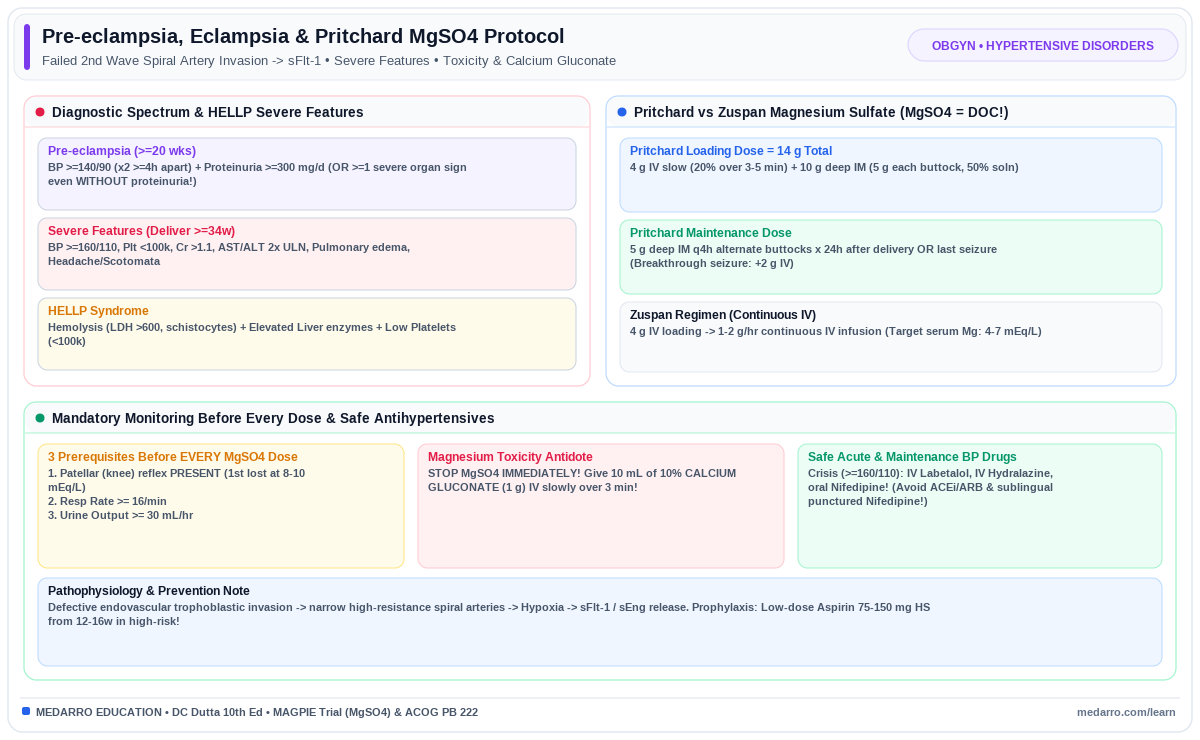
High-Yield Clinical Pearls & Exam Keys
Pre-eclampsia is new-onset hypertension (SBP >= 140 or DBP >= 90 mmHg on two occasions >= 4 hours apart) AFTER 20 weeks gestation PLUS proteinuria (>= 300 mg/24h or P:C ratio >= 0.3) OR maternal end-organ dysfunction even WITHOUT proteinuria.
Magnesium sulfate (MgSO4) is the undisputed drug of choice for preventing and arresting eclamptic seizures (MAGPIE trial) — it is NOT a primary antihypertensive agent.
Pritchard Regimen loading dose = 4 g IV slowly (20% over 3-5 min) + 10 g deep IM (5 g in each buttock, 50% solution) = 14 g total; maintenance = 5 g IM q4h alternate buttocks.
Before every maintenance dose of MgSO4, verify ALL THREE safety prerequisites: (1) Patellar (deep tendon) reflexes present, (2) Respiratory rate >= 16/min, and (3) Urine output >= 30 mL/hr.
Antidote for Magnesium toxicity (loss of patellar reflex at ~8-10 mEq/L, respiratory depression >12 mEq/L) is 10% Calcium Gluconate 10 mL (1 g) IV slowly over 3 minutes.
Ask Dr. Medarro about Obstetrics & Gynaecology
Instant NMC-grounded answers with standard textbook citations
HELLP Syndrome & Severe Feature Thresholds
HELLP: Hemolysis (LDH >600 U/L, schistocytes) + Elevated Liver enzymes (AST/ALT >=2x ULN) + Low Platelets (<100,000/uL)
Severe BP Threshold: SBP >=160 mmHg OR DBP >=110 mmHg sustained
Premonitory Symptoms: Frontal headache, visual blurring/scotomata, epigastric/RUQ pain (Glisson's capsule stretch)
Hypertensive Disorders in Pregnancy & MgSO4 Regimen Comparison
| Entity / Regimen | Diagnostic Threshold / Composition | Key Clinical Rule & Drug of Choice |
|---|---|---|
| Gestational Hypertension | New BP >=140/90 after 20 wks without proteinuria or severe features | Resolves within 12 wks postpartum; ~25-50% can progress to pre-eclampsia |
| Pre-eclampsia (Severe Features) | BP >=160/110, Plt <100k, Cr >1.1 mg/dL, AST/ALT 2x ULN, pulm edema, cerebral/visual symptoms | Proteinuria >=5 g/24h is NO LONGER required to classify severe pre-eclampsia; deliver at >=34 wks or immediately if unstable |
| Eclampsia | New-onset generalized tonic-clonic seizures in a pre-eclamptic woman (antepartum 50%, intrapartum 30%, postpartum 20%) | Airway/left lateral decubitus + Pritchard MgSO4 + control BP (IV Labetalol / IV Hydralazine / oral Nifedipine) -> deliver after stabilization |
| Pritchard Regimen (IM/IV) | Load: 4 g IV (20%) + 10 g IM (50%, 5g each buttock); Maint: 5 g IM q4h | Standard in Indian PHCs/FRUs; therapeutic serum Mg level 4-7 mEq/L (4.8-8.4 mg/dL); continue 24h after delivery or last fit |
| Zuspan Regimen (IV Pump) | Load: 4 g IV over 15-20 min; Maint: 1-2 g/hr continuous IV infusion | Requires infusion pump; avoids painful deep IM gluteal injections and abscesses |
Interactive Clinical Vignette Practice
Live Rule-Out EngineA 26-year-old primigravida with eclampsia received the Pritchard loading dose of MgSO4 4 hours ago. Prior to her next 5 g IM maintenance dose, her nurse notes: BP 146/94 mmHg, respiratory rate 18/min, urine output 150 mL over 4 hours, and absent bilateral patellar reflexes. What is the most appropriate next step?
Unlock Complete Viva Traps & Additional Case Vignettes
Access model examiner answers, comprehensive rule-out breakdowns, and 4K spotter explanations.
Want 50+ Clinical Vignettes & 4K 3D Spotters on Obstetrics & Gynaecology?
Practice Spaced Repetition Decathlon, generate instant 7-day adaptive study plans, and upload your college PDFs into the personal vault.