
Postpartum Haemorrhage (PPH) 4 Ts Etiology, Uterotonics & Balloon Tamponade
High-Yield Clinical Pearls & Exam Keys
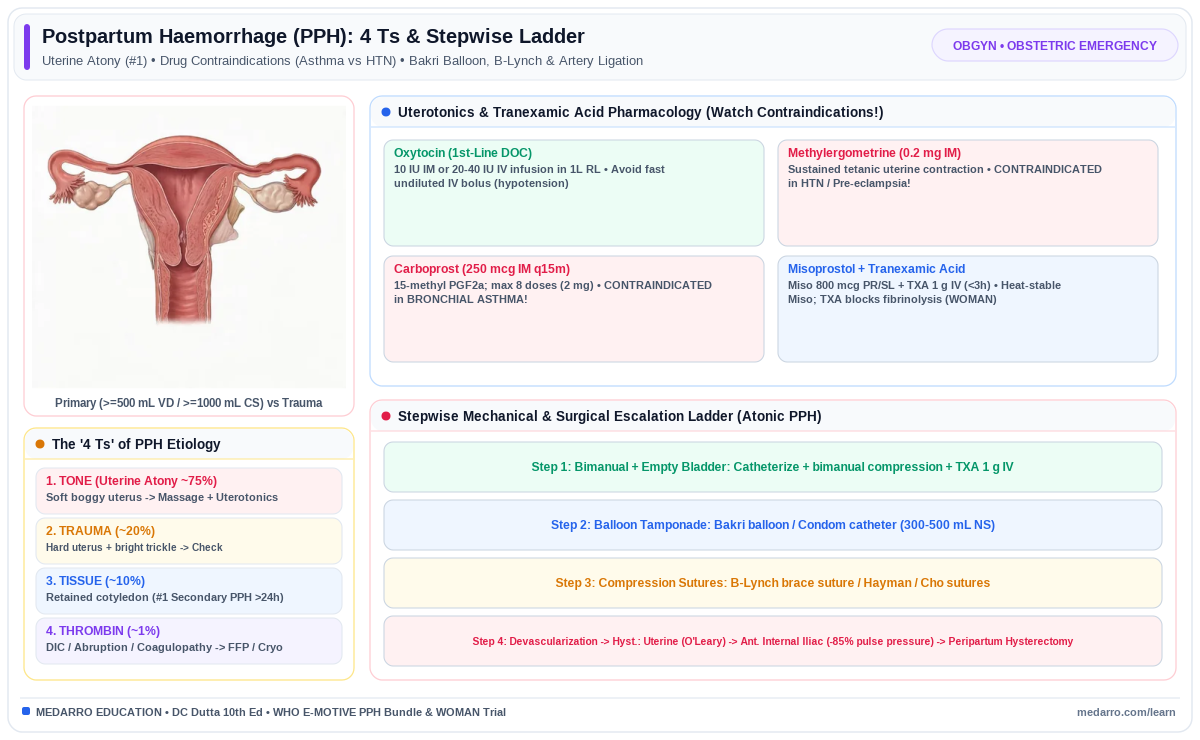
Classic PPH definition: Blood loss >= 500 mL after vaginal delivery or >= 1000 mL after cesarean section (ACOG reVITALize threshold: cumulative >=1000 mL OR any blood loss with hypovolemia within 24h).
The '4 Ts' of PPH: Tone (uterine atony — 70-80%, #1 cause), Trauma (cervical/vaginal tears, rupture — ~20%), Tissue (retained placenta/cotyledons — ~10%), and Thrombin (coagulopathy — ~1%).
Contraindications of second-line uterotonics are high-yield exam favorites: Methylergometrine is contraindicated in Hypertension/Pre-eclampsia & Heart disease; Carboprost (15-methyl PGF2alpha) is contraindicated in Bronchial Asthma.
Tranexamic acid (TXA 1 g IV over 10 min within 3 hours of delivery, per WOMAN trial) reduces death due to bleeding in PPH without increasing thrombotic events.
When medical therapy fails in uterine atony, proceed immediately to uterine tamponade (Bakri balloon / condom catheter 300-500 mL saline), followed surgically by uterine compression sutures (B-Lynch / Hayman), stepwise devascularization, internal iliac ligation, or hysterectomy.
Ask Dr. Medarro about Obstetrics & Gynaecology
Instant NMC-grounded answers with standard textbook citations
Critical PPH Resuscitation Sequence (Primary PPH <=24h)
First Step: Call for help + 2 wide-bore IVs (16G/14G) + Bimanual uterine massage + Empty bladder
Medical Bundle: Oxytocin (IV infusion) + Tranexamic Acid 1 g IV + Ergometrine / Carboprost (if not contraindicated) / Misoprostol
Mechanical -> Surgical: Bakri / Condom Tamponade -> B-Lynch Brace Suture -> Bilateral Uterine / Internal Iliac Artery Ligation
Uterotonic Agents & Mechanical/Surgical Interventions in PPH
| Agent / Procedure | Dose, Route & Mechanism | Strict Contraindication / Key Exam Fact |
|---|---|---|
| Oxytocin | 10 IU IM (prophylaxis) or 20-40 IU in 1 L RL IV infusion; rhythmic uterine contraction | First-line DOC; rapid undiluted IV bolus can cause severe maternal hypotension/tachycardia |
| Methylergometrine | 0.2 mg IM/slow IV q2-4h (max 5 doses); sustained tetanic contraction | CONTRAINDICATED in Pre-eclampsia/HTN, Heart disease, & before delivery of second twin |
| Carboprost (15-Me-PGF2a) | 250 mcg IM q15-90m (max 8 doses = 2 mg); potent prostaglandin uterotonic | CONTRAINDICATED in Bronchial Asthma (causes severe bronchospasm) and active cardiac/pulm disease |
| Misoprostol (PGE1) | 800 mcg PR/SL/PO single treatment dose (600 mcg oral prophylaxis); heat-stable | Ideal for low-resource settings without refrigeration; causes transient shivering & pyrexia |
| Bakri Balloon / B-Lynch | Bakri inflated up to 500 mL saline (tamponade test); B-Lynch vertical brace suture | If Bakri stops bleeding (positive tamponade test), avoid laparotomy; remove after 12-24h |
Interactive Clinical Vignette Practice
Live Rule-Out EngineA 29-year-old woman with a known history of severe persistent bronchial asthma develops uterine atony after normal vaginal delivery. Oxytocin infusion fails to contract the uterus adequately, and her BP is 158/98 mmHg due to gestational hypertension. Which second-line uterotonic is SAFE to administer?
Unlock Complete Viva Traps & Additional Case Vignettes
Access model examiner answers, comprehensive rule-out breakdowns, and 4K spotter explanations.
Want 50+ Clinical Vignettes & 4K 3D Spotters on Obstetrics & Gynaecology?
Practice Spaced Repetition Decathlon, generate instant 7-day adaptive study plans, and upload your college PDFs into the personal vault.